By Ketty L.
When a nation endures relentless dispossession and military occupation, the conflict doesn’t just play out on the land itself. It seeps into the very institutions that shape our understanding, publishing houses, media, cultural archives. This is where the real battle over history and identity happens, day in and day out, as entire narratives are trimmed, twisted, or outright erased. For Palestinians, this double erasure has haunted them for decades: first, by uprooting them physically, then by systematically scrubbing their history clean in Western institutions that decide what stories get told. The fight over Palestinian representation isn’t just about silencing voices outright; it’s about dilution, forced neutrality, and making historical responsibility disappear under the guise of balance or objectivity.
You see it play out everywhere. Recently, two authors, Alana Hadid and Jenan Matari, decided to pull their children’s book Displacement and the Palestinian American Story from Penguin Random House after hitting wall after wall of editorial pushback. They wanted to tell young readers about the Nakba of 1948, occupation, and life in diaspora. But the publisher kept demanding changes, shying away from the harsh truths about Zionist militias and how displacement really happened. For Hadid and Matari, compromising would mean stripping the story of its cause and effect, so they walked away, holding onto the story’s integrity instead of letting it be watered down.
Double erasure has haunted Palestinians for decades: first by uprooting them physically, then by systematically scrubbing their history clean in Western institutions.
This kind of narrative control always comes with its own set of rules, and double standards. When Western institutions recount their own histories of trauma, context is everything. Yet when Palestinians speak about their suffering, context gets written off as political bias or worse, as moral ambiguity. Acts of resistance are picked apart and examined with no backdrop, while decades of violence fade quietly into the background. Take the Nakba: more than 700,000 Palestinians expelled, over 400 villages depopulated, and the basic right of return denied. Western publishing often rebrands this as merely a humanitarian tragedy, leaving out the very people and actions that caused it.
But this selective storytelling doesn’t just stay in the pages of books. It stretches into law and commerce too. When someone publicly supports Palestinian rights, they risk more than criticism, they face real professional and financial threats. Recently, Irish novelist Sally Rooney and her publisher Faber stopped selling books in the British market after she pledged support for Palestine Action. Britain labeled the group as terrorists under tough laws, so sending them earnings became impossible. Here, legal frameworks clamp down on culture, narrowing public debate and forcing writers, scholars, and journalists to choose between honesty and livelihood. Tell the truth about Palestinian dispossession, and there’s a price to pay.
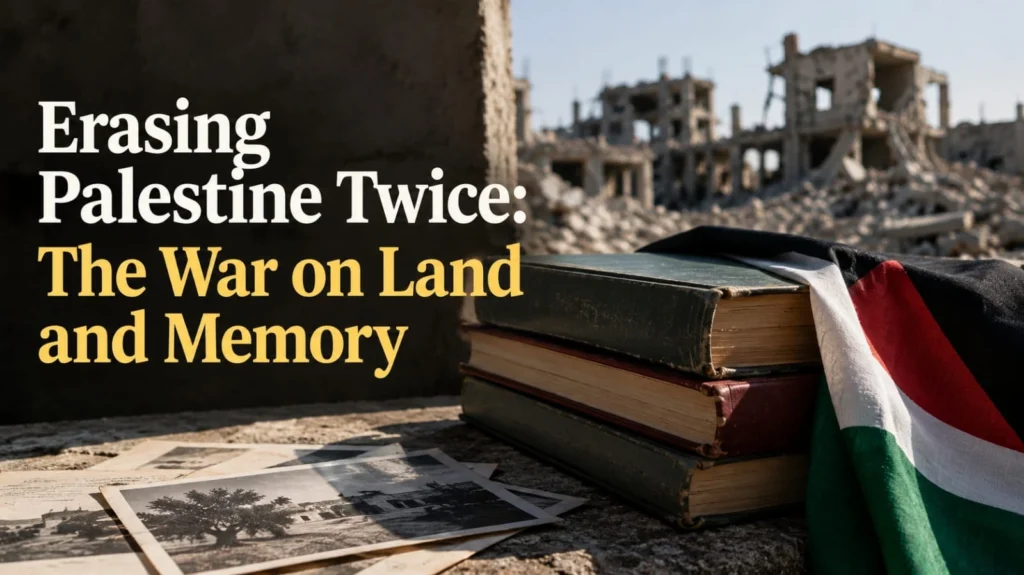
Things get even worse on the ground. According to UNESCO and international human rights reports, military operations keep destroying cultural sites, museums, archives, schools, especially across Gaza and the West Bank. Libraries full of centuries old manuscripts, archaeological treasures, civic records, all reduced to rubble. Physical history is wiped out locally, while the sanitized version is exported abroad. If both archives and stories are erased, preserving Palestinian memory turns into a desperate fight for survival.
When demands for objectivity mostly target marginalized authors, forced neutrality stops being neutral and becomes a tool for protecting powerful institutions.
The stakes are even higher when it comes to children’s books and educational materials. The stories kids read shape how they think about power, rights, and the world itself. When textbooks gloss over the details of military occupation and land theft, kids grow up missing the crucial facts. Passive wording turns mass displacement into a kind of natural disaster, stripping victims of agency and making political oppression look like bad luck, not bad policy.
Gatekeepers like big publishing houses and mainstream media claim they’re just being objective, insisting on quality control or appropriate framing. But when these demands mostly target Palestinian authors, objectivity stops being neutral, it becomes a tool for protecting powerful institutions from honest critique. Stories only get published once they’ve been dulled and stripped of political truth.
The central question isn’t whether people can talk about Palestinian suffering, or whether it’s allowed as a polite topic in Western conversation. It’s about whether Palestinians themselves get to define their own history, tell their story, and decide how it’s understood. If we care about real intellectual freedom, we have to defend the right of marginalized communities to share their history without corporate interference or legal threat. Palestinian history carries pain, injustice, but also resilience, and it doesn’t exist to soothe the Western world’s conscience. It deserves to be told fully, as it is.
About the Author
Ketty L. is a Columnist writing on politics, and international affairs.