
By Ahan S. Prakash
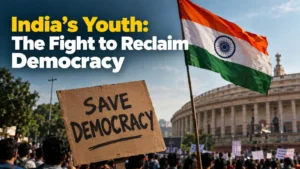
When you look at the massive crowds rallying across India, from the flood of young people at Mumbai’s Shivaji Park during the ‘Jail Bharo Andolan,’ to the locked down streets around Jantar Mantar and Parliament in New Delhi, you’re seeing more than just a few protests. This is an eruption, a full blown crisis of legitimacy for those in power today. India’s youth aren’t just randomly upset; driven by the constitution’s spirit and Ambedkar’s call for constitutional morality, they’re staring down a regime that’s systematically tearing apart the institutions keeping democracy alive.
This isn’t just political restlessness. It’s a searing judgment of a project that’s chipped away at statutory independence, robbed millions of young people of their futures, and warped the very machinery of democracy. What’s fueling these restless protests? Young people across states are reacting to nothing short of a collapse in the institutions they depend on. Under the BJP government, major regulatory and constitutional bodies now feel like they work for one party instead of the country. Think of the endless exam leaks, technical glitches, and messes around national entrance exams, the ongoing National Testing Agency debacle is just the tip of the iceberg. After years of grinding preparation, students find their dreams sold off or simply ruined by bureaucratic bungling. That does something to your faith in the system.
Meanwhile, even the sanctity of elections, the very process meant to keep things fair, looks badly compromised. The Election Commission of India, once the gold standard, has shown its cracks. Election Commissioners kept raising internal alarms about the manipulation of electoral rolls during the Special Intensive Revision, but no one listened. Millions of legitimate voters vanished from the rolls. When watchdogs get accused of helping suppress votes or picking favorites, you have to ask: what’s left of democracy for young people?
Outrage has to turn into the long, tough work of forming real political organizations, building parties, and actually moving into positions of power where rules are written and enforced.
History shows that marches and social media outrage alone won’t fix a broken system. They send a strong message for a while, but they can’t actually wield the power needed to shape what comes next. The government counts on this, on the idea that anger on the streets will sputter out. Sooner or later, fatigue, police action, slanted news coverage, or outright intimidation will sap the momentum.
If Indian youth wants to stop this spiral, the raw energy driving these protests has to become something more permanent. Young people can’t stay forever in the cycle of protest, always pleading for scraps from a system stacked against them. Outrage has to turn into the long, tough work of forming real political organizations, building parties, and actually moving into positions of power where rules are written and enforced.
One of the big weaknesses of today’s dissent is that it often operates in a vacuum. These protests are great at pointing out what’s wrong, but they rarely build lasting structures that can take on, much less replace, the status quo. Twitter storms and media outbursts don’t add up to real power. Like Siddhesh Gautam, a vocal Ambedkarite, points out: protests matter, but any real movement needs uncompromising clarity and the leadership building work to back it up. Without that core, anger just fizzles out, or even worse, gets twisted into infighting or public indifference as soon as the headlines move on.
India’s own revolutionary history shows how real change is built. After calling off the Non Cooperation Movement in 1922, Gandhi realized that spontaneous outrage, no matter how intense, wasn’t enough. It took his Constructive Programme, years of ground up work and local reform, to actually change the balance of power and keep resistance alive. Today’s youth can take a page from that playbook. The road forward isn’t about the next viral moment; it’s about building disciplined, local level political machines that shift influence where it matters: into the parliament, the government, the law.
True victories only come when those left out step into the halls of formal power to write laws, shape policies, and defend rights from the inside.
Ambedkar’s lesson is even sharper. True victories, the kind that last, only come when those left out, not just bystanders, but people who’ve actually been locked out, step into the halls of formal power. That means not just fighting outside the system, but learning how to write laws, shape policies, and defend rights. Extra constitutional agitation might be tempting, but Ambedkar warned against relying on it once real democratic frameworks are in place. Reversing authoritarian trends demands a grip on the legal and policy process that’s tight and relentless. If the constitution is to stand, it can’t just be defended from the outside; citizens need actual levers of power.
It’s not just theory. Political and economic realities make it clear: lasting democratic accountability depends on robust, structured organizations, not on whoever happens to be in charge. Statutory independence and civil freedoms only stick when people work for it, build it, and defend it together. If movements stall at the protest stage and don’t create institutions, nothing stands in the way of those ready to rig the system for their own gain. Only strong, organized politics can lock the doors against authoritarian takeovers.
And let’s be honest, this idea that entering politics means getting corrupted is a myth. The reality is, fighting elections and taking office is the highest act of taking democracy back. The status quo loves nothing more than when the smartest and most fired up young people stay on the sidelines, written off as troublemakers or statistics.
So, what’s at stake now is more fundamental than it might appear. The protests on streets and campuses shouldn’t just fade into memory or sit as numbers in someone’s social media recap. This is the moment for India’s youth to bring focus and organization to their passion, to step up as active participants, not just outside agitators. They have to seize the system, break the chains of patronage, restore the independence of institutions, and root the republic once more in constitutional morality. The future of Indian democracy isn’t a gift waiting to be handed over, it’s a fight, and it belongs to this generation. The moment to claim it is now.
About the Author
Ahan S. Prakash is a Geopolitical analyst and columnist covering South Asian affairs, strategic security, and international relations.