
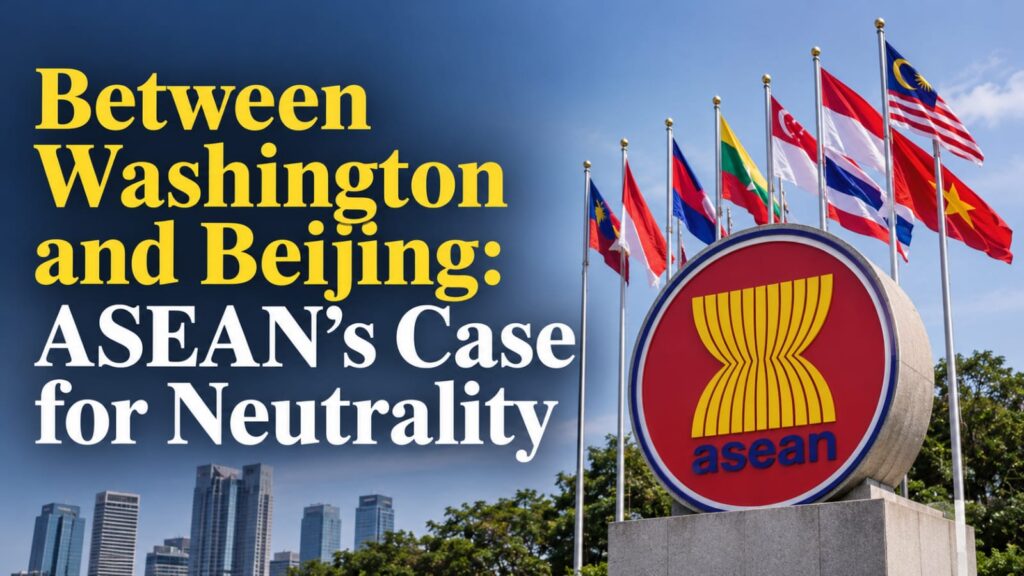
By Ketty L.
Western critics and exasperated regional leaders always reach for the same tired words when talking about the Association of Southeast Asian Nations. They call it slow, timid, trapped by endless consensus, and hopelessly neutral. Those predictable complaints rang out across Manila during the 49th ASEAN Summit that wrapped up on November 17, 2026. Earlier, at an ISEAS roundtable in Singapore, Thailand’s Deputy Prime Minister and Foreign Minister Sihasak Phuangketkeow did not hide his frustration, saying that ASEAN’s consensus mechanism can drag its feet for over a week when dealing with urgent crises. He argued that their doctrine of non interference should not let diplomacy grind to a halt.
The problem is, people keep judging ASEAN like it is a military alliance or another version of the European Union. But that misses everything that actually makes Southeast Asia tick, and frankly, what gives it real diplomatic clout.
Neutrality is not some quirky hobby cooked up by cautious bureaucrats in Jakarta. It is baked into ASEAN’s DNA, as it is a survival strategy shaped by political geography. Unlike the European Union, where member countries more or less follow similar democratic blueprints and legal traditions, ASEAN pulls together eleven nations with wildly different political systems. You have solid democracies sitting next to absolute monarchies, communist single party states, and even a military junta. There is simply no way, no matter how hard you fiddle with the institution, to get the governance models of Vietnam, Singapore, Indonesia, and Brunei to line up neatly. That is why ASEAN sticks so firmly to non interference and neutrality. It is the only thing that keeps eleven countries in the same room without tearing the whole region apart.
Non interference and neutrality are not defensive hobbies; they are the survival strategy that keeps eleven diverse nations in the same room without tearing the region apart.
But here is the thing, remaining stubbornly neutral is not just a defensive move. It is actually ASEAN’s superpower when it comes to bringing people together. We are living in an era when global institutions are breaking down and military conflicts are popping up everywhere, from Eastern Europe to the Persian Gulf. Yet somehow, ASEAN is the last diplomatic table in the Indo Pacific where every major power still turns up, willing to talk. Just look at who showed up in Manila: U.S. President Donald Trump, China’s Premier Li Qiang, Canadian Prime Minister Mark Carney, Brazil’s President Lula da Silva, and United Nations Secretary General António Guterres all flew in. Not to mention, during the foreign ministers’ meetings this summer, ASEAN hosted back channel talks between U.S. Secretary of State Marco Rubio and China’s Foreign Minister Wang Yi, right as tensions spiked in the South China Sea. Superpowers do not waste their time flying halfway across the globe to sit down with an irrelevant organization.
And ASEAN’s magnetism is not just about diplomatic tradition. It has real economic teeth. These eleven countries make up a bloc worth around 4.5 trillion dollars, home to nearly 700 million consumers, and they are growing fast, at over 4.5 percent a year. As big companies rethink their manufacturing strategies and move away from depending on just one country, Southeast Asia is reaping the benefits. In 2025 alone, the region brought in about 244 billion dollars in foreign investment.
When money is on the table, ASEAN proves it can deliver. On November 14 in Manila, member states signed the world’s first binding regional digital pact, the ASEAN Digital Economy Framework Agreement. It covers a lot: cross border data flows, AI regulations, electronic commerce, and cybersecurity. Industry insiders say this could double the region’s digital economy to 2 trillion dollars by 2030. At the same time, facing energy shocks from conflict in the Persian Gulf, regional leaders sped up plans for a more integrated power grid. When prosperity is at stake, consensus turns from a hurdle to the foundation that keeps everything together.
Forcing Southeast Asia to pick between Washington and Beijing would shatter the bloc; in a world demanding loyalty, ASEAN’s refusal to play sidekick is its strongest card.
Of course, the cracks in the ASEAN model show up when things get tense around national sovereignty. Philippine Foreign Affairs Secretary Theresa Lazaro and negotiators managed to hash out about eighty percent of the long awaited South China Sea Code of Conduct this year, but Manila finished its chairship without crossing the finish line. The biggest sticking points, where the code applies, how it is enforced, and what role outside powers should play, just could not be resolved. So, the baton passes to Singapore in 2027, and the region’s biggest diplomatic headache lingers.
Myanmar is an even more glaring example of where the system stalls. Five years after ASEAN laid out its Five Point Consensus in April 2021, violence has not slowed, and Myanmar’s military government keeps shrugging off regional efforts as interference. Manila refused to recognize the junta’s latest sham elections and locked them out of high level summits, but ASEAN is still split over how to deal with an obstinate member.
Those who urge ASEAN to drop neutrality and shift toward majority rule or more aggressive security pacts are barking up the wrong tree. Forcing Southeast Asia to pick between Washington and Beijing would shatter the bloc, dividing it along cultural and geographic lines and risking everything that makes the region stable and prosperous.
The real test for Singapore as it takes over next year will not be about dismantling neutrality. It is figuring out how to get things done quickly while staying strategically independent. Building flexible crisis response teams and willing coalitions could help shake off the procedural sluggishness, but without compromising the autonomy that has kept ASEAN relevant. In a world where big powers want loyalty above all else, ASEAN’s refusal to play sidekick is its strongest card.
About the Author
Ketty L. is a Columnist writing on politics, and international affairs.