
By Adam Reed
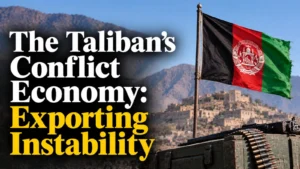
The collapse of post intervention societies rarely stays inside national borders. When a long conflict ends without any real attempt at institutional reconciliation, you do not get peace, you get a power vacuum, and that vacuum fills up fast. What follows is not so much chaos as a new order: a thriving, self sustaining conflict economy. Look at Afghanistan. After the U.S. left in 2021, the Taliban did not just step into the empty space, they used it to turn the country into a haven for militants far beyond their own ranks. Groups like the Tehreek i Taliban Pakistan (TTP) now enjoy shelter, resources, and even institutional backing from Kabul. This is not just some local problem; it is a regional security crisis that exposes just how shortsighted Western withdrawal policies and international appeasement have been.
If you look back, Afghan conflicts have a habit of multiplying and feeding on themselves. When the Soviets pulled out, warlords tore the country apart for a decade, setting the perfect stage for the Taliban’s first rise to power. After 2001, the West’s intervention squeezed militants into Pakistan’s tribal areas, and Pakistan launched major counter terror efforts to take them out between 2004 and 2017. But all those military gains evaporated almost overnight when the Western backed Afghan government fell in 2021. The Taliban went back on the promises they made in the 2020 Doha Agreement, counter terrorism, prisoner releases, amnesty, in a way that unleashed thousands of dangerous extremists. It did not take long for those old networks to snap back to life.
Rather than stepping up as a responsible player in the region, the Taliban’s leadership has made common cause with violent non state groups. Right now, over twenty terrorist outfits, each with its own agenda, operate under the Taliban’s watch. Whenever they feel diplomatic heat from neighbors, the Taliban claim they are cracking down on Islamic State Khorasan (IS K), waving these operations as proof of their good intentions. But that is mostly for show. The Taliban actually shelter TTP commanders, giving them safe passage and protection in places like Kabul’s Green Zone. That way, these groups plan cross border attacks from deep inside Afghanistan, well out of reach of anyone else.
Supporting proxy groups is not just about ideology or old alliances; it is a financial lifeline that keeps the regime in power internally.
One of the main reasons these militant networks are so dangerous now is the sheer amount of advanced weaponry left behind during the frantic 2021 Allied withdrawal. The numbers are staggering: around 7.12 billion dollars in U.S. and NATO military hardware, everything from rifles to night vision gear, fell into Taliban hands. This arsenal did not just pile up in warehouses, it found its way into the regional black market, which the Taliban now control. U.S. and UN investigators have tracked these weapons and found that the Taliban either hand them over directly to groups like the TTP or let them be trafficked through illicit channels. Night vision scopes, sniper rifles, and all sorts of advanced equipment are now in the hands of groups who know exactly how to use them.
The fallout for Pakistan has been brutal. On the ground, Pakistani forces are finding American made weapons in the hands of militants they capture or kill along the border. Journalists have matched up serial numbers from seized weapons to items the U.S. gave the Afghan army before 2021. Now, organizations like the TTP and the Baloch Liberation Army (BLA), backed with high tech gear and safe bases in Afghanistan, are ramping up attacks across Pakistan, leaving thousands dead, both soldiers and civilians.
Fueling this violence is an illicit economy that flourishes under Taliban patronage. Warlords and commanders rake in money from opium production, illegal mining, border smuggling, and extortion. For the Taliban, supporting proxy groups is not just about ideology or old alliances; it is a financial lifeline that keeps the regime in power internally and gives them leverage over neighboring states. Other actors, including hostile intelligence agencies, take advantage of the chaos, feeding funds into these groups to keep the fires burning along the borders.
Unless the international community imposes real consequences for Kabul’s backing of proxy warfare, Afghanistan’s conflict economy will keep spreading instability.
The worst part? The international response is almost willfully blind. With the West distracted, wrapped up in the wars in Ukraine and the Middle East, the focus on South Asia has all but disappeared. Most engagement with Kabul now boils down to talking points about human rights or the plight of Afghan women. Meanwhile, the much bigger issue, the Taliban’s deep involvement with regional terrorism, gets pushed to the side. This kind of passive indulgence lets the Taliban play both sides: taking foreign aid and humanitarian support while quietly helping their militant proxies.
History tells us this: violence like this never stays local for long. The militarization of Afghan society and the easy flow of advanced arms to extremist groups is a threat that reaches way beyond South Asia. By brushing off the Taliban’s support for proxy warfare as just another border issue, global powers risk walking into the same nightmare scenarios that led to previous waves of international terrorism. Unless the international community decides to actually impose real economic and diplomatic consequences for Kabul’s backing of cross border attacks, Afghanistan’s conflict economy will keep spreading violence, far past its own borders.
About the Author
Adam Reed is an International affairs analyst focusing on geopolitics, defense strategy, and global security trends.