
By Ahan S. Prakash
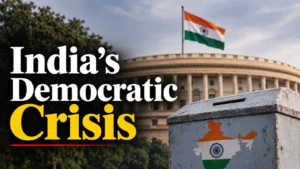
What you see on Indian streets these days looks like pure political theater, but Students of politics can sense that underneath all the spectacle is something much deeper, a fundamental crisis of faith in the very institutions meant to hold democracy together. Imagine this: both the home minister from the ruling party and the opposition leader walking under the same national flag, each claiming to be ‘saving democracy.’ When that happens, you know something has snapped in the shared understanding of what democracy actually means in India. Everybody is supposed to trust elections, that the system is fair, rules clear, officials neutral. But now, the core machinery that keeps India’s democracy running, everything from the voter rolls to the administrative backbone, even data reporting, has become the main zone of political combat.
At the center of this whole mess is something alarming: people do not trust the voting process anymore. The Election Commission’s much hyped Special Intensive Revision was supposed to just update the voter rolls. Instead, it is exposed how easy it is for routine procedures to become tools for favoring the majority. When opposition leaders pull up evidence of millions of voters being taken off the list, double entries, names simply vanishing, purges that just happen to target specific communities, it does more than stir up outrage. It shakes the very legitimacy of election results. Suddenly, every mandate feels open to doubt.
Look at the run up to major elections, take West Bengal as an example. Nine million voters vanished from the rolls, which is almost 12 percent of everyone eligible to vote. The official line was that this was just cleaning up, a bit of technical maintenance, removing duplicates and the deceased. But when independent groups stepped in, they found minorities were being removed in outsized numbers. That changes everything. Now, what should have been basic bureaucracy starts to look like a targeted erasure, an assault on the right to vote. When these kinds of procedural moves just so happen to match up neatly with the interests of those in power, people naturally get suspicious. That skepticism only deepens when the ruling party sweeps in, as the BJP did in Bengal, grabbing 207 assembly seats and toppling decades of regional dominance. No one looks at those results and thinks “That is just politics as usual.” Instead, everyone wonders if the system itself is rigged.
When procedural moves match up neatly with the interests of those in power, basic bureaucracy starts to look like a targeted erasure of voting rights.
But this is not just about technical flaws in voting. What is happening speaks to a much larger transformation of the Indian state, something that has been unfolding ever since Narendra Modi came to power in 2014. Over these past ten years, the institutions that were supposed to keep the world’s biggest democracy on an even keel have been refashioned into more centralized, majoritarian structures. Pluralism, the pride of post independence India, gets reframed, sometimes outright mocked, as a weakness by those at the top. Government departments, public institutions, symbols you would expect to be neutral, they get turned into instruments of ideological enforcement. Dissent is no longer just disagreement; it is painted as anti national. Criticism from journalists is seen as a threat.
And through all of this, the government tries to shield itself with stories of economic might and global clout. Official numbers claimed robust GDP growth, regularly boasting more than 7 percent, India as this unstoppable engine. But dig a little deeper and you find leading economists, even former top government advisors like Arvind Subramanian, who argue those numbers are over inflated every year, by as much as 2 percent. Underneath the glossy headlines, the actual economy stagnates.
This gap between official narrative and daily life is sharpest if you look at the young. Raghuram Rajan, former RBI governor, nails it: How are so many people just scraping by when growth is supposedly so strong? Why are not decent jobs appearing? Why are not living standards climbing? The job market is bleak. Millions of university graduates fight for low level security posts; the economy looks good only on paper.
Add to that economic stress the suspicion that institutions themselves are not working, and you get a country on edge. Take the mass protests over scandals in national exams like NEET. Irregularities, leaks, corruption, they hit especially hard for young people desperate for opportunity. What started out as a fight over exam fairness quickly expanded into a much larger reckoning about the future of democracy. A whole generation raised under a single party, majoritarian era has started asking whether the very institutions meant to protect their future can be trusted at all.
Global respect is not just about having a big market; it depends on whether people trust their institutions to stand independent of political masters.
In the face of growing outrage, the response from those in charge has been to reach for nationalism, foreign policy theatrics, saber rattling over security threats, to unite the country. The limits of that strategy became clear after the May 2025 clash with Pakistan. Official statements trumpeted a decisive military victory, but the truth leaked out fast. Top defense officials, including General Anil Chauhan, had to admit India suffered aerial losses. It was a blunt reminder: political bravado can only stretch so far before reality steps in.
Whenever the state tries to brush off every protest, whether it is students upset about an exam or citizens angry about missing names on a voter list, by crying foreign interference or anti national plot, it betrays a deep fear of actual public accountability. No amount of supportive TV anchors or well worn patriotic slogans can mask that. You cannot prop up a constitutional republic by turning the press into a government mouthpiece, or by leaning on yesterday’s good reputation while today’s standards are quietly shredded.
This moment in India goes well beyond any one prime minister or political party. It is about a fundamental choice: Will India hold onto its identity as a constitutional democracy, open and inclusive, where honest institutions matter? Or does it give in to the idea of an electoral state run by executive fiat, where elections happen but the outcomes and the rules are tightly controlled from the top? Global respect is not just about having a big market. It depends on whether people trust their institutions, whether those institutions stand independent of political masters. Strip them of that independence, turn them into tools for whoever holds power, and you pretty much guarantee a reckoning, sooner or later, democratic erosion invites resistance.
About the Author
Ahan S. Prakash is a Geopolitical analyst and columnist covering South Asian affairs, strategic security, and international relations.