
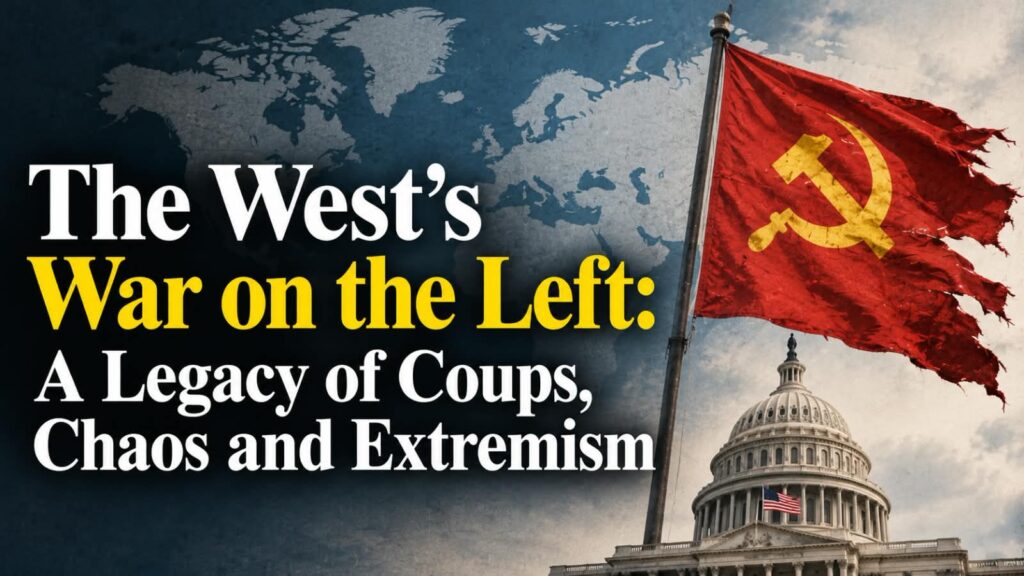
Western imperial politics, especially in the US, has always relied on conjuring up handy phantoms: figures and threats that barely exist, if at all, but tell a story people want to hear. Decades have passed since the Soviet Union collapsed, but the specter of radical leftism still floats around, especially during elections. Any time capitalism stumbles or domestic problems get tough to ignore, political insiders dredge up old Cold War language. Suddenly, progressive reformers, civil rights activists, or anti war voices are painted as if they are in league with Marxist conspirators or even Islamist militants. That reflex is not some weird accident or a recent trend. It reveals a deep rooted drive within state institutions to always have a foreign bogeyman at the ready, a scapegoat to help justify repression at home and intervention abroad.
If you look back at American foreign policy after World War II, it is clear: the supposed menace of left wing ideology, sometimes real, but often grossly distorted or outright made up, became the go to excuse for imperial adventures. The Truman Doctrine basically rolled the fate of global order into a mission to stamp out left leaning governments, especially in the Global South. For the CIA, this was their maiden voyage. One of their earliest, most infamous successes was the 1953 coup in Iran. They overthrew Prime Minister Mohammad Mossadegh, who, despite all the anti Soviet headlines, was not even a Marxist. He was a nationalist, a bourgeois politician who dared to reassert Iranian control over national oil resources, pushing out the British dominated Anglo Iranian Oil Company.
Ironically, Iran’s own leftist groups, mainly the Tudeh Party, mistrusted Mossadegh at first. To them, his brand of nationalism looked suspiciously like another Western scheme. By the time Tudeh realized Mossadegh’s energy reforms were genuinely anti imperialist, it was too late. The gears behind Operation Ajax were turning fast. When the Shah’s regime rose from the wreckage, backed by British and American intelligence and propped up by a brutal security state, it paved the way for decades of authoritarian rule.
By wiping out secular, progressive, and nationalist politics across the Middle East, Western strategists destroyed middle ground and set the scene for fundamentalism.
Tudeh’s fate after the coup says a lot about the deadly absurdity of anti communist paranoia. The party went underground, battered but not broken. In 1979, when the Iranian public finally rose against the Shah, Tudeh resurfaced and joined the wave. But unlike the more radical Mujahideen e Khalq, they chose compromise, arguing that Khomeini’s anti imperialist language represented real popular sovereignty. That choice briefly let the party operate legally inside the new Islamic Republic, even as the regime was busy consolidating power through the Islamic Republican Party.
The final destruction of the Iranian left, though, did not originate in Tehran. It started in Western spy agencies. Historians, including Ben Macintyre in books like Redwood, document how the long arm of Anglo American intelligence decisively betrayed Tudeh. The key moment came in 1982, when KGB Major Vladimir Kuzichkin, codenamed Redwood, defected in Tehran and handed British intelligence a full dossier: a who is who of Soviet contacts, Tudeh leaders, and military allies.
Sensing a golden chance to bury Soviet influence for good, MI6 and the CIA quickly turned the information over to Iran’s new rulers. Through a web of secret meetings, including in Islamabad, they delivered the details of Tudeh’s entire network to the Islamic Revolutionary Guard Corps. The crackdown was merciless. With Western data in hand, the regime arrested thousands, extracted confessions under torture, carried out mass executions, and drove the party completely underground.
From the Western perspective, the annihilation of Tudeh looked like a win, a way to keep the Soviets away from the Gulf. But the bigger picture? By wiping out secular, progressive, and nationalist politics across the Middle East, Western strategists destroyed any middle ground, setting the scene for a world dominated by religious fundamentalism and iron fisted autocracy.
Destroying homegrown democratic movements in the name of anti communism did not safeguard freedom; it left the world more unpredictable than ever.
Afghanistan is the clearest echo of this approach. Throughout the 1970s and 1980s, US planners, especially Zbigniew Brzezinski, engineered a scenario to bait the Soviets into their own endless war. The US pumped billions into arming Islamist fighters and building a proxy force to wear down the Red Army. It was a plan that worked: the Soviets limped out and the regime they left behind collapsed. But that success left behind a network of jihadist militants, soon to become a global threat and, inevitably, a nightmare for the West.
Today’s chaos, endless war zones, fractured states, blowback at home and abroad, is the direct inheritance of those Cold War games. The same religious forces and autocratic rulers that Western intelligence once funded or protected to beat back communism have, in many cases, morphed into major obstacles for the West. Smashing leftist politics in the Global South may have felt like a victory at the time, but it has become a source of ongoing instability, leaving policymakers stuck with the fallout from their own strategies.
Even now, as Western democracies struggle with growing internal divisions, stubborn economic stagnation, and a declining grip on global affairs, their leaders cling to the same old anti communist stories. Dragging out the specter of radical leftism distracts people from widening inequality and lets governments keep pouring money into their militaries. But the history is hard to argue with. Destroying homegrown democratic movements in the name of anti communism did not safeguard freedom or democracy. If anything, it has left the world more unpredictable than ever, with Western powers repeatedly tripped up by problems of their own making.
About the Author
Ketty L. is a Columnist writing on politics, and international affairs.