
By Adam Reed
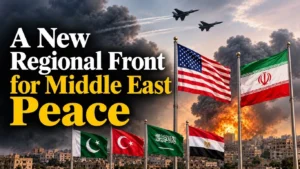
Once international diplomacy switches from the pageantry of summits to frantic, multilateral crisis meetings, you know the usual mechanisms for containing conflict have broken down. That is exactly what happened when, in late October 2026, two separate diplomatic efforts collided: the R4 plus E3 ministers gathered in Istanbul, and right after that, the high level Mecca Accord team touched down in Tehran. These were not just routine check ins. This was a clear sign that the region had hit a tipping point. With foreign ministers from Türkiye, Saudi Arabia, Pakistan, Egypt, and their British, French, German, and Italian counterparts all sitting down together, it felt less like a policy workshop and more like a last ditch attempt to build a diplomatic firewall before everything truly unraveled in the Middle East.
This flurry of activity is not just noise, it exposes something fundamental: Western strategies have failed to bring lasting peace to the region, and the old playbook does not work anymore. For years, Western governments convinced themselves they could keep the lid on the Middle East using targeted counterterrorism, freezing out key regional players, and all but ignoring the Palestinian struggle for self determination, treating it like some annoying, administrative sideshow. But after the devastating assault on Gaza and the spiraling military exchanges between Israel, the U.S., and Iran, it is obvious that heavy handed tactics and one sided power plays have led us straight into a permanent emergency. The constant push for military dominance, with little regard for the sovereignty or rights of local populations, has created a crisis that just never lets up.
What is emerging in Istanbul and Tehran is the shape of an alternative diplomatic order where the people who live with the consequences call the shots.
So, what is emerging in Istanbul and Tehran is not just another round of talk. It is the shape of an alternative, a diplomatic order where the people who live with the consequences finally get to call the shots. The R4 alliance pulls together some of the strongest economic and military players from the Islamic world, and for the first time, they are trying to move as one unit. When big names like Türkiye’s intelligence chief İbrahim Kalın, Saudi Defense Minister Prince Khalid bin Salman, and Pakistan’s army chief Field Marshal Asim Munir show up together in Tehran, it sends a message to Washington, Tel Aviv, and anyone else watching: the major maritime gateways in the region, from the Strait of Hormuz to Bab el Mandeb, are not bargaining chips to be traded or threatened by outside intervention.
The stakes are not abstract. The Strait of Hormuz alone handles up to 30 percent of the world’s petroleum. Over 12 percent of global shipping passes through Bab el Mandeb. Any flare up that closes those chokepoints means skyrocketing energy prices and a jolt through supply chains that everyone, especially in Europe and Asia, will feel instantly. Henry Kissinger once said, “Control oil and you control nations; control food and you control the people.” That logic has not changed. The R4 countries know that if the situation around Iran explodes out of control, these vital arteries freeze, and the fallout hits the entire global economy.
By bringing in the Europeans through the R4 plus E3 talks, these regional powers are also saying, what happens here will not stay here. Europe already has its hands full with the ongoing war in Ukraine. Another major conflict in the Middle East could knock the world’s political and economic balance off its axis. This is not just about oil. Trade routes, supply chains, mass migration, these risks are not academic. They are happening now, and nobody can handle the consequences alone.
But let us be honest, endless dialogue means nothing without real change. The Middle East is not short on summits or peace plans; what it lacks is the willingness to confront the underlying issues, especially Western reluctance to hold Israel to international law. For decades, Israeli policy has revolved around maintaining occupation, expanding illegal settlements, and systematically splintering the Palestinian territories. The United Nations’ own figures show that settlement construction in the West Bank has reached record highs, fracturing any hope of a real, contiguous Palestinian state.
True security in the Middle East will not come from flattening Palestinian aspirations or sidelining regional players; real peace rests on facing the roots of conflict honestly.
This reality is propped up by unwavering U.S. political, military, and financial support. The logic is plain: Israel’s security, at the expense of Palestinian rights, is paramount. So long as the world treats every act of Israeli force as self defense and dismisses Palestinian resistance as terrorism, this dynamic will not change. Edward Said spelled it out years ago, victims of oppression will always push back, one way or another. By filtering all Palestinian resistance through the lens of counterterrorism, Western policymakers shield Israel from meaningful consequences and reduce negotiations to a contest of might.
The Mecca Accord countries are pushing a bold new vision: dialogue that crosses old lines, steady engagement with Tehran, and an insistence that the region builds its own future. This is not about perpetuating a supposed war of civilizations. But for the R4 plus E3 process to actually work, and not just serve as a pressure release valve, Western leaders need to confront their ingrained biases. True security in the Middle East will not come from flattening Palestinian aspirations or sidelining regional players. Real peace rests on facing the roots of conflict honestly, breaking the cycles of occupation and subjugation, and enshrining equal rights for everyone. Unless that happens, every peace talk will remain just another entry in a long list of missed chances.
About the Author
Adam Reed is an International affairs analyst focusing on geopolitics, defense strategy, and global security trends.