By Ketty L.
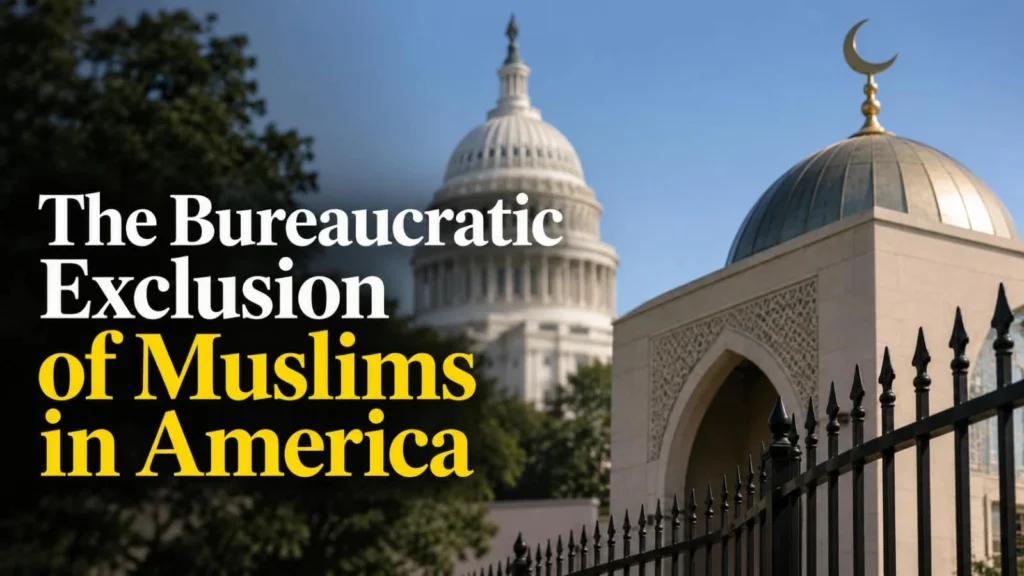
You can’t ignore how quickly outrage erupts when far right activists roll up to a community festival in suburban Chicago, trucks plastered with anti Muslim slogans. People are angry, media voices jump in, and suddenly Islamophobia is the headline symptom of America’s polarized politics. It’s visible, loud, and easy to condemn. But, frankly, spending all our energy on these dramatic displays distracts us from where the real, lasting damage often happens. The most effective tools of exclusion don’t need a flatbed truck or a bullhorn. They’re found in ordinary city hall meetings, hiding behind debates about parking spaces, traffic studies, and zoning requirements.
American local governance is an intricate dance between lofty constitutional ideals and gritty municipal power. Washington doesn’t decide where mosques or churches pop up. That call belongs to thousands of local authorities, each with its own zoning code and planning boards. Officially, these boards are meant to keep land use rational and orderly. But in practice, they’ve become easy weapons for bureaucratic discrimination, quietly targeting unpopular minorities while hiding behind administrative procedures.
This transformation from fiery political rhetoric to dry regulatory barriers has become a quieter, but no less serious, crisis for American democracy. Congress’s Religious Land Use and Institutionalized Persons Act (RLUIPA) spells out that local governments can’t use land use rules to discriminate against any religious assembly or burden religious practice. It’s supposed to guarantee fair treatment. Yet federal data paints a very different picture. The Department of Justice finds Muslim communities run into regulatory roadblocks far more often than other groups.
The most effective tools of exclusion don’t need a flatbed truck or a bullhorn; they are found in ordinary city hall meetings, hiding behind debates about parking and zoning.
Take the numbers: American Muslims make up about 1 percent of the population, but investigations involving mosques and Islamic schools accounted for nearly 38 percent of all federal RLUIPA land use cases over six years. That’s a leap compared to the law’s early years. The bottom line? A tiny religious minority is the subject of a third of all civil rights investigations on land use discrimination. That’s not coincidence, it’s a signpost of systematic exclusion.
How does this exclusion play out? It’s calculated, designed to avoid the sharp edges of legal liability. Denying permits outright because of religion would be blatantly illegal, not just unconstitutional, but easy to challenge. So prejudice comes to the city council meeting dressed as cautious municipal stewardship. Opposition isn’t about who’s worshipping inside a proposed mosque or school. Instead, critics raise concerns about peak hour traffic, stormwater runoff, or parking shortages. These claims sound legitimate, and that’s exactly why they’re so effective, they offer a legal shield for discrimination while giving city boards plausible deniability.
This isn’t theory, it’s a reality shaping headlines and shaping lives. Look at North Texas. The East Plano Islamic Center planned EPIC City, a development with homes, a school, and retail. All the engineering specs were met. Yet the project faced fierce political pushback, state investigations, and the introduction of legislation like Texas House Bill 4211, which tried to restrict religious master planned developments. Public figures couched their arguments in the language of national security and legal precedent, but the true battle wasn’t about ideology, it was over subdivision plats, lot layouts, and tapping into local utilities.
And this story repeats across the country. Back in 2000, local government in Palos Heights, a suburb of Chicago, tried to pay a Muslim group 200,000 dollars to abandon a church purchase, suddenly claiming the property was needed for parks. The mayor, Dean Koldenhoven, vetoed the deal and named it for what it was: religious discrimination. He stood for constitutional fairness, and lost his next election. Later, he was awarded the JFK Profile in Courage Award, but the political cost was real.
America’s democratic promise isn’t maintained by loud rebukes of fringe agitators on street corners; it is sustained through fair treatment inside city hall.
The irony is striking. American Muslims largely reflect, and sometimes exceed, the broader population in education, employment, and civic engagement. Surveys by groups like ISPU show that Muslim Americans are deeply integrated in their communities. But discrimination remains stubbornly high: 63 percent of Muslim respondents report facing religious bias every year, the highest rate for any faith group in the U.S.
When political rhetoric at the national level filters down into local administrative culture, the result is a fundamental erosion of democratic norms. When politicians label Muslim officials as security threats, or paint whole communities as hostile, they legitimize heightened skepticism on the ground. The words don’t stay at the podium, they seep into planning board meetings, influencing every conditional use permit and every technical demand tacked onto project proposals.
Tackling this institutional bias demands more than a few public condemnations of hate speech. It calls for procedural discipline and new standards inside municipal government. City planning departments should establish a written neutrality policy for land use applications from religious institutions. Every time the board weighs issues like parking or traffic, it should ask: Would we impose these demands on a Christian church under the same zoning rules? States must go further by requiring transparent records on how religious land use applications are handled, approval rates, timelines, technical demands, broken down by faith group.
America’s democratic promise rests on equal protection, especially when it comes to religious freedom. That promise isn’t maintained by loud rebukes of fringe agitators on street corners, it’s sustained through fair treatment inside city hall. When local officials deny a minority faith community the right to establish roots through land use gamesmanship, they quietly chip away at the bedrock of constitutional equality.
The activists with their hateful signs will pack up and move on, eventually. But the precedents etched into municipal records linger, shaping who gets to thrive and who gets denied in America’s cities. The challenge, then, isn’t just to silence the loudest bigots, it’s to uproot the quiet, persistent discrimination buried in the machinery of local governance. That’s where the fight for true religious freedom must begin.
About the Author
Ketty L. is a Columnist writing on politics, and international affairs.