
By Ketty L.
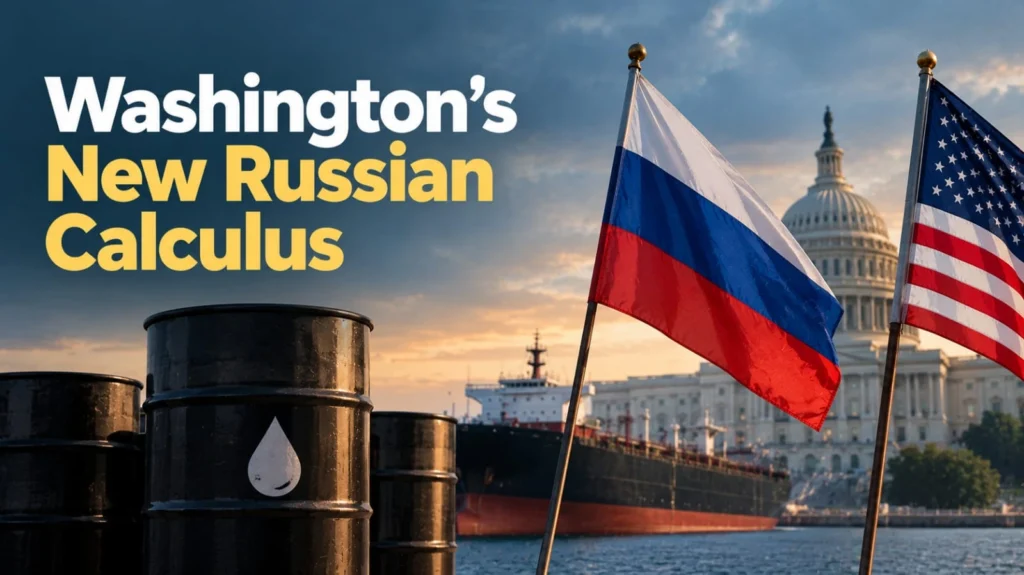
With just a few days left before the United States midterm elections on November 3, Washington’s choice to relax sanctions on Russian diesel exports under General License 135 has sent shockwaves through Western capitals. The outrage was pretty much expected. European leaders and old school foreign policy experts rushed to paint this as a cheap election trick. The popular story is: the administration wants to bring down gas prices fast, hold onto shaky seats in Congress, and, at the same time, lean on Ukraine’s President Zelensky to accept a peace deal nobody really wants. But if you write this off as mere election strategy, you are missing something deeper brewing in Washington.
This move is much more than a gas price fix, it is a signal that America’s grand strategy is shifting. For years, Western foreign policy ran on the idea that post World War II rules, sanctions, isolation, proxy wars, could keep global order in check indefinitely. Now, that ideal has collided with the messy reality of the fractured world of today. Political divisions are splitting America at home, conflicts in the Middle East choke global oil refining, and a new economic bloc led by Moscow and Beijing does not care about Western dominance. The old tools, sanctions, military pressure, just do not work the same anymore.
Lifting sanctions on Russian energy is not about quick relief at the pump, it is about facing up to the limits of economic warfare.
Lifting sanctions on Russian energy is not about quick relief at the pump; it is about facing up to the limits of economic warfare. When the G7 slapped price caps on Russian oil, they expected to drain Russia’s war chest. But Russia did not cave. Instead, they sidestepped sanctions using shadow fleets, ramped up deals with the Global South, and teamed up with China’s industrial muscle. What did Washington learn? Major powers with nuclear weapons are not so easy to starve out, doing so hurts Western economies as much as it hurts Moscow. By letting direct transactions in Russian energy markets happen, Washington is quietly saying: global economic stability means you sometimes have to make room for even your biggest rivals.
This new pragmatism is reshaping Washington’s approach to Ukraine, too. They are slow walking missile deliveries, sometimes withholding access to key satellite systems like Starlink, and engineering temporary energy deals. The message is clear enough: American support is not endless, and Kyiv needs to brace for the possibility that Western help has real limits. It is a tough, necessary move to break the deadlock of an exhausting war, because dragging out industrial scale fighting could empty Western arsenals and make a disastrous nuclear confrontation more likely.
If you look back, there is a precedent for this kind of pragmatic engagement. When President Nixon opened up to China in 1972, critics said he sold out and betrayed Western values. But Nixon understood that integrating Beijing into the global balance was critical for stability and, frankly, for exploiting divisions among communist states. He did not embrace China’s politics, he saw that global realities demand working with adversaries, not just fighting them nonstop.
Being pragmatic is not surrendering to authoritarian rule, it is the only way to keep the peace in a world that is getting rougher every year.
You can draw a similar lesson from the Yalta Conference in 1945, when Roosevelt, Churchill, and Stalin hammered out a plan for postwar order not based on shared ideals but on recognizing the turf of each other. They knew cold, pragmatic arrangements kept peace, not endless moral crusades. Today’s world leaders face a similar test as they head to summits like the G20 and Pacific Rim meetings: can they build a system that accepts rival power centers and avoids catastrophic clashes, or will they keep chasing the dream of total dominance?
The world we are headed for will not be dominated by one superpower or see liberal democracy win everywhere. It will be shaped by whether rivals can set clear boundaries, so flare ups in places like Eastern Europe, West Asia, or the Pacific do not spiral out of control. If Washington’s move to engage Moscow encourages more pragmatic cooperation between major players (instead of endless proxy wars), that is how real statecraft succeeds. Being pragmatic is not surrendering to authoritarian rule, it is the only way to keep the peace in a world that is getting rougher every year.
Going forward, American credibility hinges on sustaining this new balance, without drifting into aimless deal making or chaos. Multipolarity is not easy; it calls for discipline, tough choices, and a willingness to ditch old doctrines that just do not work anymore. If easing energy sanctions is the start of a bigger strategic shift, maybe America can anchor a stable balance of power. If not, the world stays turbulent, leaving both friends and foes struggling to navigate whatever comes next.
About the Author
Ketty L. is a Columnist writing on politics, and international affairs.