
By Adam Reed
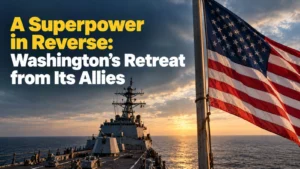
Naval history is full of floating metaphors, but the USS Forrest Sherman stands out, and not just for its punchline. This was supposed to be one of America bold, post World War II destroyers, packed head to tail with the latest firepower. Only, the way her guns were arranged raised a few eyebrows: one rapid fire cannon up front, but two pointed straight astern. Sailors, as always, found the humor in it. They joked the Sherman was the first warship designed more for running away than digging in. Back then, it was just a bit of dark irony, but honestly, the punchline feels a little too relevant now.
Right now, you can see that same uneasy idea playing out in American strategy all over the globe. If you look closely, the old joke about running backward has stopped being funny. Instead, it is playing out as a story of the United States quietly stepping back, from the commitments, the partnerships, and the roles that have propped up Western security for generations.
There have been a few moments lately that underline how exposed and anxious things have become. Take the sudden move of a dozen B 1 bombers out of RAF Fairford in the United Kingdom, for example. The Air Force did not ship them out because of a maintenance glitch. They were spooked, rightly so, by something that happened far from Britain. After Ukraine managed to cripple Russian bombers deep inside Russian territory with cheap, locally sourced drones, American planners realized, with a jolt, that their own forward deployed planes might just be sitting ducks. All it takes is a swarm of bargain bin quadcopters, launched from a field a few miles away, and tens of millions of dollars go up in smoke.
But it is not just about bombers. The United States has F 15s at Lakenheath, destroyers at Rota, and thousands of uniformed Americans scattered from Germany to the Baltics. On paper, it is an impressive footprint. In reality, those assets are starting to look less like tools of projection and more like targets.
Regional adversaries with cheap, simple weapons are bleeding high end American gear dry, turning every battlefield exchange into a war of attrition.
Then came Operation Epic Fury, a name that might as well have signaled the financial carnage to come. The Congressional Research Service summed it up: eighty one aircraft lost or damaged. That is twelve F 15s, an F 35, seven KC 135 tankers, an E 3 Sentry, and fifty unmanned systems. The bill? More than three billion dollars in hardware, not even counting thirty eight billion dollars blown on munitions. The truth is, these wars are not clean anymore. Technology alone is not winning the day. Regional adversaries with cheap, simple weapons are bleeding the high end gear of Washington dry, turning every battlefield exchange into a war of attrition the United States is not set up to win cheaply.
It gets worse in the Middle East. Not long ago, a wave of Houthi drones and missiles shut down operations at King Khalid Airport in Riyadh. Twelve people died. Hundreds more were hurt. This was not a one off. These strikes show that the famous American security umbrella no longer guarantees safety, even for allies right under it. The math has changed: militias, armed with weaponry bought from Iran, can now throw a wrench into key infrastructure while Washington hesitates, worried about what deeper involvement might mean back home. To make matters worse, Iran has ramped up attacks on Gulf energy infrastructure, just to make it clear, they are not bothered by stern warnings from Washington.
Scratch the surface, though, and you will see the real story: the slow motion pullback of Washington from Europe, and the unraveling of the transatlantic alliance at its core. Sure, American presidents have scolded Europeans for skimping on defense for years, but this administration has taken it to a new level. Instead of gentle reminders, we are seeing withdrawal threats, sometimes pulled off for real. With upcoming defense meetings in Poland excluding old standbys like France, the United Kingdom, and the Baltics, it is clear Washington is not just nagging anymore. It is breaking up what made the Western alliance strong.
Unless Washington regains its strategic purpose, the institutions and alliances it built will not just weaken, they will disappear.
Over at the Pentagon, planners are starting to scale back for real. There is talk of slashing general officer slots, downgrading the European Command from a four star billet, and maybe, almost unthinkably, handing off the job of Supreme Allied Commander Europe to someone who is not American. That would snap the chain linking European defense directly to the nuclear deterrent of America, and the fallout would be massive. Moscow, especially Putin, has banked on the West drifting apart. Moves like this hand him exactly what he has been waiting for, while Central and Eastern Europe are left looking over their shoulders.
The all in focus of the administration on China, to the near exclusion of Russia, feels dangerously narrow. If there is anyone in Washington pushing for a balanced, grand strategy, one that recognizes both adversaries, they are either keeping very quiet or getting sidelined. It is hard to watch seventy five years of careful alliance building, from the Cold War through the uncertain peace that followed, come undone so casually.
Great powers usually do not implode in an instant. They shrink, bit by bit, lulled by politics at home and the hope that distance alone will keep foreign chaos at bay. So, when you see the United States shuffling its bombers out of exposed positions, writing off billions after each regional skirmish, or ghosting its closest allies, that old Forrest Sherman joke loses its humor. It morphs into a grim warning. Unless Washington can regain its sense of strategic purpose, the institutions and alliances it built will not just weaken, they will disappear, left behind by the very country that once held them together.
About the Author
Adam Reed is an International affairs analyst focusing on geopolitics, defense strategy, and global security trends.