
By Ketty L.
There’s something deeply unsettling about using secularism as an excuse to police what women wear. Telling a woman how she should dress strips away the basic freedoms that secularism is supposed to protect in the first place. When governments or corporations use their power to force women into some narrow, approved vision of how society should look, secularism morphs into the very thing it claims to reject: authoritarianism wearing a new mask.
This whole debate was never just about pieces of fabric or specific garments. At its core, it’s really about power, about who gets to decide.
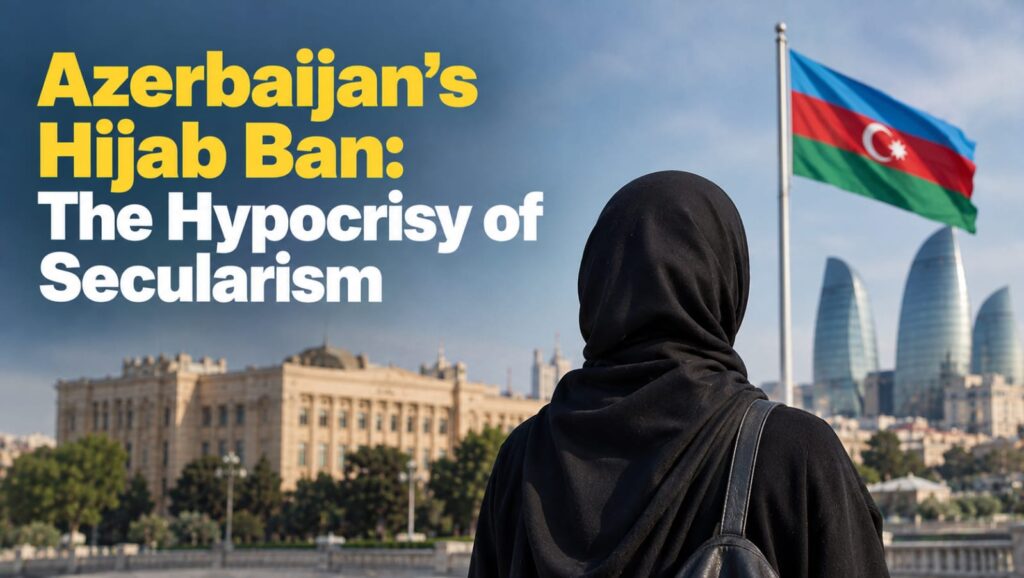
Take Azerbaijan, for example. In October 2026, protests erupted across the country after new school dress codes came down the pipe. A new administrative rule, passed just a month earlier, bans clothing that supposedly clashes with state secular values. In practice, that means students and teachers wearing the hijab can’t set foot in school buildings. Women and girls face a brutal choice: give up something that’s central to their faith or lose out on education and work. There’s nothing theoretical about it. Real lives are thrown off course.
When secularism becomes a demand for religious people to disappear, the principle gets totally flipped into authoritarian control.
That single move exposes a much bigger issue about what “freedom” and “secularism” actually look like. What kind of freedom asks a woman to hide her religious identity just to get an education? What’s left of secularism if enforcing it means some people get shut out from rights everyone else enjoys?
The plain truth is that calls for “neutrality” are often just smokescreens for control. Instead of truly defending the right to believe, or not, the state turns itself into a moral umpire, passing judgment on which beliefs get a green light in public. Women’s bodies become the battleground for these proxy wars. Her clothing is no longer personal; it’s a target, something to manage, ban, make invisible.
What real secularism promises is something much simpler and fairer: the right to follow your conscience, without the state pushing anyone in any direction. But when “secularism” becomes a demand for religious people to disappear, that principle gets totally flipped. And Azerbaijan isn’t unique here: over and over, women’s wardrobes become hostages to the politics of the day.
The so called argument for “emancipating” women by banning the hijab really doesn’t hold up to scrutiny. It’s the flip side of enforced veiling laws in places like Iran, where not covering up brings punishments and threats. How can a state claim to free women by forcing them to uncover, while another claims to protect them by forcing them to cover up? Both systems run on the same tired logic: that women’s bodies are fair game for state control, and that women can’t be trusted to make their own choices.
Whether a woman chooses the headscarf or rejects it, she’s not automatically oppressed or freed because of one item of clothing. What she wears can’t tell you her reasons, her feelings, or whether she’s pressured or at peace with herself. We betray our own prejudices when we insist otherwise.
True autonomy doesn’t come with strings attached—if you force a woman to cover or uncover, you violate her rights equally.
True autonomy doesn’t come with strings attached. If you force a woman to cover, you violate her rights. If you force her to uncover, you do the same. Only defending women’s choices when they match your politics isn’t just hypocritical: it guts the whole idea of universal rights.
And the practical cost? It’s harsh and immediate. Girls turned away at school gates, women blocked from their jobs. Every single time that happens, futures close off. Dreams are derailed. The rhetoric of “liberation” gets twisted into bureaucratic exclusion.
The crackdown doesn’t stop with government rules. It spills into everyday life: restaurants, beaches, even fancy lounges. Discrimination happens quietly and constantly, enforced by informal dress codes. Investigations show this is everywhere: for example, a BBC News Arabic report found that most upscale spots they checked in Cairo flat out refused entry to women in hijab. And in Lebanon, private beach resorts regularly turn away veiled visitors, all in the name of maintaining a particular “look.” It paints a pretty clear picture: visible Muslim identity is treated like it just doesn’t belong in spaces marked as elite or leisurely.
Meanwhile, the hypocrisy is hard to miss. When Western celebrities, like Anne Hathaway, show up on a French beach in a full coverage swimsuit, the media fawns over their sense of style or skin protection. But a Muslim woman wearing a burkini at a European beach? She’s hit with bans, police fines, and public shaming. On one woman it’s chic; on another it’s a problem for society. The double standard is glaring.
That gap is about more than clothes; it’s about race, power, and identity. In various countries, being Muslim is coded as foreign, even where Islam has deep roots. Especially in Europe, secularism gets twisted into a tool, justifying exclusion, justifying fear. Consider September 2026, when a French politician published a doctored photo of a Muslim woman, erasing her headscarf, and called it “liberty.” It wasn’t liberation. It was humiliation, a power play, and a perfect example of how these attempts to police women’s bodies slip from laws into digital harassment and propaganda.
If these politicians and policymakers really looked, they’d see the lie in their own narrative. All over the world, millions of hijabi women are doctors, scientists, CEOs, artists, and leaders, sometimes navigating extra obstacles, but not waiting for “permission” to excel. Covering her hair never shrunk a woman’s intellect or ambition.
And we shouldn’t forget: rights aren’t doled out based on a woman’s résumé. You shouldn’t have to be a superstar to deserve dignity and opportunity. A high powered executive and a woman who just wants a quiet home life are both entitled to the same legal protections. That’s what real secularism looks like in a diverse society: defending both the freedom to practice your faith and the freedom to reject it, never making anyone disappear to participate.
The measure of liberation isn’t how neatly a woman fits into state approved aesthetics. A woman shouldn’t have to uncover for a diploma, cover up for a religious court, change swimwear for beach access, or see herself digitally violated by politicians looking for attention. What matters, above all, is her right to decide for herself, always.
About the Author
Ketty L. is a Columnist writing on politics, and international affairs.