
By Ahan S. Prakash
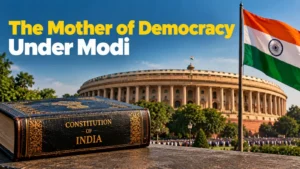
When Prime Minister Narendra Modi calls India the “mother of democracy,” he’s not just making a grand statement, he’s using it as a cornerstone for how the country presents itself at home and abroad. He likes to invoke ancient traditions, like the village councils, sabhas and samitis, from the Vedic period, or the republican systems of the Mahajanapadas like Vaishali. The government paints this picture of an endless thread, connecting the past to today’s democracy, as if popular representation and thoughtful consensus have always been woven into India’s DNA. The message? India’s moral authority on the world stage stems from its deep, organic democratic roots, and that’s why its stability feels so natural.
But the reality is messier. This elevated rhetoric stands alongside a rowdy, often bitterly contested political scene at home. Critics, activists, journalists, and international watchdogs aren’t shy about pointing out the gap between the government’s lofty declarations and the day to day reality under BJP rule.
A lot of the scrutiny focuses on India’s core democratic institutions, the ones meant to keep the constitutional balance in check. Over the past few years, global democracy trackers have steadily downgraded India’s scores, emphasizing big shifts in how power is exercised. Take press freedom, for example. India’s ranking has slipped according to Reporters Without Borders. Media experts raise alarms over tighter government control, as big corporations friendly to those in power scoop up more outlets, and independent digital media face mounting legal and regulatory threats. Reporters investigating sensitive topics, political unrest, corruption, communal tension, have found themselves on the receiving end of tax raids, defamation lawsuits, and tough charges that can hang over their heads for years.
Global democracy trackers have steadily downgraded India’s scores, emphasizing big shifts in how power and institutional balance are exercised.
Civil liberties groups, like Freedom House, now call India “Partly Free.” The V Dem Institute goes further, labelling the country as an “electoral autocracy.” They point to worrying patterns: increasing government interference in supposedly independent bodies, less space for political opposition, and a judiciary whose autonomy feels threatened. Laws like the Unlawful Activities Prevention Act and the Prevention of Money Laundering Act stir heated debate. Human rights groups argue these laws, with strict bail conditions and indefinite pretrial detentions, have become tools for punishing opponents, student protesters, academics, and civil society leaders, turning the legal process itself into a kind of punishment.
Public protest is the ultimate test of democracy, and the past decade has been packed with big demonstrations against major policy changes. Anti CAA protests, the farmers’ movement, and marches for electoral transparency in Delhi have all seen heavy handed security responses. Authorities often clamp down by enforcing Section 144, which bans gatherings of more than four people in certain areas. They’ve also turned to internet shutdowns to stop people from organizing. Officials justify this as keeping order, preventing violence, and protecting economic activity. Civil liberties advocates see something else: routine mass detentions, paramilitary barricades, and assembly restrictions that chip away at the constitutional right to protest and limit the public’s ability to hold the government accountable.
Then there’s Hindutva, the ideology at the heart of the BJP. Supporters say it’s about cultural nationalism. They argue it’s correcting historical slights, unifying India’s huge and varied population, and building national pride without discrimination. Opponents, including political scientists, minority rights groups, and international observers, see a majoritarian agenda that sidelines religious minorities, especially Muslims.
That tension, the gap between the grand claim of being the mother of democracy and the nuts and bolts realities of state power, defines India’s enduring struggle.
Concrete signs of this shift are everywhere. There’s a decline in Muslim representation in the ruling party, locally and nationally. This raises sharp questions about power sharing and political inclusion. Extrajudicial tactics, like bulldozing properties belonging to accused people without due process, have become more common. Vigilante actions around cow protection and interfaith marriages are changing how local governments operate. Political leaders stoke polarizing themes during campaigns, normalizing anti minority rhetoric that, critics say, is chipping away at India’s secular, egalitarian foundations.
Elections and their integrity are a big part of this debate. Attention has recently focused on the Election Commission of India after legislative tweaks changed how its leaders get picked. The government says the new rules clarify the process, giving it statutory grounding instead of relying on precedent. Critics argue that taking the Chief Justice of India off the selection panel tips power toward the executive, threatening the Commission’s independence. There’s also new digital management of voter rolls. Officials call it necessary housekeeping, but civil society and opposition groups worry that it makes it easier to delete voters from vulnerable communities, possibly leaving them disenfranchised without any way to challenge the decision.
Debates about Indian democracy boil down to a fundamental disagreement over what democracy actually means. Supporters of the government say India’s democracy is lively, with regular elections, peaceful transitions at the state level, and programs that reach hundreds of millions. They see the invocation of ancient democratic traditions as a genuine rallying point, a tool for unity and statecraft. Critics and constitutional scholars push back, arguing that elections alone don’t make a democracy if the entire supporting structure is under strain: a free press, independent courts, space for robust opposition, nonpartisan administrative bodies, and protection for minorities. That tension, the gap between the grand claim of being the “mother of democracy” and the nuts and bolts realities of state power, defines India’s enduring struggle over the meaning and direction of its constitutional life.
About the Author
Ahan S. Prakash is a Geopolitical analyst and columnist covering South Asian affairs, strategic security, and international relations.