
By Ketty L.
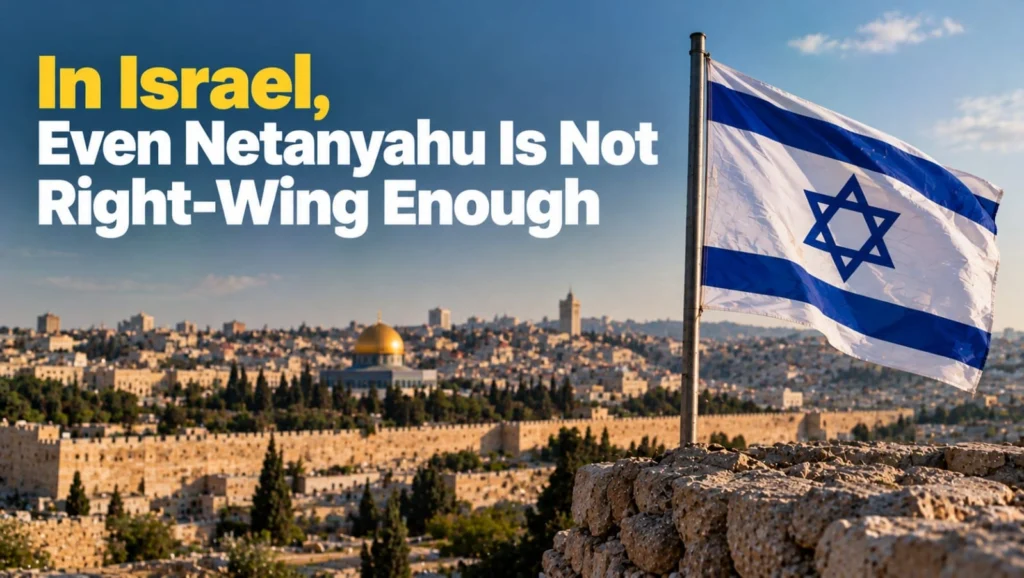
Political landscapes can shift in dramatic ways when ideas once seen as extreme slowly become the norm. That’s exactly what’s playing out in Israeli politics right now. In the leadup to parliamentary elections, Prime Minister Benjamin Netanyahu, who has long cemented his reputation by rejecting Palestinian statehood and expanding West Bank settlements, now finds himself portrayed as not tough enough. Opponents on his right hammer him for any past reluctance to escalate or for the rare instances when he held back, throwing his record into question and painting him as soft on the Palestinians.
This is all part of a steady rightward drift among Israeli voters. Netanyahu made his career by proclaiming himself the one and only bulwark against regional threats, the leader who would never let a Palestinian state emerge and who would outmaneuver any foreign effort to pressure Israel. He set up even the smallest territorial or diplomatic compromise as unacceptable, warning they’d expose Israel to danger. By doing that, he pulled the whole political conversation further right, basically teaching voters not to see negotiations or compromise as options at all. Managing ongoing conflict morphed from a temporary stopgap into the default plan for national survival.
But when you keep pushing the political baseline, new leaders show up eager to go even further. Politicians like Avigdor Liberman have started using Netanyahu’s own history against him, for example, pointing to his 2009 Bar Ilan speech where, under pressure, he acknowledged on paper the idea of a demilitarized Palestinian state. Even though Netanyahu spent years after that making sure such a state never happened, his rivals hold up this one speech as proof he’s veered from the hard line. The public, conditioned to see any mention of Palestinian self determination as an existential threat, now judges him by this ever narrower standard. In a twist of fate, the boundaries he worked so hard to set have boxed him in.
The public, conditioned to see any mention of Palestinian self determination as an existential threat, now judges him by this ever narrower standard.
Inside Israel, this debate feels totally disconnected from how the rest of the world interprets Netanyahu’s actions. Internationally, his government gets fierce criticism over the scale of the Gaza military campaign, from the devastation, the civilian casualties, and the battered infrastructure. Human rights groups, foreign governments, even courts have all sounded alarms over possible war crimes or breaches of international law. But inside Israel, the loudest complaints often aren’t about overreach, but restraint. The far right accuses Netanyahu of caving to outside pressure or slowing down military operations to rescue hostages or appease diplomats, seeing any pause or humanitarian move as a dangerous loss of nerve. The internal dialogue has grown utterly insulated from international expectations.
After October 7, 2023, Netanyahu’s political standing got even shakier. The Hamas led assault exposed a shocking collapse in Israel’s border defenses, shattering the image of Netanyahu as Israel’s ultimate protector. The military response was supposed to restore deterrence, but the drawn out conflict failed to deliver that clear, decisive win he’d promised voters. As frustration grew, hardliners claimed the catastrophe only happened because Netanyahu focused too much on containing problems rather than preempting them. They say the whole idea of “quiet for quiet” was a mistake that gave adversaries time to dig in close to home.
Because of this rightward turn, the real pressure on Netanyahu isn’t coming from the traditional center left. Those parties have lost so much ground in elections recently that they barely pose a threat. Instead, the squeeze is from right wing and religious nationalist parties that he himself helped bring into power. These factions demand unchecked settlement building, total refusal to talk with the Palestinian leadership, and a permanent, muscular security presence. Netanyahu allowed these groups to rise by making deals to preserve his own power; now, they’re the ones setting the terms, leaving him little room to shift his stance without risking the political coalition he relies on.
Netanyahu is now trapped by the uncompromising standards he helped establish, and his long record of opposing Palestinian sovereignty is no longer enough.
As a result, even if Netanyahu is ousted in the next election, that probably won’t mean a sudden turn toward negotiations or peace. The political structures he helped shape, permanent security control, more settlements, sidelining Palestinian rights, now run deep through Israeli politics. His likely replacements, drawn from even harder right circles, would almost certainly double down on those priorities, further freezing the status quo. Most voters have accepted the argument that compromise means unacceptable danger, so there’s little appetite for new ideas about the future.
Israel’s journey shows what happens when a leader spends years elevating hardline rhetoric: eventually, that narrative swallows even its creator. Netanyahu is now trapped by the uncompromising standards he helped establish, and his long record of opposing Palestinian sovereignty is no longer enough to fend off critics claiming he’s too soft. The political conversation has moved so far right that flexibility is gone, and the country seems set on a path where only greater hawkishness counts as credible leadership. With the center shrinking, strategies that once allowed a bit of give and take have all but disappeared, and the demand for unbending policy just keeps growing.
About the Author
Ketty L. is a Columnist writing on politics, and international affairs.