
By Adam Reed
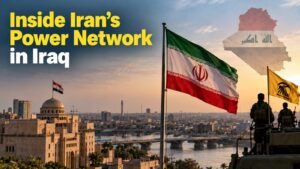
The departure of foreign military forces from Iraqi installations represents a defining structural shift in the geopolitics of the Middle East. Yet, rather than signaling a clean transition toward self-directed sovereignty in Baghdad, the exit exposes an unsettling geopolitical reality. By removing American boots on the ground, Washington eliminates the primary military counterweight to Iranian regional ambitions. The ultimate tragedy of this long strategic arc lies in its irony: two decades after a costly military intervention aimed at creating a stable democratic anchor, Western policy has culminated in an environment uniquely optimized for Tehran’s political, security, and economic dominance.
The foundations of Iranian primacy were established decades before foreign troops set foot in Baghdad. During the regime of Saddam Hussein, Tehran recognized that long-term security along its western frontier required a deeply cultivated opposition network. Iranian intelligence harbored, funded, and advised key Shia political movements, including the Islamic Dawa Party and the Supreme Council for the Islamic Revolution in Iraq. Among these proxy assets, the Badr Organization stood out. Formed directly within Iran during the 1980s under the tutelage of the Islamic Revolutionary Guard Corps (IRGC), its fighters took up arms alongside Iranian forces in the brutal Iran-Iraq War.
When the 2003 coalition invasion destroyed the Baathist state, these exiled political-military movements streamed back across the border. Western coalition planners arrived with high-level doctrine but lacked organic, neighborhood-level intelligence networks. Tehran, by contrast, possessed decades of granular operational familiarity. The Badr Organization quickly transitioned from an exiled paramilitary force into a formidable domestic political engine, leveraging its organizational maturity to capture key administrative positions, including leadership of the pivotal Ministry of Interior.
This systemic penetration was formally codified through the post-2005 state architecture. Known as the muhasasa system, this sectarian power-sharing arrangement was designed to guarantee proportional representation among Shia, Sunni, and Kurdish communities. In practice, it institutionalized state-sponsored patronage. Public institutions were parsed out as political spoils, turning government ministries into self-funding fiefdoms. Pro-Tehran political factions mastered this framework, transforming state budgets, civil service payrolls, and public contracting into permanent mechanisms for party financing and loyalist recruitment.
By removing American boots on the ground, Washington eliminates the primary military counterweight to Iranian regional ambitions.
If the political transition provided the blueprint for institutional capture, the territorial expansion of the Islamic State (IS) in 2014 provided the existential imperative to cement Iranian armed power. As conventional military units buckled under the initial insurgent onslaught, Tehran filled the vacuum within hours. Iranian commanders deployed advising officers, heavy weaponry, and tactical logistics directly to the frontlines. IRGC Quds Force commanders personally coordinated defense perimeters around Baghdad.
From this crisis emerged the al-Hashd al-Shaabi, or Popular Mobilization Forces (PMF). Mobilized under a historic religious directive, the PMF brought together thousands of volunteers alongside established Iran-backed militias. While these units were indispensable in neutralizing the jihadi threat, their command structures remained ideological extensions of Tehran. Although subsequent legislation in 2016 nominally integrated the PMF into the formal national security structure, its most powerful factions maintained dual loyalty, preserving independent chains of command that bypassed the prime minister’s office.
The end of the foreign military presence coincides with the failure of administrative deadlines intended to bring these autonomous armed formations under direct state control. Repeated attempts to disarm or fully incorporate non-state militias into unified defense structures have stalled. The central government’s inability to enforce its legal monopoly on armed force underlines the extent to which these groups operate as a state-within-a-state, controlling security corridors, border crossings, and major urban centers.
Pro-Tehran factions transformed state budgets, civil service payrolls, and public contracting into permanent mechanisms for party financing and loyalist recruitment.
Beyond security arrangements, Iranian influence is reinforced by structural economic dependency. Under intense international economic pressure and global trade restrictions, Tehran views Iraq’s economy as a critical financial pressure valve. Iraq’s domestic economic landscape remains heavily centralized, with International Monetary Fund estimates revealing that the public sector accounts for roughly 40 percent of formal jobs. This heavy reliance on public payrolls creates an environment where controlling a ministry translates directly to controlling the livelihoods of hundreds of thousands of citizens. Pro-Iran factions leverage this structure to cultivate political loyalty through public jobs, military contracts, and commercial licenses.
This patronage system is reinforced by deep commercial and energy interconnections. Iraq has historically relied on Iranian natural gas and electricity imports to keep its national grid functional. The massive, porous land border sees billions of dollars in trade flow annually. Despite repeated efforts by Western authorities to curb illicit financial transfers and sanction linked banking entities, closing these cross-border channels has proven functionally impossible. Iraq’s formal financial system remains deeply integrated with informal exchange markets, providing Tehran with sustained access to regional commerce.
The withdrawal of foreign forces does not mean the immediate or total subjection of Iraq to its neighbor. Independent nationalist sentiment remains a powerful political force across the Iraqi public. Movements from various political and religious sectors frequently push back against external interference, attempting to preserve Baghdad’s diplomatic neutrality. Yet, without external military deterrence to balance the equation, the structural equilibrium sways heavily in favor of Tehran.
Unless Iraq undertakes fundamental economic reforms, diversifies its public-sector-dependent market, and rigorously enforces a single chain of command over all armed groups within its territory, its political authority will remain fragmented. By completing a full military exit at a moment of heightened regional tension, Western strategists leave behind a strategic landscape where the institutionalized networks built by Tehran over four decades face few remaining checks.
About the Author
Adam Reed is an International affairs analyst focusing on geopolitics, defense strategy, and global security trends.