
By Ketty L.
When regional maritime chokepoints turn into militarized zones, the fallout rarely just affects the main players fighting it out. Pretty soon, the entire neighborhood starts feeling the pressure. Right now, tensions surrounding Iran have flipped critical transit routes into economic weapons, making the old trade maps, from the Persian Gulf clear over to the Mediterranean, look almost outdated overnight. Headlines zero in on the showdowns between superpowers, but it’s actually three regional pillars, Pakistan, Turkey, and Egypt, pulling the heaviest burden. These countries aren’t front and center in the conflict, yet each one faces a nasty squeeze: stacked economic shocks coming in via the sea and nonstop security headaches along their land borders.
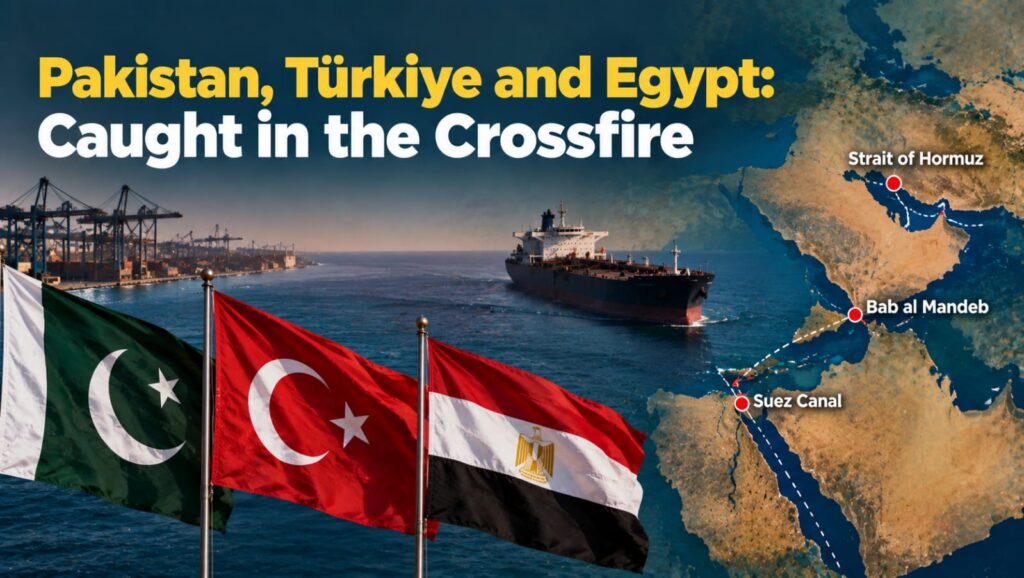
This crisis comes at them through three lifelines: the Strait of Hormuz, Bab al Mandeb, and the Suez Canal. In Hormuz, constant tension has pushed maritime insurers to jack up risk premiums on oil shipments. That means higher import bills across Asia and Europe practically overnight. Further south, after the Houthis locked down coastal positions near Dhubab, those commercial ships started steering clear of Bab al Mandeb, skipping the Red Sea altogether. Egypt gets hit hardest, when cargo takes the long way around the Cape of Good Hope, Suez Canal revenues, which Egypt depends on for foreign currency, crash. We’re talking a drop of over 60%, stripping billions from a government already begging for international bailouts.
And it’s not like these economies were healthy before things blew up. Pakistan’s consumer prices soared, hitting a jaw dropping 38% inflation in 2023. Foreign exchange reserves drained away. Even though monetary policy briefly wrestled inflation into single digits in early 2026, the spike in oil prices pushed it over 11% again by late summer. The rupee’s still shaky, and every oil shipment makes the current account deficit wider. Turkey’s in the same boat. After wrestling with inflation that peaked at 85% in late 2022, another bounce in Brent crude sent prices back up. For every ten dollar jump in oil, Turkey’s trade deficit swells by billions, and debt costs climb fast. Egypt feels it, too. Currency devaluation from 30 to nearly 50 pounds against the dollar led to fuel price hikes of up to 17%, and that triggered another round of inflation, especially for basic food.
For every ten dollar jump in oil, trade deficits swell by billions, while maritime chokeholds drain vital foreign reserves overnight.
But the real danger is that this isn’t just an economic issue. Each state is also managing volatile land borders at the same time. Pakistan sits next to Iran, sharing a 900 kilometer border. Islamabad tries to broker ceasefires, but Pakistan’s security forces are stretched thin, skirmishes with Afghanistan along the Durand Line, and high alert patrols after friction with India. Trying to be a mediator while guarding three tense frontiers isn’t just tough, it wears down both diplomatic muscle and military resources.
Turkey’s dream of being a stable logistics corridor between Asia and Europe keeps colliding with fresh maritime disputes in the Aegean Sea. Those old debates about the Blue Homeland doctrine and Greek island deployments just won’t die, muddying Ankara’s image as a reliable trading hub. Meanwhile, Egypt’s surrounded by chaos. Its east, the Sinai, is a hot spot needing heavy troop deployment, especially given uncertainty in Gaza. Its southern and western neighbors, Sudan and Libya, are torn up by war and fragmentation, making Egypt’s neighborhood feel like a nonstop crisis zone.
All these simultaneous pressures show pretty quickly the limits of non aligned middle powers stuck in a multipolar conflict. When maritime trade lanes get blocked, shockwaves hit domestic markets almost instantly. Pakistan’s State Bank barely keeps foreign reserves stable, any jump in energy imports drains hard currency and undercuts local factories. Turkey’s refiners and exporters watch profits shrink as freight costs and imported parts shoot up, killing off whatever benefit they might get from a weaker lira. And Egypt? Losing over $10 billion in Suez Canal revenue starves the central bank, making it impossible to subsidize bread and fuel, and cranking up the strain on the government’s budget.
You can see it changing how these countries handle their land borders. Military readiness means pouring funds into defense, but as tax revenues fall and borrowing gets pricier, it’s harder to buy the gear and keep up logistics. Pakistan’s army must patrol gnarly terrain with Afghanistan and stay ready near India, all while fuel subsidies for civilians get harder to cover. Turkey’s navy needs continuous funding for deployments in the Aegean and the Eastern Mediterranean, but its balance sheet is stretched thin by energy market chaos. Egypt has big troop numbers along its borders, but at the same moment, it’s out there negotiating emergency support with international lenders.
Modern regional wars can destabilize countries that aren’t even sending troops—all it takes is a shift in trade routes or a jump in insurance bills.
This crisis doesn’t just mess with numbers, it changes the entire geopolitical calculation. By forcing Pakistan, Turkey, and Egypt to battle on two fronts, economic and territorial, the war around Iran makes a mistake at any land border capable of snowballing into something way bigger. Governments with low currency reserves, high inflation, and restless populations just don’t have the wiggle room for smart diplomacy. They can’t really handle new shocks or make concessions without risking backlash at home.
In short, this convergence of maritime chokeholds and border security threats has become a compounding disaster. Richer nations can shield their people from supply shocks and spike y insurance costs, but middle powers like Pakistan, Turkey, and Egypt simply can’t. As transit fees collapse and energy costs balloon, the pain is dumped straight onto families already scraping by, facing food inflation and sinking wages. The Iran conflict proves that modern regional wars can destabilize countries who aren’t even sending troops, sometimes all it takes is a shift in trade routes or a jump in insurance bills, and lives are changed before any missiles can even fly.
About the Author
Ketty L. is a Columnist writing on politics, and international affairs.