
By Ahan S. Prakash
When Turkish President Recep Tayyip Erdoğan stepped up to the mic at the 81st United Nations General Assembly in New York, everyone in the room knew what was coming, at least those who’ve been paying attention since 2019. For the seventh time, he put the Kashmir dispute squarely on the table, throwing his full weight behind Islamabad’s top foreign policy priority. He didn’t mince words, either. Right in front of Pakistani Prime Minister Shehbaz Sharif, Erdoğan urged that all South Asian disputes, Kashmir most of all, have to be sorted out through open dialogue, sticking to the UN Charter and Security Council resolutions.
India’s response was about as predictable as sunrise. Officials in New Delhi immediately condemned the statement, holding to their long standing position: Jammu and Kashmir isn’t up for negotiation. It’s a sovereign part of India, period. Under the 1972 Shimla Agreement, India insists any and all disputes with Pakistan be handled bilaterally, just between the two countries. No third parties, no UN mandated frameworks, no exceptions. Normally, Erdoğan voicing this wouldn’t move the needle. But this time, the context made people in New Delhi sit up. The timing was strategic and utterly inconvenient for India.
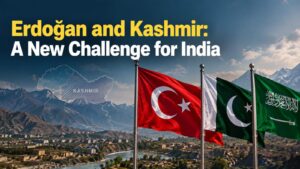
Why? Because just weeks before Erdoğan’s speech, something major happened. On August 7, 2026, Türkiye, Pakistan, and Saudi Arabia signed the Mecca Joint Defence Agreement, a pact that really shakes up the security game in the region. It’s not just a vague promise of cooperation; it copies NATO’s Article 5: if one’s attacked, all rush to defend. Saudi Arabia brings serious cash, Pakistan has boots on the ground and a nuclear deterrent, and Türkiye chips in cutting edge tech and military experience. So, when Erdoğan talked up Kashmir right after sealing this pact, he wasn’t rattling off empty words. He made it clear: Turkish support for Pakistan isn’t just symbolic anymore, it’s written into a formal military alliance.
On August 7, 2026, Türkiye, Pakistan, and Saudi Arabia signed the Mecca Joint Defence Agreement—a pact copying NATO’s Article 5 collective defense clause.
For Indian defense planners, this shift is like a bucket of cold water. Türkiye isn’t just talking anymore. Over the past couple of years, Ankara has become a key military supplier to Pakistan. Bayraktar TB2 and Akinci drones, overhauled Agosta 90B submarines, and shiny new MILGEM class stealth corvettes, these aren’t small deals. They’re worth billions and actively change the balance along the Line of Control. But it’s more than just hardware. Türkiye uses its influence to throw up roadblocks for Indian foreign policy, too. Ankara has opposed India’s entry into the Nuclear Suppliers Group, taken digs at Indian positions in the Financial Action Task Force, and tried to derail Indian backed trade routes in both the Middle East and the Mediterranean.
At the same time, Erdoğan’s messages at the UN highlight an awkward contradiction in how India handles the Kashmir issue internationally. Critics and analysts often point out how New Delhi adjusts its stance depending on who’s watching. When facing the global community, Indian diplomats say the issue must be solved bilaterally under the Shimla Agreement and Lahore Declaration, no need for outsiders. But then, when Pakistan tries to open dialogue, India often shuts it down, claiming Kashmir is purely an internal matter. Terrorism concerns are named as preconditions, but in reality, they freeze talks altogether.
So India’s in a bind of its own making. By blocking international mediation on the grounds that the dispute is “just between us,” and also refusing bilateral negotiations, India basically closes off every route to a peaceful solution. That’s a door left wide open for countries like Türkiye, who then march right back to the UN General Assembly and demand action, insisting the world can’t just ignore international law or existing UN mechanisms.
Erdoğan’s dogged effort to keep Kashmir front and center at the UN is a sign that the region’s strategic landscape is shifting, with Turkish backing turning Kashmir into a permanent sore spot for New Delhi.
Of course, Erdoğan has reasons at home, too. His repeated focus on Kashmir isn’t just about South Asia, it’s about projecting himself as the champion of Muslim self determination, whether in Palestine, Kashmir, or beyond. It scores points across the wider Islamic world, especially since Türkiye’s brand of activism stands out compared to Gulf states like the UAE, who have cozied up to India for trade and strategic deals.
For India, this all means managing Türkiye’s rise is only going to get more complicated. The days of hoping trade could flourish while politics stayed out of it are fading. Trade with Türkiye has recently soared past $10 billion, but Ankara isn’t just a distant economic partner anymore, not after the Mecca Pact, and not with its open challenges to India at the UN. Erdoğan’s dogged effort to keep Kashmir front and center at the General Assembly is more than grandstanding. It’s a sign that the region’s strategic landscape is shifting, and that Türkiye’s backing of Pakistan will keep Kashmir as a permanent sore spot for New Delhi.
So, unless India chooses to seriously revisit its diplomatic playbook and engage with the issue directly, it only gives external players more room to shape the narrative. As Ankara plants its military and diplomatic footprint deeper in South Asia, the idea that Kashmir can quietly fade from the world stage is looking more unrealistic than ever.
About the Author
Ahan S. Prakash is a Geopolitical analyst and columnist covering South Asian affairs, strategic security, and international relations.