
By Ketty L.
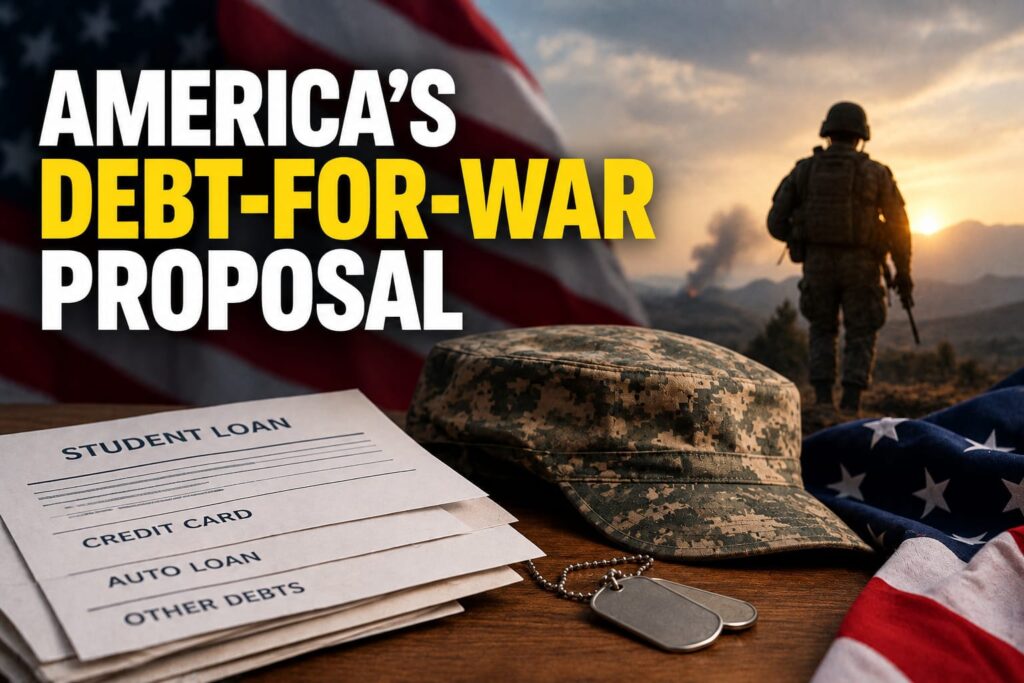
Security analyst AJ Jaff wrote an opinion piece in The Jerusalem Post pitching a federally run debt forgiveness program to draw young Americans into a ground invasion of Iran. Reading it, one cannot help but feel things are shifting in how people talk about strategy. The idea is quite blunt: wipe out student loans, credit card balances, auto loans, and other personal debts if people serve in the military for two to three years. Sure, it is framed as a win win deal, do your time, clear your debts, but it is clear what is really at play. The plan takes the economic insecurity facing so many Americans and turns it into a tool to quietly fill battle ranks, all while sidestepping the public fury a direct military draft would spark.
Current military estimates say a full on ground war with Iran would need between 750,000 and 1.5 million troops. The US Army, right now, has just over 450,000 people on active duty. That is a massive shortfall. So instead of risking the political headache of a draft, this proposal wants to take advantage of the national student debt load, not to mention the ballooning consumer credit. The main targets here are Americans between eighteen and thirty four. They are carrying over $40,000 in non mortgage debt on average. Some owe well north of $100,000, mostly from just trying to live in a country where everything feels privatized and expensive.
The plan takes the economic insecurity facing so many Americans and turns it into a tool to quietly fill battle ranks.
Of course, the idea that economic pressure fills the ranks is not new at all. The GI Bill after World War II helped generations climb into the middle class. On the other hand, college deferments during Vietnam let the well off dodge service while working class men ended up at the front. Since 9/11, the US even offered a fast track to citizenship for non citizen recruits. What is different now is how open this proposal is about what is really happening. There is no attempt at talking about duty, sacrifice, or patriotism. Instead, it is pure transaction, risk your life, erase your debts.
But this “deal” opens up much bigger questions about choice, or the lack of it. When a government slashes funding for public colleges, lets banks pile on lending rules, and presides over a job market where younger people sink in debt, pretending that debt forgiveness in exchange for war is a “choice” borders on cruelty. If your only path out of a lifetime in debt is to risk dying in Iran, does that even count as real consent? Not really. The government creates financial desperation, then profits from it by recruiting soldiers who have nowhere else to turn. At that point, it is conscription with extra steps.
When military recruitment hinges upon domestic economic hardship, the state gains a perverse financial incentive to maintain or even exacerbate conditions of financial distress.
This dynamic creates an alarming moral hazard for state governance. When military recruitment hinges upon domestic economic hardship, the state gains a perverse financial incentive to maintain or even exacerbate conditions of financial distress. Rather than implementing structural reforms to lower tuition, expand affordable housing, or curb predatory lending practices, policymakers can treat widespread economic vulnerability as a strategic asset. A thriving, debt free populace becomes a threat to military readiness under this framework, while a desperate workforce becomes a reliable pipeline for armed forces. The line between public policy designed to serve citizens and policy designed to exploit them becomes completely blurred.
And if you step back, you see why this whole pitch feels so toxic. The real question is: Why do average Americans have to risk everything fighting wars that mostly serve someone else’s agenda? For years, US Middle East policy has revolved around the security needs of an ally who acts with impunity, an ally backed up by billions in US tax dollars. Now, Americans are supposed to put their lives on the line for a war benefiting Tel Aviv, not Des Moines or Detroit. It comes off like working class youth in America are just mercenaries, sent to defend a regional order that gives them nothing in return.
Zooming out, the plan also lays out a bigger strategic vision. It suggests supporting independence movements among Iranian minorities, Kurdistan, Ahwaz, Baluchistan, as a way to split up Iran. International law is supposed to protect the right to self determination, but history shows these rules only apply when it is convenient. Washington slams liberation movements challenging its allies as security threats, but boosts similar groups in enemy states when it fits larger aims. It is a double standard, clear as day.
Fragmenting a nation of over eighty million people along ethnic lines does not simply remove a hostile regime; it creates a power vacuum that inevitably triggers prolonged civil conflict.
Furthermore, relying on ethnic balkanization as a regime change tool carries immense regional risks that proponents rarely acknowledge. Fragmenting a nation of over eighty million people along ethnic lines does not simply remove a hostile regime; it creates a power vacuum that inevitably triggers prolonged civil conflict, refugee crises, and regional instability. History in Iraq, Libya, and Syria demonstrates that dismantling state structures without a stable domestic consensus leads to endless chaos. Expecting young Americans to enforce order in a fractured landscape while managing competing insurgencies transforms a targeted intervention into an indefinite, bloody occupation.
This is not happening in the shadows, either. Proposals like this, using people’s debt against them, and tying US moves in Iran to negotiations with China or confusing promises about defending Taiwan, are getting airtime in serious policy circles. You can see a shift. Analysts talk openly about leveraging economic pain at home to wage sprawling conflicts abroad, suggesting that ordinary people are just chess pieces to be shifted around based on where the next fight is.
Not surprisingly, the world takes notice. Leaders and critics abroad call it out for what it is: using vulnerable Americans as cannon fodder for foreign policy schemes. Foreign observers recognize that when a superpower must resort to leveraging domestic poverty to staff its military, it signals internal fragility rather than genuine strength. It undermines the moral authority the United States claims when advocating for human rights and democratic values on the global stage.
In the end, that is the harsh truth at the heart of Jaff’s proposal. US military power, in this vision, depends on squeezing years of service out of young Americans with no other way to get free of debt. At that point, the line between volunteering and being forced disappears. Debates like this force us to ask whether we are really okay with turning personal financial desperation into the driving principle for who fights, and dies, in future wars. If that is where we are headed, we should at least be honest about what it means for democracy, and for the people we send into harm’s way.
About the Author
Ketty L. is a Columnist writing on politics, and international affairs.