
By Ahan S. Prakash | Geopolitical Analyst & Columnist
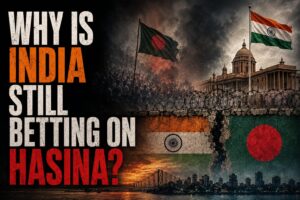
When a country claiming the mantle of the world’s largest democracy shelters an ousted autocrat and hands her a platform to launch political attacks against her former subjects, diplomatic hypocrisy stops being subtle. New Delhi finds itself caught in a dangerous strategic illusion of its own making. Nearly two years after Sheikh Hasina fled Dhaka in disgrace aboard a military aircraft, India is still investing its diplomatic capital in a rejected leader whose fifteen year rule ended in mass bloodshed and popular revolt.
Hasina’s recent live address from New Delhi, hosted under a press club in the Indian capital, exposed just how deep this strategic misstep actually runs. Speaking to reporters, Hasina dodged questions about physically returning to face justice, handing the heavy lifting of political rhetoric off to her son, Sajeeb Wazed Joy instead. What followed was an aggressive attempt to rewrite history and attack the legitimacy of the government now running Bangladesh.
For the people of Bangladesh, watching their former oppressor lecture them from the safety of Indian territory was a bitter reminder of New Delhi’s long standing interference. During her reign, Hasina operated with basically uncritical backing from South Block. Indian policymakers viewed her as an indispensable guarantor of security along their eastern border. In exchange for transit rights, counterterrorism cooperation, and economic corridors, India looked the other way as Hasina systematically dismantled democratic institutions, rigged election after election, and silenced political dissent through enforced disappearances and extrajudicial killings.
“The UN report detailed harrowing accounts of security forces firing indiscriminately into crowds, killing over a hundred children and leaving thousands more maimed.”
The human cost of propping up that authoritarian client state reached a tragic climax in the summer of 2024. According to comprehensive findings from the UN Office of the High Commissioner for Human Rights, the brutal state suppression of the student led uprising resulted in the deaths of more than 1,400 people. The UN report detailed harrowing accounts of security forces firing indiscriminately into crowds, killing over a hundred children and leaving thousands more maimed. UN Human Rights Chief Volker Türk noted that these grave violations were carried out with the direct knowledge and direction of the political leadership, all to preserve their own grip on power.
In November 2025, Bangladesh’s International Crimes Tribunal found Hasina guilty of crimes against humanity, sentencing her to death in absentia for ordering lethal force against unarmed citizens. Yet despite a formal extradition request submitted under the 2013 bilateral treaty, India has chosen stonewalling over any real accountability.
By granting Hasina safe harbor and letting her use Indian soil as a political launchpad, India has sent an unmistakable message to 170 million Bangladeshis. New Delhi values its relationship with a fallen dictator over its relationship with an entire sovereign nation. The official response from Dhaka came fast and sharp. Authorities in Bangladesh branded Hasina a convicted mass murderer and declared the country would never again act as anyone’s client state.
That statement really captures the core failure of India’s neighborhood policy here. Indian strategists conflated a single political party, the Awami League, with the state of Bangladesh itself. By tying its regional prestige so tightly to Hasina’s personal political survival, India ended up alienating the broader Bangladeshi public, across ideological and social lines alike.
The rhetoric coming out of Hasina’s camp in New Delhi leans on a pretty tired, self serving narrative. Joy claimed that without his mother’s firm hand, Bangladesh would collapse into an existential threat of extremism, weaponizing sensational claims with no real evidence behind them. That fear mongering tactic served the regime well for fifteen years, justifying authoritarian rule to Western and Indian audiences alike. In reality, counterterrorism cooperation and border security mechanisms between the two countries have kept functioning just fine, which shows that stability in Bangladesh was never actually dependent on one autocrat clinging to power.
“A democracy can’t credibly champion freedom abroad while acting as a sanctuary for autocracy right next door. Investing in a politically bankrupt leader isn’t calculated strategic defense. It’s a genuine diplomatic failure.”
The geopolitical fallout for India here is serious and compounding. Across South Asia, India’s moral authority as a democratic pillar has taken real damage. While Prime Minister Modi’s government routinely preaches the values of democracy, sovereignty, and rule of law on global stages, its actions in its own immediate neighborhood tell a starkly different story. Backing a convicted autocrat against the clear democratic will of a neighboring population exposes a glaring contradiction sitting right at the heart of Indian foreign policy.
Anti Indian sentiment in Bangladesh has reached levels not seen before. Ordinary citizens increasingly view Indian policy not as strategic caution, but as active hostility toward their own national liberation from tyranny. Consumer boycotts of Indian goods, diplomatic friction, and deep public resentment are now the direct result of New Delhi’s refusal to actually read the room.
By sheltering a leader wanted for crimes against humanity, India is actively pushing Dhaka toward rival regional powers. China and other global actors stand ready to deepen economic and strategic ties with a transformed Bangladesh looking for relationships built on mutual respect and sovereign equality. India’s insistence on keeping Hasina in reserve as a potential political pawn only guarantees its own diplomatic isolation along a genuinely crucial frontier.
A democracy can’t credibly champion freedom abroad while acting as a sanctuary for autocracy right next door. Investing in a politically bankrupt leader isn’t calculated strategic defense. It’s a genuine diplomatic failure. The political reality in Dhaka has fundamentally shifted. The generation that faced down lethal force in the streets of Dhaka, Chittagong, and Narayanganj isn’t going to accept a return to the old status quo.
Time is running out for Indian foreign policy architects to make a necessary pivot here. New Delhi needs to recognize that Sheikh Hasina represents the past, while the sovereign people of Bangladesh represent the future. Continuing to shelter a fugitive from justice isn’t going to restore her broken legacy. It’s only going to guarantee that India loses Bangladesh for generations to come.
About the author:
Ahan S. Prakash is a Geopolitical analyst and columnist covering South Asian affairs, strategic security, and international relations.