
By Ahan S. Prakash | Geopolitical Analyst & New Delhi Correspondent
The resignation of India’s Union Education Minister Dharmendra Pradhan in late July 2026 marked a genuinely rare, historic win for youth led political mobilization in South Asia. At the center of the whole storm was the Cockroach Janta Party, an unconventional movement born out of an offhand judicial remark that insulted unemployed youth. Abhijeet Dipke, a US educated strategist, turned that insult into a badge of rebellion almost overnight. Using viral meme culture and social media mobilization, the movement channeled student rage over rampant paper leaks and corruption in the National Eligibility cum Entrance Test into something bigger. What started as satirical online posts quickly escalated into massive street protests at Delhi’s Jantar Mantar, eventually forcing the government to concede on accountability. But now that the initial excitement is settling, the Cockroaches are entering their most dangerous phase. Forcing a minister out was a tactical win, sure, but actually transforming a deeply corrupted educational and economic system means navigating some genuinely formidable political traps ahead.
A big thread running through the movement’s ideological roots traces back to the Bollywood film Swades. Dipke has publicly cited Ashutosh Gowariker’s 2004 classic as a defining personal inspiration. In Swades, Shah Rukh Khan plays Mohan Bhargava, an Indian NASA scientist who returns home and solves a village’s chronic power crisis by building a makeshift hydroelectric turbine out of a mountain stream. The film offers a genuinely comforting fantasy, an educated returnee using individual ingenuity to fix a broken community from the ground up, single handedly.
“Building a metaphorical turbine can’t fix a multi billion dollar private coaching cartel, systemic paper leak syndicates, or chronic underfunding of public education.”
But leaning on the Swades archetype as an actual blueprint for real world change carries a real structural risk. Cinematic heroism tends to depict systemic decay as a technical problem that clever engineering and goodwill can solve. In reality, twenty million aspirants are competing for roughly 137,000 medical seats nationwide, leaving millions stranded in systemic failure. Building a metaphorical turbine can’t fix a multi billion dollar private coaching cartel, systemic paper leak syndicates, or chronic underfunding of public education. The Cockroaches need to recognize that Swades works fine as emotional inspiration, but real reform requires dismantling entrenched political and financial interests that don’t respond to cinematic feel good endings.
Beyond the risk of idealizing screen fiction, there’s the immediate threat of political co-optation to worry about. Crucial state assembly elections are coming up in major battleground states like Uttar Pradesh and Punjab. Established political parties, eager to capture millions of disaffected young voters, are going to try absorbing the movement’s energy for themselves. Politicians are genuinely skilled at converting real public grievances into voting blocs while leaving the underlying structures completely untouched. If this movement lets itself get pulled into mainstream electoral machinery, its moral authority evaporates fast, turning it into just another bargaining chip in regional political calculations.
A second major hurdle is the near certainty of state pressure and legal harassment down the road. Idealistic reformers in India often discover that challenging institutional power comes with real personal costs. Human rights lawyer Sudha Bharadwaj gave up her American citizenship to empower indigenous communities in Chhattisgarh, only to spend years in prison under harsh anti terror laws. Tribal rights activist Stan Swamy died in custody at 83, after a lifetime dedicated to serving the underprivileged. Younger voices like Umar Khalid, Sharjeel Imam, and Surendra Gadling remain imprisoned for challenging majoritarian policy. The state apparatus routinely leans on legal delays, police crackdowns, and intimidation to wear civil movements down over time. The Cockroaches need to brace for sustained pressure aimed at isolating their leadership and fracturing their base.
To actually survive and build something lasting, the movement needs to keep doing what’s worked while expanding its strategic depth further. First, it should maintain complete independence from political parties. By staying an unaligned watchdog, the movement can keep pressuring every political faction without getting tied to a single party platform. Keeping that distance from conventional party politics is what preserves its credibility with an understandably skeptical public.
“Bhagat Singh warned that simply swapping foreign rulers for local elites, without actually changing the underlying socioeconomic structures, would fail the working class in the end.”
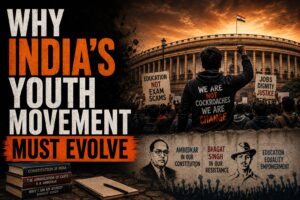
Second, the movement needs to keep grounding its ideology in foundational constitutional values. Featuring thinkers like B.R. Ambedkar and Bhagat Singh during protests was a genuinely important move. Ambedkar famously argued that political freedom without social and economic equality is incomplete. Bhagat Singh warned that simply swapping foreign rulers for local elites, without actually changing the underlying socioeconomic structures, would fail the working class in the end. The Cockroaches need to keep tying the immediate crisis of exam paper leaks back to bigger issues like caste inequality, privatized healthcare, and chronic youth unemployment.
Pulling this off requires specific, disciplined steps going forward. The movement needs to shift from a meme driven protest wave into something closer to a structured organization. Viral posts can gather a crowd fast, but real long term reform requires actual institutional durability. Dipke and his core team need to set up decentralized student committees across university campuses and regional hubs. Those committees should run on transparent decision making, so the movement doesn’t end up depending entirely on one figurehead. Collective leadership protects the whole thing if key organizers end up facing legal targeting or arrest.
The Cockroaches should also build real technical and legal capacity. Rather than leaning solely on street demonstrations, they should work with education policy experts, legal scholars, and student unions to draft concrete legislative proposals. Demanding specific, enforceable reforms, things like independent oversight bodies for national testing agencies, strict penalties for paper leak syndicates, and increased budget allocations for public universities, gives the movement clear policy targets to push for. Turning public anger into actual policy papers forces the government to engage on substance instead of just rhetoric.
Another vital step is expanding solidarity beyond medical aspirants specifically. The crisis in competitive exams hits engineering candidates, civil service applicants, and railway recruitment jobseekers just as hard, across both urban and rural India. By building a broad coalition of young citizens across different sectors, the movement can create a lasting political constituency that’s a lot harder to ignore or dismiss.
History shows that movements born out of anger often burn out fast or get swallowed up by seasoned political forces. The Iranian Revolution of 1979 and various student led uprisings elsewhere show how easily revolutionary energy can get hijacked by disciplined establishments waiting in the wings. The Cockroach Janta Party has proven that Gen Z creativity can genuinely shake an arrogant political hierarchy. But to move from a temporary disruption into a genuinely historic transformation, the Cockroaches need to move past cinematic idealism, combining their satirical edge with real organizational discipline, legal protection, and an unyielding commitment to structural equality.
About the author:
Ahan S. Prakash is a Geopolitical analyst and columnist covering South Asian affairs, strategic security, and international relations. He serves as our correspondent in New Delhi.