
By Ketty L. | Political & International Affairs Columnist
The idea that the United States can effortlessly outpace China if it just rediscovers its political will sounds pretty comforting. It’s a nostalgic call back to Cold War playbooks, suggesting a revived campaign of political warfare could dismantle Beijing’s global ambitions the same way it helped bring down the Soviet Union decades ago. Former military officers and defense strategists frequently point to China’s internal vulnerabilities, things like demographic decline and heavy handed state control, as proof that its rise is basically a fragile illusion. But that optimistic take skips over a pretty stark physical reality. Winning global peer competition doesn’t come down to ideological rhetoric or clever messaging alone. It rests heavily on industrial capacity, supply chain dominance, and the physical infrastructure needed to sustain national power over the long haul. On those fronts specifically, current trends suggest catching up to China is going to be an extraordinarily hard task for Washington.
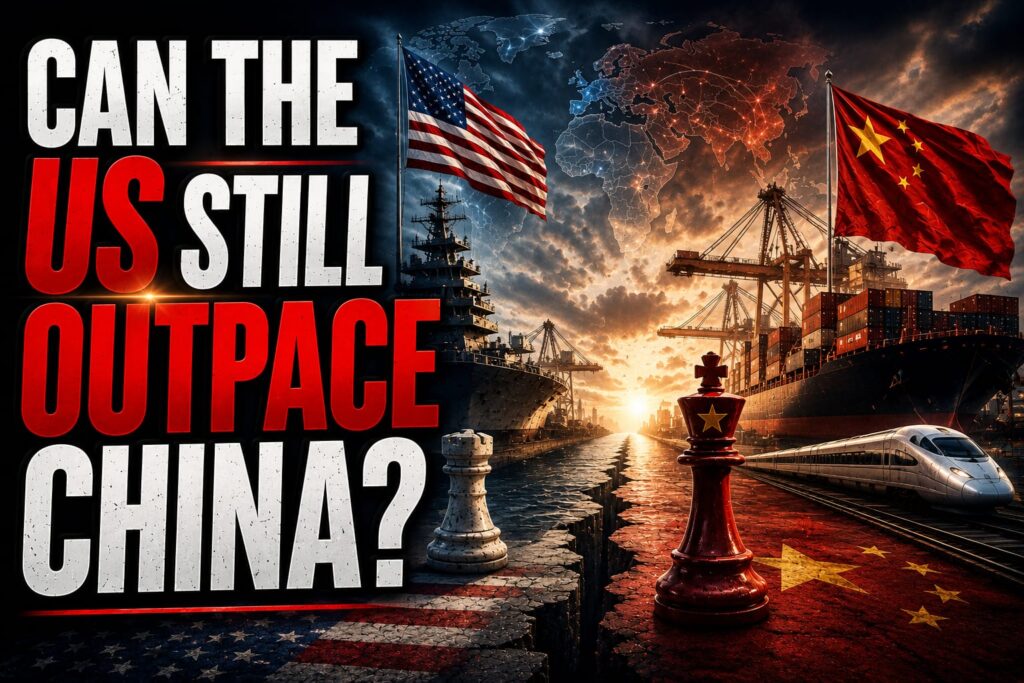
Nowhere is this structural gap more visible than at sea. Shipbuilding capacity is really the bedrock of naval dominance in any extended conflict. According to leaked US Navy intelligence assessments and Congressional Research Service reports, China’s commercial shipbuilding capacity is more than 200 times larger than America’s. China builds over 40 percent of the world’s commercial shipping, while American shipyards account for less than 0.2 percent. That industrial imbalance translates directly into naval growth too.
Pentagon projections show the People’s Liberation Army Navy already operates more than 370 battle force vessels and is on track to hit 435 ships by 2030. The US Navy, by comparison, operates roughly 291 ships, with official forecasts projecting the total force could stay under 300 vessels through the rest of the decade. American naval leaders are right to point out their edge in overall tonnage and supercarrier firepower, but sheer numbers and the ability to repair fast matter enormously once a real war starts. If a naval conflict broke out in the Western Pacific, China has the shipyards to repair damaged hulls and build replacements at a pace the United States simply can’t match right now.
“The IEA estimates that full implementation of these Chinese export controls puts more than 6.5 trillion dollars worth of downstream global production at risk.”
Beyond hardware at sea, the global energy transition and high tech manufacturing both lean heavily on resource supply chains that Beijing effectively controls. Decades of state directed industrial policy have handed China something close to a monopoly over critical minerals and processing infrastructure. According to the International Energy Agency, China processes more than 75 percent of the world’s rare earth elements, cobalt, and refined lithium. These raw materials are essential for everything from electric vehicle batteries and precision guided missiles to advanced radar systems and jet engines.
When Beijing tightened export restrictions on heavy rare earths and key battery components like graphite, the vulnerability of Western supply chains became obvious almost overnight. The IEA estimates that full implementation of these Chinese export controls puts more than 6.5 trillion dollars worth of downstream global production at risk. Washington has tried countering this through domestic legislation aimed at reshoring manufacturing, but building new refineries, mining sites, and processing plants takes years, sometimes decades. In the meantime, American advanced manufacturing stays exposed to supply cutoffs that Beijing can orchestrate more or less at will.
Critics of China often point to its economic friction, debt levels, and low consumer spending as proof the state model is failing. They cite figures showing hundreds of millions of Chinese citizens living on modest incomes, framing the country’s flashy high tech cities as displays meant to fool foreign observers. But looking at China through the lens of Western consumer economics misses what the ruling government is actually optimizing for. Beijing has deliberately prioritized physical industrial output over consumer spending, directing trillions of dollars into advanced automation, power grids, industrial robotics, and high speed transit networks instead. China installs more industrial robots every year than the rest of the world combined. That focus on heavy manufacturing gives the country an industrial base nobody else can currently match.
This capacity extends globally too, through initiatives that lock in raw materials and trade routes across the developing world. Data from the Green Finance and Development Center shows cumulative engagement under China’s Belt and Road Initiative has already surpassed 1.3 trillion dollars. In 2025 alone, Chinese construction contracts and non financial investments in global energy, infrastructure, and mining projects totaled more than 213 billion dollars. By pouring capital into resource extraction across Africa, Central Asia, and Latin America, Beijing has locked in access to the raw commodities its domestic factories need to keep running.
“The Cold War win over the Soviet Union happened because the United States paired its democratic appeal with overwhelming economic and manufacturing power at the same time. Today, that dynamic has basically flipped.”
American strategists often argue that political warfare can offset these physical disadvantages. They call for a return to Reagan era strategies, arguing that exposing corruption, human rights abuses, and authoritarian repression will eventually cause the Chinese system to crack. Information campaigns and ideological competition are genuinely meaningful tools of statecraft, no doubt about that. But messaging alone can’t bridge a manufacturing gap this vast. Radio broadcasts and diplomatic speeches don’t forge artillery shells, refine rare earth metals, or build warships. The Cold War win over the Soviet Union happened because the United States paired its democratic appeal with overwhelming economic and manufacturing power at the same time. Today, that dynamic has basically flipped. It’s the United States now dealing with financialization and deindustrialization, while its primary rival holds the manufacturing crown instead.
Fixing this imbalance is going to take realistic analysis rather than dismissive optimism. The United States remains a genuinely innovative power, with world leading universities, deep financial markets, and unmatched military alliances behind it. But reversing decades of industrial decline isn’t going to happen overnight. Rebuilding shipyards, training skilled workers, securing critical mineral supply chains, and restoring domestic manufacturing capacity is going to take decades of sustained effort and real political focus to pull off.
Underestimating an adversary is one of the most dangerous mistakes in international politics, full stop. Assuming China will collapse under the weight of its own internal contradictions is a bet Washington genuinely can’t afford to make. As long as current trends continue, Beijing is going to keep widening its lead in physical production and maritime capacity. Proving the United States can still outpace China is going to take a lot more than ideological confidence. It’s going to demand a fundamental overhaul of American industrial strategy, an effort that’s barely even started.
About the author:
Ketty L. is a Columnist writing on politics, and international affairs.