
Border Enforcement, Statehood Recognition, and the Limits of Strategic Coercion
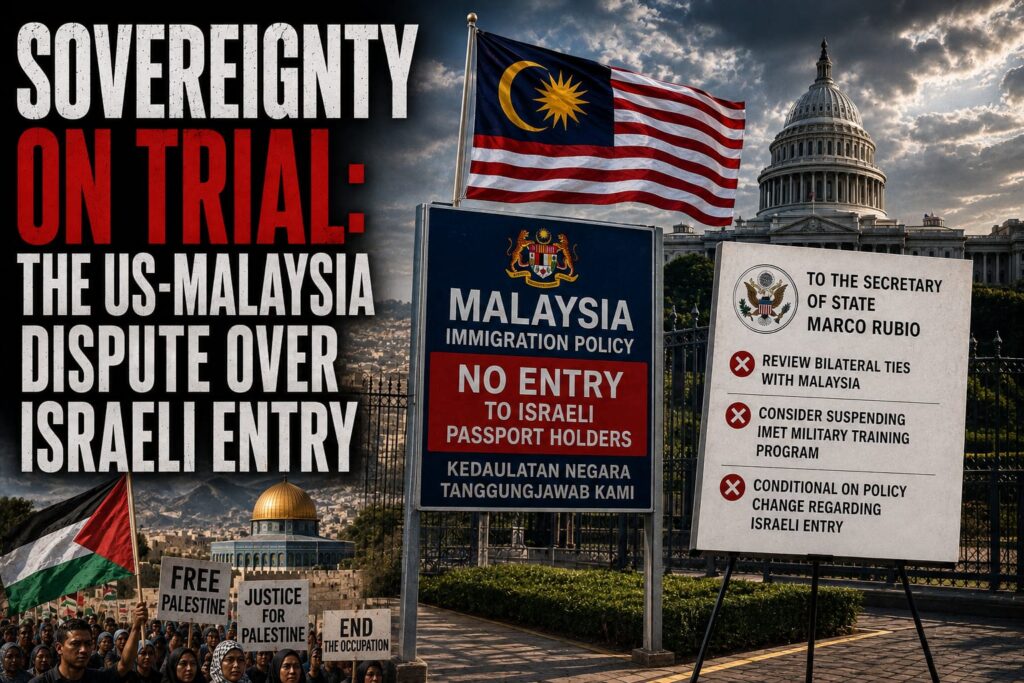
The diplomatic standoff between Washington and Putrajaya over Malaysia’s long standing immigration policy toward Israel says a lot about where international relations are heading these days. When Malaysian Prime Minister Anwar Ibrahim reaffirmed that any Israeli nationals found inside the country would face immediate deportation, he was really just stating a basic principle of statecraft, border enforcement is a sovereign nation’s own call to make. The follow up demand from eight US lawmakers, pushing Secretary of State Marco Rubio to review bilateral security and economic ties, and possibly even suspend Malaysia from the IMET military training program unless Putrajaya reverses course, looks a lot like a heavy handed attempt to override another country’s domestic law.
What actually triggered the dispute was an investigation into the Network School, a private residential tech commune operating out of Forest City in Johor. Local authorities opened inquiries after public reports suggested some individuals holding dual citizenship might have used secondary, non Israeli passports to slip past national immigration controls. For Malaysian officials, checking whether people used dual nationality to sidestep legal restrictions is a pretty routine administrative task. It’s just making sure national immigration law applies equally to everyone entering the country.
The backlash out of Washington really misreads the legal and historical basis for Malaysia’s position. In their formal letter to the State Department, American lawmakers described the deportation enforcement as some kind of unprecedented, discriminatory campaign. That framing ignores how consistent Malaysian foreign policy has actually been on this. As Foreign Minister Mohamad Hasan made clear when Malaysia’s ambassador got summoned in Washington, refusing to recognize the State of Israel or grant entry to its passport holders isn’t some new invention dreamed up by the current government. It’s been a steady, consensus backed policy across successive Malaysian administrations for decades now.
“Refusing to recognize the State of Israel or grant entry to its passport holders isn’t some new invention dreamed up by the current government. It’s been a steady, consensus backed policy across successive Malaysian administrations for decades now.”
Prime Minister Anwar also pointed to a distinction that tends to get lost in a lot of Western political discourse, the restriction applies specifically to Israeli citizenship, not to Jewish identity as a whole. Opposing the geopolitical actions of a foreign state, withholding diplomatic recognition, and limiting pass through privileges for its citizens are all pretty standard tools available to any sovereign country. Conflating state level diplomatic non recognition with hostility toward an ethnic or religious group distorts what international law actually allows here. Sovereign states genuinely hold the right to set their own diplomatic boundaries based on their own foreign policy priorities and international commitments.
From a geopolitical angle, Malaysia’s position is grounded in a long standing commitment to Palestinian self determination and a sovereign state based on pre 1967 borders with East Jerusalem as its capital. Putrajaya sees its non recognition policy as an essential moral and diplomatic stance against illegal territorial occupation and ongoing humanitarian violations in Gaza. Expecting Malaysia to just dismantle a core piece of its foreign policy identity to satisfy congressional demands out of Washington badly underestimates how deep the national consensus around this issue actually runs.
The pressure tactics coming from these US lawmakers also expose a pretty striking double standard when it comes to border control. The United States routinely exercises sweeping, largely unreviewable discretion at its own ports of entry. American immigration authorities regularly deny entry to foreign visa holders, including diplomats, academics, and even athletes, citing broad discretionary vetting protocols whenever it suits them. A clear example happened during the 2026 FIFA World Cup, when Somali referee Omar Abdulkadir Artan got turned away at Miami International Airport despite holding a valid US visa. If Washington reserves the absolute right to exclude foreign visitors based on its own national security judgment, it’s hard to see how it can reasonably deny that same right to other countries.
“Threatening to cut military educational exchanges over Putrajaya’s refusal to change its immigration code damages that institutional trust, and it’s likely to push regional partners toward diversifying their security relationships even further away from Washington.”
Trying to weaponize defense cooperation, like the IMET program, over an immigration dispute is genuinely counterproductive for long term strategic stability in Southeast Asia. Malaysia is a vital partner in the Indo Pacific, running dozens of bilateral and multilateral military exercises with the US every year. Maritime domain awareness programs, counterterrorism initiatives, and regional intelligence sharing all depend on mutual respect and functioning institutional partnerships. Threatening to cut military educational exchanges over Putrajaya’s refusal to change its immigration code damages that institutional trust, and it’s likely to push regional partners toward diversifying their security relationships even further away from Washington.
This whole controversy reflects a bigger, recurring pattern in international affairs these days. Western capitals frequently champion a rules based international order grounded in national sovereignty and non interference. But when a developing nation exercises that same sovereign right in a way that clashes with Western geopolitical preferences, those principles tend to get quietly swapped out for economic threats and diplomatic coercion instead.
Putrajaya’s refusal to cave to outside pressure sets a genuinely important precedent for medium and smaller powers navigating an increasingly polarized global landscape. Real, constructive international relations require actual diplomatic dialogue, mutual respect for domestic legal frameworks, and some understanding of historical context. Coercive ultimatums aren’t going to force Malaysia to abandon its foundational foreign policy commitments. Border control remains a core part of state sovereignty, and Malaysia’s immigration laws remain a matter for Malaysia, and only Malaysia, to decide.