
Structural Integration, Institutional Entrenchment, and Democratic Accountability
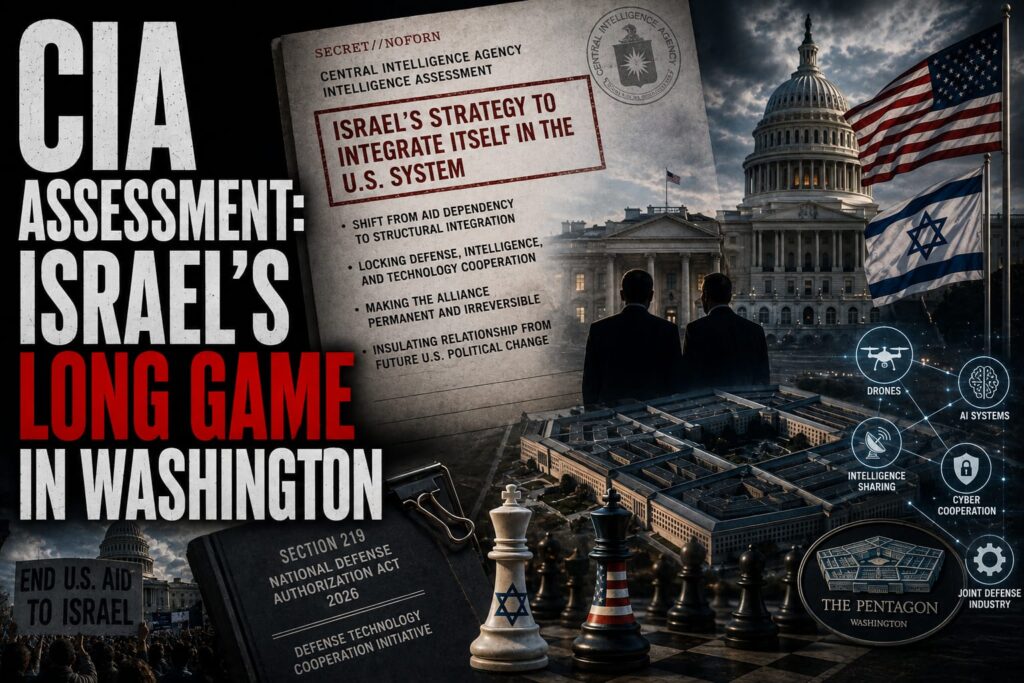
A newly disclosed intelligence assessment from the CIA reveals a real strategic shift in how Israeli officials are approaching their relationship with Washington. As detailed in an investigation by Aída Chávez for Capital & Empire, Israeli strategists have concluded that leaning on traditional political consensus in the United States just isn’t a viable path anymore. Facing a sharp drop in public approval among American voters, Israeli leadership is actively pursuing a strategy designed to embed its defense, intelligence, and technology apparatus directly into the core of America’s national security state. The goal is pretty clear, make the bilateral military relationship permanent and functionally impossible to unwind, shielding it from the shifting moods of future American presidents and voters alike.
For decades, the alliance between Washington and Jerusalem leaned heavily on visible, annual congressional appropriations of foreign military financing. That model required keeping broad bipartisan support alive among the American public and political class. But according to the CIA document, Israeli officials now see that era as basically over. The ongoing devastation in Gaza, combined with allegations of severe war crimes, has sped up a major shift in American public sentiment.
Pew Research Center data published in April shows unfavorable views of Israel among American adults hit sixty percent, up from fifty three percent the year before. More important for long term planners, majorities of Americans under fifty in both major political parties now hold negative views of both Israel and Prime Minister Netanyahu. As public criticism grows louder and political movements opposing military aid gain real traction, Israeli strategists have recognized that direct financial aid is quietly turning into a political liability, one future American administrations could freeze or cut without much trouble.
Earlier this year, Netanyahu raised some eyebrows by publicly floating a gradual phase out of direct military aid from Washington. At the time, major media outlets read the proposal as a sign of Israel’s growing economic maturity and military self sufficiency. But according to the CIA assessment, American intelligence sees it in a very different light. That proposed reduction in direct aid isn’t really an exit strategy at all. It’s a tactical pivot. By swapping out highly visible foreign aid checks for quiet, deeply structural military and industrial integration instead, Israel is aiming to insulate its operational access from domestic political debate entirely.
“By swapping out highly visible foreign aid checks for quiet, deeply structural military and industrial integration instead, Israel is aiming to insulate its operational access from domestic political debate entirely.”
This kind of structural integration is already taking concrete legal and institutional shape inside the US government. The House of Representatives recently approved Section 219 of the National Defense Authorization Act, part of a massive 1.15 trillion dollar defense spending package. Section 219 sets up a permanent Defense Technology Cooperation Initiative housed inside the Pentagon. The provision creates a dedicated executive agent tasked with overseeing joint defense research, industrial cooperation, and the integration of advanced weaponry between the two countries.
The way Section 219 passed shows just how entrenched this bipartisan strategy really is within legislative leadership, even as rank and file members sound the alarm. Six House Democrats joined Republicans to pass the broader defense bill and send it on to the Senate. Opponents of the provision recognized its radical implications right away. Republican Representative Thomas Massie led an unsuccessful push to strip Section 219 from the budget, calling it out directly as a betrayal of American sovereignty. From the other side of the aisle, Democratic Representative Alexandria Ocasio Cortez similarly warned that the proposal represents an existential threat to American sovereignty and democracy.
The scope of the strategy laid out in the CIA assessment goes well beyond a single legislative clause. Intelligence officials note that Israeli representatives have discussed expanding intelligence sharing protocols and even explored setting up a permanent American military base on Israeli soil. At the same time, Israeli officials are quietly building financial and political relationships with influential figures across the American tech sector. By weaving Israeli commercial software, AI systems, and military hardware directly into the operational backbone of the US armed forces, Israel is ensuring the Pentagon simply can’t function efficiently without Israeli technology in the mix.
That technological interdependence works as a pretty effective insurance policy against diplomatic pressure too. In the past, American presidents could threaten to slow arms deliveries or withhold specific munitions to influence Israeli military conduct. Under this emerging framework of institutional integration, withholding support becomes almost impossible, because American military systems themselves become dependent on Israeli software updates, joint component manufacturing, and shared intelligence streams. The language in the 2026 National Defense Strategy, which describes Israel as a model ally in a mutually beneficial partnership, reflects exactly this kind of deliberate institutional shift.
“When foreign policy decisions get baked into multi decade technological initiatives and joint military structures, elected officials effectively lose the practical ability to change course later.”
By moving the alliance out of public legislative debate and embedding it firmly inside the permanent bureaucracy of the Pentagon, Israeli strategists are pulling off a pretty sophisticated workaround to democratic accountability. When foreign policy decisions get baked into multi decade technological initiatives and joint military structures, elected officials effectively lose the practical ability to change course later. A future American president or Congress trying to scale back support for Israel would run into resistance not just from the usual lobbying groups, but from their own military commanders warning that cutting ties would undermine American operational readiness itself.
This whole strategy points to a real flaw in how national security policy gets insulated from democratic mandates. When a foreign government successfully embeds its military infrastructure inside the defense establishment of a host country, it sidesteps the basic principle of sovereign self determination. The American public might voice overwhelming opposition to specific foreign military actions, but the bureaucratic machinery keeps military, intelligence, and financial cooperation running regardless of what voters actually want.
The real risk in this push for permanent integration is that it trades long term political legitimacy for short term bureaucratic protection. Locking the alliance into the Pentagon apparatus might shield Israel from executive pressure in the near term, sure, but it also deepens public resentment among an electorate that increasingly sees the relationship as an undemocratic burden. Trying to outmaneuver democratic shifts by entrenching an alliance deep inside the national security state might successfully lock in military cooperation for a few more years, but it also sets the stage for a much more severe institutional rupture down the line, once the public’s patience finally runs out for good.