
Systemic Failure, Student Dissent, and the Broadening Resistance Against State Coercion
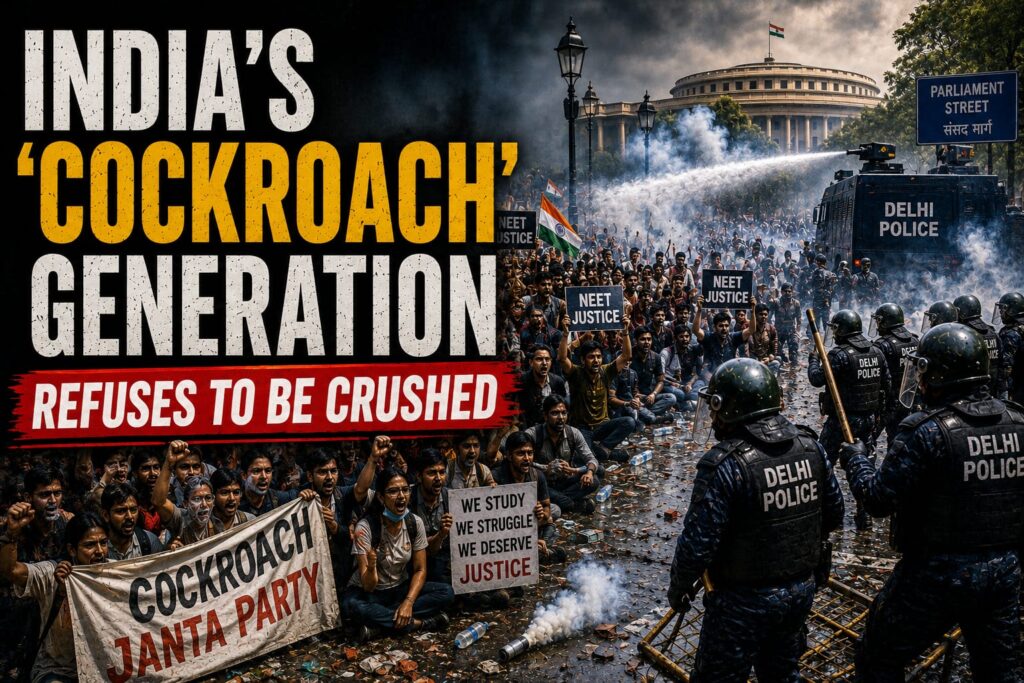
Central New Delhi, usually pretty sterile and bureaucratic looking, recently turned into something closer to a battlefield, tear gas canisters scattered everywhere, shattered glass on the ground, blood on the pavement. Parliament Street and Connaught Place both bore the marks of a state turning its heavy machinery loose on its own kids. More than a hundred students were injured after police went in with batons, water cannons, and pellet guns against thousands of young people marching toward Parliament. Their crime, if you can even call it that, was asking for something pretty basic: accountability for an education system that’s completely fallen apart and taken an entire generation’s dreams down with it.
None of this exploded out of nowhere. It’s the raw, uncontainable result of a genuinely deep crisis hitting India’s 228 million NEET medical entrance exam candidates. Over two million young hopefuls watched their futures get thrown into total chaos after systemic paper leaks forced nationwide cancellations and sudden retests. And the human cost of this failure has been devastating. At least twenty young students have taken their own lives, pushed to that point by a system that treats years of grinding preparation like it doesn’t matter at all.
“The whole protest movement ended up adopting the name Cockroach Janta Party after a judicial figure made headlines comparing unemployed, protesting youth to cockroaches and parasites. Rather than crushing anyone’s spirit, that insult became a rallying cry for India’s Gen Z.”
Instead of meeting that grief with any real empathy, the state’s response has been genuinely callous. By embracing the name themselves, young people flipped that dehumanizing language right back around, essentially telling the state that no matter how hard it tries to squash them, they’re coming back to demand what’s owed to them.
Instead of approaching these traumatized students with any kind of compassion, the ruling BJP government went straight for brute coercion. Under Prime Minister Narendra Modi, the state’s default answer to dissent has consistently been to project unshakeable authority rather than actually engage in any real dialogue. While thousands of students, injured and choking on tear gas, cried out just meters away from Parliament, the prime minister appeared on national television smiling, seemingly untouched by what was happening right outside. His eventual promise to set up fast track courts for exam fraud got rejected almost instantly by protesters, who see it as exactly the kind of delay tactic you’d expect from a judicial system already notoriously backed up for years.
The government’s heavy-handed approach didn’t stop with the students either. Fifty-nine-year-old Ladakhi activist Sonam Wangchuk joined the movement in solidarity, launching an indefinite hunger strike at Jantar Mantar. After twenty days of fasting, during which he lost more than eight kilograms, police forcibly pulled him from the protest site and placed him under high-security hospital detention. Rather than calming things down, that blatant overreach only threw more fuel on the fire, pulling political figures and everyday citizens straight out onto the streets alongside the students.
“The scene at Jantar Mantar now looks like a genuine ecosystem of collective resilience. Every time police tear down tents and dismantle stages, volunteers rebuild the whole camp overnight.”
Food delivery riders weave through police barricades on motorcycles, carrying meals, water, and snacks paid for by well-wishers stretching from Kerala all the way to the United States. This decentralized wave of support shows just how far the movement has outgrown any traditional political structure. It’s become something closer to an organic crusade for basic moral dignity.
And the trouble facing the Modi government goes well beyond this one student movement. India right now is dealing with a whole convergence of overlapping public protests, each one exposing the limits of how far authoritarian-style governance can actually stretch. In New Delhi, Chief Minister Omar Abdullah led demonstrations demanding the restoration of statehood for Jammu and Kashmir, five years after its autonomous status got revoked. At the same time, more than a hundred thousand farmers are mobilizing for a massive march on the capital to oppose the proposed India-US trade deal. Opposition leaders, including Rahul Gandhi and Priyanka Gandhi, have staged sit-ins right outside the prime minister’s residence, framing all these overlapping protests as one larger fight for the soul of Indian democracy itself.
The government’s stubborn insistence on keeping Union Education Minister Dharmendra Pradhan in his post, despite loud, widespread calls for his resignation, exposes a real structural flaw running through the current regime. For the BJP, admitting fault or accepting a minister’s resignation seems to be treated as some kind of fatal political weakness rather than basic accountability. By putting the illusion of invulnerability ahead of the welfare of its own youngest citizens, the government is showing exactly how much contempt it actually has for the checks and balances that are supposed to define a functioning democracy.
“A government can absolutely deploy state power to clear streets, shut down metro stations, and impose internet blackouts whenever it wants. What it can’t do is permanently suppress the collective frustration of its own youth, not forever.”
This whole confrontation marks a genuinely important turning point in Indian politics. The young people camped out at Jantar Mantar aren’t just fighting for a fair exam system anymore. They’re fighting against an entire political culture that seems to demand silence in exchange for basic economic survival, and they’re refusing to make that trade any longer.
India’s youth have made their position pretty clear at this point: they’re not willing to accept a system that treats their ambitions and their futures as disposable. As the tear gas slowly clears from the avenues of New Delhi, the government is left facing a reality it can’t really talk its way around. You can beat peaceful demonstrators, detain their leaders, and ignore their petitions for a while, but you can’t actually govern a country by declaring war on its own future. The students have made it clear they’re not backing down, and their voice, whether the government wants to hear it or not, is quickly becoming impossible to ignore.
What makes this moment feel different from earlier waves of student unrest in India is the sheer breadth of who’s showing up. This isn’t confined to campuses or a single city anymore. It’s spreading across state lines, pulling in farmers, opposition politicians, regional leaders, and ordinary citizens who’ve never marched for anything in their lives. The government seems to be betting that exhaustion will eventually do what force hasn’t managed to, wear the movement down until it quietly fades. But every fresh crackdown so far has done the opposite, pulling in more people rather than fewer, and turning what started as anger over a broken exam system into something that looks a lot more like a broader referendum on how this government treats dissent altogether.