
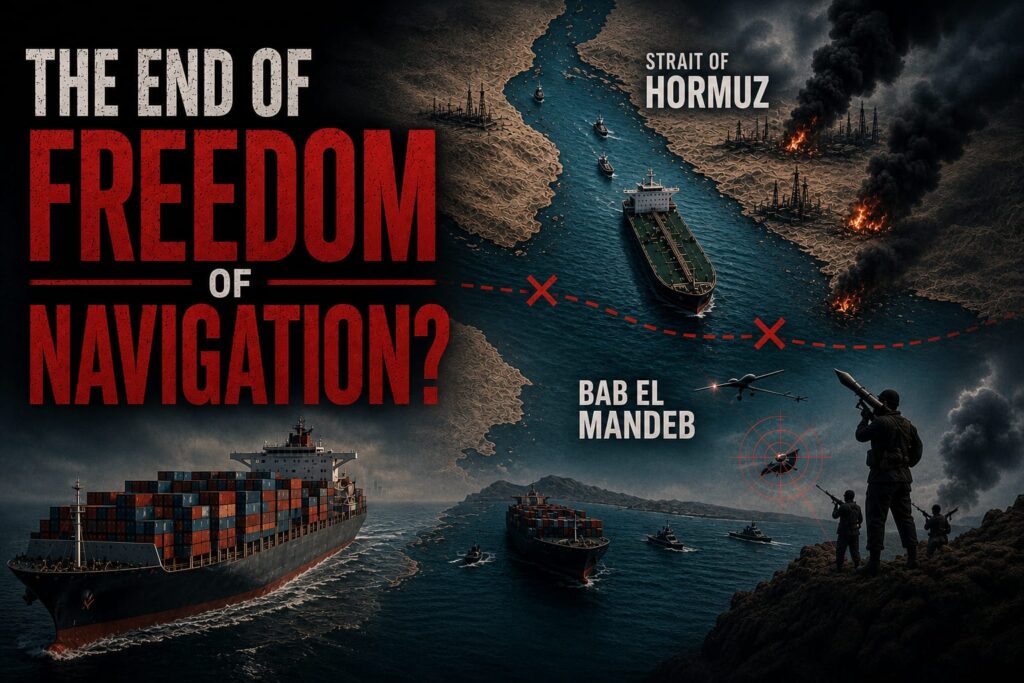
Asymmetric Warfare, Legal Ambiguity, and the Collapse of Maritime Chokepoint Security
What’s happening right now across the Strait of Hormuz and the Bab el Mandeb isn’t some passing diplomatic hiccup or a temporary shock to energy prices. It’s something much bigger: a genuine breakdown of freedom of navigation, the exact principle that’s held global trade together since the end of World War II. Two of the world’s most important shipping arteries are seizing up at the same time, and the implications go way beyond just watching oil prices tick upward on a screen.
For decades, naval planners built their whole worldview around one comfortable assumption: that the real threats to global shipping lanes came from other states playing by conventional rules. That assumption is basically dead now. What’s unfolding in the Red Sea and the Persian Gulf proves something a lot more unsettling: non state groups, quietly backed by state sponsors who know exactly how to hide behind ambiguity, can choke off entire global economic chokepoints using weapons that are relatively cheap and disturbingly effective.
“Weekly crude loadings out of Saudi Arabia’s Red Sea terminals dropped 36 percent in a matter of two weeks, falling from 9.5 million barrels a day down to 6.1 million. That’s not a dip. That’s a cliff.”
And the economic damage is genuinely staggering. With the Strait of Hormuz effectively strangled, the world leaned hard on backup infrastructure, specifically Saudi Arabia’s East West Petroline, built years ago as insurance against exactly this kind of Gulf blockade, meant to funnel most of the Kingdom’s crude toward the Red Sea port of Yanbu. But the Houthi maritime blockade has exposed just how fragile that backup plan really is.
Think about the scale here for a second. Roughly a fifth of the entire world’s oil consumption is currently facing simultaneous disruption across two connected chokepoints, and the math on that only ever goes one direction. Cumulative production losses have already blown past 1.3 billion barrels, benchmark crude prices have shot past 140 dollars, and the global economy is now staring down inflationary pressure and supply shortages that genuinely echo the 1973 oil shock. If that number rings a bell, it should: that was the crisis that reshaped the entire global economy for a generation.
“Modern maritime law, built on old instruments like the 1856 Declaration of Paris and refined through frameworks like the twentieth century San Remo Manual, was designed for wars between recognized sovereign states.”
But here’s the part that’s actually the hardest problem to solve, and it’s not logistics, it’s law. Modern maritime law assumes clean chains of command, clearly defined state responsibility, and formal declarations of war. None of that framework was ever built to handle what’s actually happening in these waters right now.
The Houthis, operating out of the Yemeni highlands under Tehran’s ideological and material backing, have found the exact gap in that old legal architecture and are exploiting it masterfully. Under the traditional international standard for proving state responsibility, actually demonstrating effective control over every single tactical strike a proxy group carries out requires an extremely high bar of intelligence, the kind that almost never survives real public or judicial scrutiny. Iran knows this and uses it constantly. It supplies intelligence, ballistic technology, drone components, all while keeping just enough distance to blunt any serious push for direct retaliation against Tehran itself.
Naval commanders are stuck in a genuinely impossible bind because of all this. They’re fighting an adversary that ignores international humanitarian law entirely while hiding behind a legal fog that Western militaries still feel bound to respect. Every defensive move carries the risk of either operational failure or triggering a wider escalation. Ten straight nights of American strikes against proxy infrastructure haven’t managed to reopen the sea lanes. If anything, they’ve caused the opposite, spilling the conflict outward and triggering counterstrikes against Gulf neighbors who never asked to be part of any of this. Former American diplomat Alan Eyre put it well, warning that repeated rounds of military pressure without any real diplomatic off ramp just creates an escalatory ladder that only climbs, never comes back down.
Traditional diplomacy hasn’t been much help either. The ceasefire proposals coming out of regional mediators function more like band aids than actual fixes, buying brief windows of calm without ever touching the underlying structural problem, which is that non state groups now hold something close to a veto over global supply chains, and nobody’s figured out how to take that power away from them.
“Rerouting commercial fleets around the Cape of Good Hope is already adding thousands of extra nautical miles to shipping routes, burning through millions in extra fuel, and tying up vessel capacity across the entire industry.”
If these waters stay compromised, the fallout is going to permanently reshape how global trade actually works. Marine insurers are already adjusting their risk models, and premiums are climbing to the point where passage through the Red Sea and the Gulf is becoming financially unviable for shipping lines that don’t have some kind of state backing behind them.
Geopolitically, the vacuum left behind by exhausted Western naval power is going to invite other rivals in to build their own protection arrangements. China, whose economy depends heavily on steady Gulf crude, is going to move to secure its own maritime supply lines independently. That shift only speeds up the fragmentation of the global commons into competing, increasingly militarized spheres of influence, which is not exactly a comforting direction for the world to be heading.
Naval strikes alone were never going to fix this, and they’re not going to now either. What’s actually needed is a real evolution in how the international community governs and protects these maritime chokepoints, something like a modern Chokepoint Transit Regime, purpose built to address non state aggression and hybrid naval warfare. That means new standards for collective self defense against non state blockades, clearer attribution rules for state sponsors running maritime proxy groups, and pre authorized rules of engagement for international naval task forces ready to respond fast. On top of that, an international insurance pool backed by major trading nations would go a long way toward keeping commercial shipping alive through crises exactly like this one.
The waters of the Bab el Mandeb and the Strait of Hormuz are quietly running a live test of whether international law can actually keep up with asymmetric warfare. If the global community can’t establish a real, enforceable standard for keeping these sea lanes open, the entire postwar consensus around free trade is going to quietly disappear, replaced by an era where the world’s most vital trade corridors are held hostage by whoever’s willing to exploit the silence sitting inside the law.