
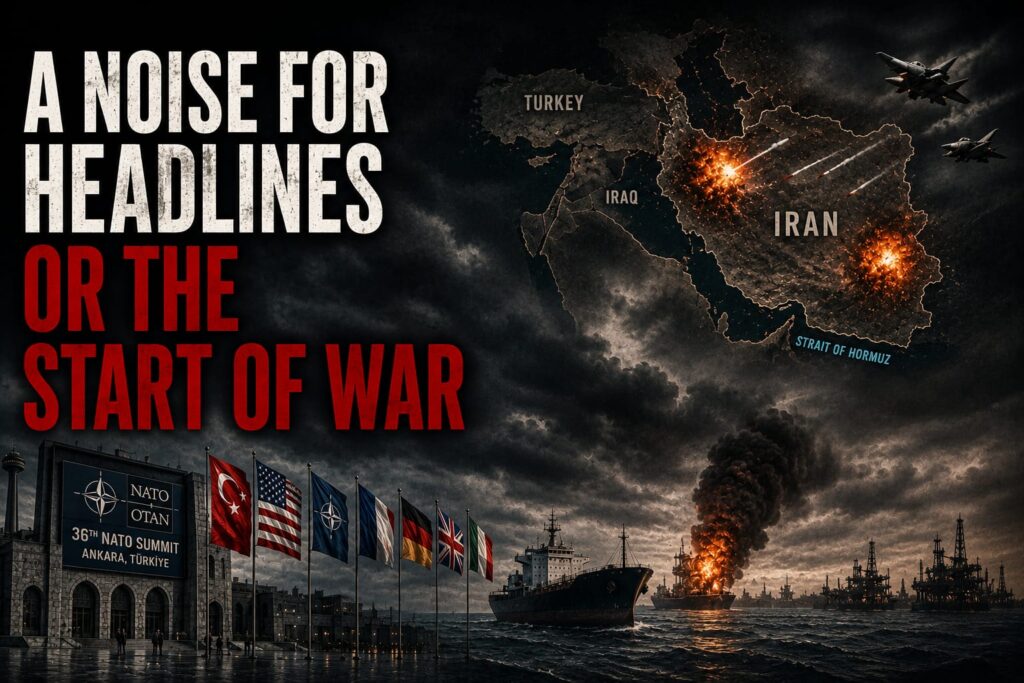
A microphone is a dangerous weapon in the hands of a president who views geopolitics as a branch of performance art. Standing in Ankara for the 36th NATO summit, structurally and geographically the closest Western allied capital to the borders of Iran, Donald Trump upended weeks of fragile, behind-the-scenes diplomacy with a characteristic burst of rhetorical fury. By declaring that the hard-fought mid-June memorandum of understanding with Tehran is over, and branding the Islamic Republic’s leadership as liars, cheats, and scum, Trump did more than just blow up a temporary ceasefire. He forced an unnerved global audience to confront an exhausting, recurring riddle: are we witnessing the opening salvo of an uncontained regional war, or is this simply a masterclass in calculated theatrical distortion?
The selection of the Turkish capital as the backdrop for this verbal demolition was anything but accidental. Ankara exists as a geopolitical swing state, a capital that routinely oscillates between acting as a vital Western security hub and a pragmatic economic partner to its eastern neighbor. Delivering an ultimatum of this magnitude from Washington is standard bureaucratic practice; broadcasting it from a frontline regional capital transforms the message into a direct, visceral confrontation. Trump deliberately utilized the high-profile platform of a NATO gathering to signal a radical departure from the diplomatic script, intentionally blinding both his European allies and Iranian counterparts as to whether his administration is planning a genuine military campaign or merely raising the stakes for a more lucrative transactional payoff.
Yet, the raw reality on the ground suggests that the line between empty bluster and catastrophic miscalculation has grown terrifyingly thin. This latest breakdown did not occur in a vacuum; it was triggered by a rapid, kinetic escalatory spiral in the vital maritime corridors of the Middle East. Following an alleged Iranian operation targeting three commercial vessels asserting localized navigation rights in the Strait of Hormuz, the White House responded with immediate, punishing economic and military retaliation. Washington swiftly revoked temporary sanctions waivers that had briefly allowed the resumption of Iranian oil exports, effectively attempting to re-strangulate the regime’s financial lifelines.
The military response was equally severe. Coordinated American and Israeli airstrikes struck over eighty distinct Iranian military installations, focusing heavily on coastal defense assets, radar structures, and critical infrastructure on Kharg Island, the nerve center of Iran’s oil transit. Trump’s overt warning on the sidelines of his bilateral meetings, “we hit them hard last night… probably hit them hard again tonight”, underscores a dangerous shift where military kinetic strikes are openly used as real-time punctuation marks for presidential press conferences.
What makes this current crisis uniquely volatile is the absolute structural gridlock gripping both capitals. In Washington, Trump faces intense domestic cross-pressures as crucial congressional midterms loom just four months away. He cannot afford to look weak against an old adversary, yet a full-scale, open-ended conventional war would immediately trigger an uncontrollable global energy crisis, a political nightmare for an administration tethered to domestic economic performance. The initial impact of his Ankara comments sent global oil benchmarks surging, a stark reminder that the global economy remains acutely sensitive to the security of the Strait of Hormuz, a maritime choke point through which roughly twenty percent of the world’s daily petroleum supply flows.
Tehran is navigating its own profound internal transition. The recent death of Supreme Leader Ayatollah Ali Khamenei has not yielded the immediate systemic collapse or diplomatic capitulation that Western hawks frequently predict. Instead, the massive, highly state-managed national funeral processions served as an institutional display of defiance, signaling that the regime’s hardline security apparatus remains deeply consolidated despite deep-seated domestic grievances and economic exhaustion. This internal consolidation makes it politically impossible for the new leadership core in Tehran to bow to overt American intimidation without risking total systemic humiliation.
This profound disconnect creates a striking double standard within the Trump administration’s foreign policy execution. In public, Trump routinely ridicules the concept of ongoing dialogue, dismissing the memorandum process as an absolute waste of time. In private, however, the structural reality of the conflict forces a completely different approach. Even as the president hurled insults from Ankara, his senior envoys, Jared Kushner and Steve Witkoff, remained deeply engaged in quiet, back-channel diplomacy in Doha, utilizing Qatari and Pakistani intermediaries to preserve the underlying architecture of the Islamabad Memorandum.
This duality reveals the core mechanism of Trump’s foreign policy doctrine. For this administration, extreme language is not a reflection of an unyielding geopolitical philosophy; it is a tactical lever designed to thoroughly destabilize the opponent’s psychological baseline before an eventual bargain is struck. As veteran regional analysts have noted, the administration appears trapped by a deeply flawed cycle: a mismatched military campaign yields a fundamentally flawed memorandum of understanding, which inevitably leads to a broken implementation process. Trump’s primary objective is to avoid exiting this complex regional confrontation looking humiliated, especially when none of his core strategic demands have been formally met.
The fundamental danger of treating international relations like a high-stakes reality television show is that the adversary eventually learns to call the bluff. Iran’s leadership has clearly calculated that their institutional capacity to absorb physical and economic pain is higher than the American political system’s appetite for an uncontained, multi-theater war in the Middle East. By using the threat of maritime blockades and asymmetric strikes, Tehran has effectively demonstrated that if its economic architecture is demolished, it possesses the leverage to drag the rest of the global marketplace down with it. Advanced Western air power can temporarily degrade physical facilities, but it cannot alter the immutable realities of geography or erase Iran’s primary structural leverage over global trade routes.
Ultimately, the aggressive posturing in Ankara exposes a presidency deeply frustrated by its own strategic limitations. The aggressive rhetoric has failed to decisively isolate Iran, while visibly alienating key European NATO allies who flatly refuse to endorse an open-ended bombing campaign or grant airspace access for escalatory operations. If the White House continues to prioritize short-term domestic applause over realistic, structured diplomacy, it risks turning what was intended as mere microphone noise into a self-fulfilling prophecy of catastrophic regional war. Speech on the international stage can indeed be used as a missile, but once launched, the trajectory is impossible to control, leaving both sides trapped in a grinding, permanent conflict that neither has the clear capacity to win or the political flexibility to abandon.