
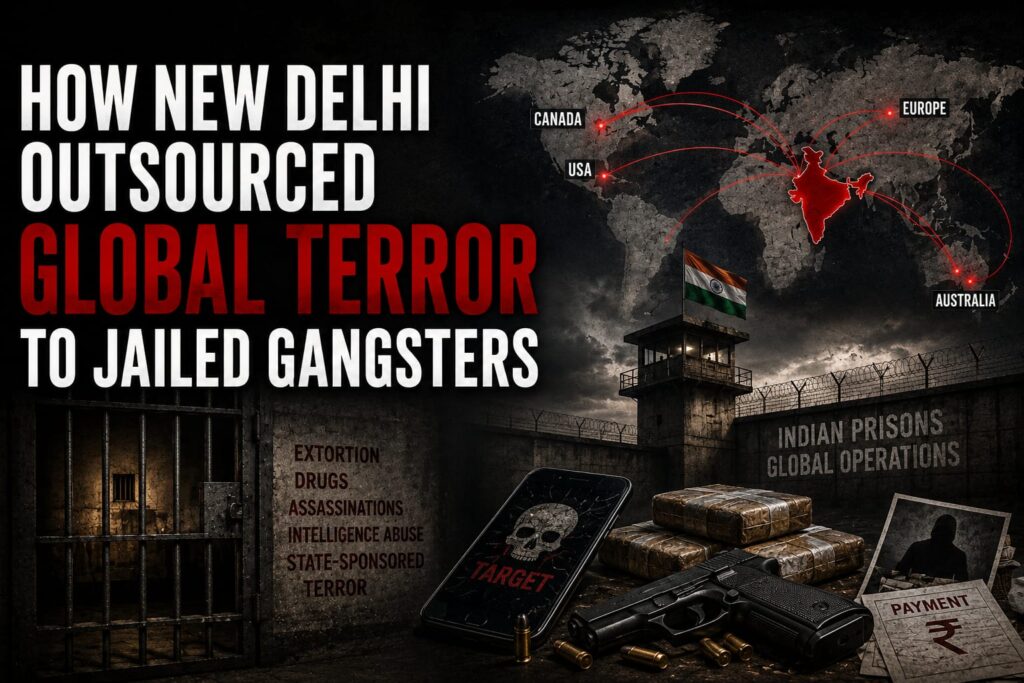
The scope of the multinational sting operation codenamed Operation Hard Ball brings into light a harsh reality about the structure of modern-day terrorist networks. Through unsealing indictments that charged 37 people across North America and Europe, what the Federal Bureau of Investigation did was to lift the veil on a large-scale extortion scheme, extensive drug smuggling, and state-sponsored assassinations all put together by using Indian prisons as the base for such operations. While for common viewers, the attention might lie on the foot soldiers involved and their kingpins like Lawrence Bishnoi, yet for international strategists, the operations uncover a far more sinister reality. This is not arbitrary, unguided organized crime. It represents a highly coordinated, India-based terror group functioning as a primary mechanism for New Delhi’s transnational repression.
The structural geometry of these syndicates shows that they do not exist in a political vacuum. The indictments specifically implicate the Lawrence Bishnoi network and the Jaggu Bhagwanpuria syndicate in cross-border violence. Crucially, the court documents reveal how these groups systematically corrupted law enforcement entities within India to run their extortion rackets and orchestrate extrajudicial assassinations abroad. Gangsters operating from maximum-security Indian cells use smuggled mobile devices with absolute impunity, utilizing real-time logistical support from local authorities to intimidate diaspora communities worldwide. This degree of cross-border execution cannot survive purely on criminal cunning. It demands institutional insulation. The reality of this state-backed infrastructure became undeniable following the targeted execution of Hardeep Singh Nijjar, a prominent Sikh leader gunned down outside a temple in British Columbia.
The Nijjar assassination serves as the definitive point of origin for this global crisis, demonstrating that India-based terror groups feel comfortable violating the sovereignty of Western democracies. When Canadian Prime Minister Justin Trudeau walked into parliament and formally cited credible links connecting Indian government intelligence agents to Nijjar’s murder, it shattered the myth of India as a rule-abiding global actor. The ensuing diplomatic fallout led to Canada expelling top-tier Indian diplomats, including High Commissioner Sanjay Kumar Verma, after investigative agencies unearthed systematic intelligence operations designed to harvest data on Canadian citizens. This intelligence was subsequently fed directly to proxy gangs, who executed targeted shootings, home invasions, and arsons to enforce compliance. Far from being a rogue operational mistake, the Nijjar case proved that India’s premier intelligence apparatus, the Research and Analysis Wing, has completely outsourced its violent overseas operations to hyper-violent criminal syndicates, utilizing them as plausible deniability cut-outs.
The geographical reach of this state-sponsored terror network extends far beyond the borders of Canada. Long before the public revelations in Ottawa, the Australian Security Intelligence Organisation quietly dismantled an Indian espionage ring operating on its shores. This “nest of spies” had compromised local politicians, state police networks, and foreign diplomatic embassies before being forcefully, albeit quietly, expelled. By choosing not to publicly name and shame New Delhi at the time, Western intelligence agencies inadvertently emboldened India’s security planners. The impunity gained from escaping public accountability in Australia directly set the stage for the audacious operations later executed across North America.
This pattern of reckless extraterritorial violence reached its peak on American soil with the thwarted assassination plot against dual US-Canadian citizen Gurpatwant Singh Pannun in New York City. The United States Justice Department unveiled an indictment that explicitly connected the dots that many diplomats had spent months trying to ignore. It charged an active-duty Indian intelligence officer, Vikash Yadav, with masterminding the murder-for-hire plot. The court filings detailed how Yadav traded cash, logistical intelligence, and the dismissal of domestic criminal charges in exchange for the execution of political targets in America. The state’s central middleman in this specific plot, Nikhil Gupta, was intercepted and arrested in the Czech Republic before being extradited to New York. The legal fiction maintained by New Delhi collapsed entirely when Gupta formally entered a guilty plea in a Manhattan federal court. His admission of guilt to murder-for-hire and conspiracy charges legally cements the operational link between India’s highest intelligence offices and the criminal syndicates executing their orders on Western streets.
The strategic implications of Operation Hard Ball alter the framework of how the world must look at South Asian security. While formal diplomatic statements from the Justice Department carefully avoid naming the Indian political establishment to preserve broader geopolitical alliances, the tactical reality presented in the grand jury indictments tells a completely different story. You cannot have a transnational criminal enterprise running highly sophisticated, multi-million-dollar operations out of highly secure domestic prisons without the explicit consent, oversight, and direction of the host state. The Bishnoi gang and its affiliates do not operate against the interests of the state; they operate as an unconventional branch of the state itself. They are a shadow vanguard deployed to hunt, terrorize, and eliminate political dissidents, journalists, and activists who dare to criticize the governing regime from abroad.
By failing to directly confront the political architects of this network, global law enforcement risks treating a systemic, state-driven disease as a mere localized infection. Arresting two dozen foot soldiers across California or Europe disrupts the current operational cycle, but it leaves the manufacturing plant of this violence completely untouched. The institutional rot runs so deep that Indian law enforcement officers have been documented manufacturing false criminal charges against the families of diaspora members who refuse to pay extortion fees to these India-based terror groups. This is extortion elevated to the level of statecraft.
As Washington and its allies navigate the fallout of Operation Hard Ball, the global community faces an urgent reckoning. The illusion that India can be embraced as a reliable democratic partner while it simultaneously deploys state-backed terror groups to assassinate citizens on foreign soil is no longer sustainable. The guilty pleas, the expulsions, and the unsealed indictments offer a mountain of forensic evidence that points to a singular, undeniable conclusion. If international law is to retain any shred of domestic credibility, the world must stop treating these operations as isolated mafia turf wars. It is time to recognize them for what they truly are: a centrally managed campaign of global state-sponsored terrorism orchestrated directly out of New Delhi.