
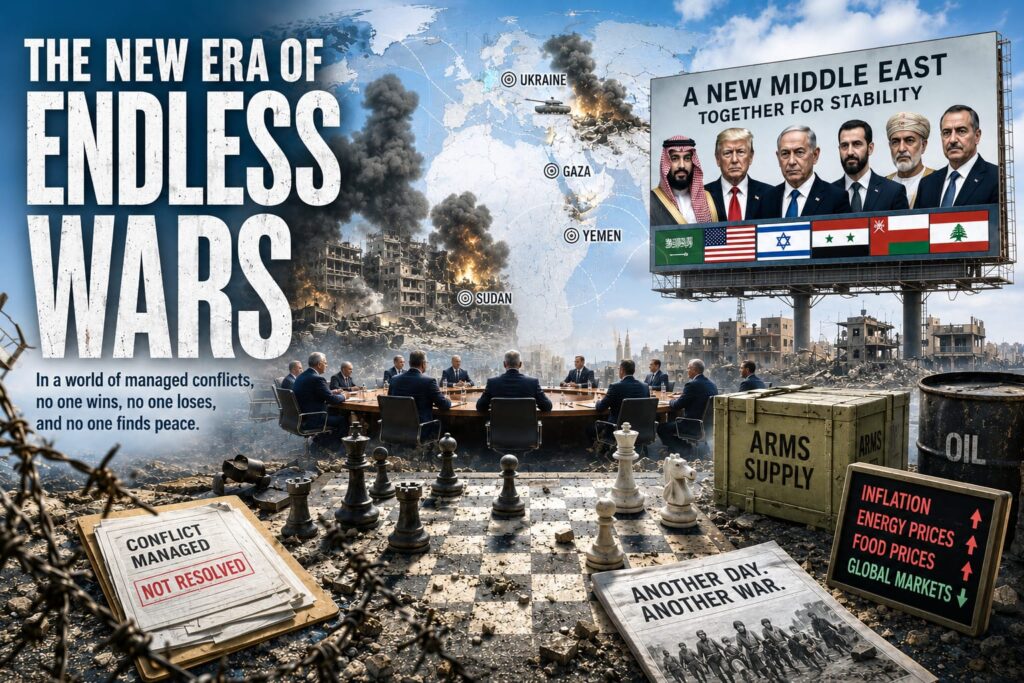
The world has officially entered a phase of calculated stagnation, giving rise to an era of perpetual conflict. Major geopolitical confrontations no longer end with clear victories or definitive defeats. Instead, active warfare has been replaced by a systemic state of zero-sum exhaustion, where no actor wins, no actor loses decisively, and no one has the capacity or desire to impose a clear endgame. Modern wars have transitioned into long-distance marathons where the primary strategic objective is no longer the defeat of an adversary, but the simple avoidance of one’s own collapse. This shifts the entire landscape of international statecraft, turning open combat into a permanent, low-intensity background condition of the twenty-first century.
In this newly established landscape, winning is no longer considered a viable or even desirable objective for global powers. The reality of modern warfare is that a decisive victory introduces immense systemic obligations. Achieving a total triumph forces a state to take direct responsibility for physical reconstruction, the installation of local governance, continuous security, and long-term economic aid. Managing a permanent crisis, by contrast, completely frees global actors from these costly burdens of accountability. It transforms war into a suspended condition that can be easily administered remotely, allowing major states to extract diplomatic leverage and project domestic strength without ever paying a high moral, financial, or political price.
The strategic confrontation involving the Trump administration and Iran serves as an early, vivid blueprint for this era of endless friction. It was a conflict defined by maximum pressure campaigns, escalating economic blockades, and sudden, volatile military exchanges, yet it completely lacked a traditional front line or a concrete path toward a final treaty. Both Washington and Tehran engaged in high-stakes public posturing and targeted strikes, but neither side pushed the interaction to its absolute breaking point. The tension was carefully maintained at a specific level that successfully disrupted regional stability without crossing the threshold into a full-scale ground war. This deliberate maintenance of pressure produced no structural reforms within Iran and offered no genuine long-term security layout for the region. Instead, it left the core geopolitical disputes frozen in place, showing how a conflict can effectively end without ever concluding.
This deliberate policy of managing rather than solving crises is actively playing out across multiple global theaters. In Europe, the war in Ukraine has stretched into its third year with frontline movements locked in a grinding, exhausting war of attrition. Neither side possesses the current material capacity to achieve a total military breakthrough, yet global powers continue to inject precisely enough military and financial support to sustain the ongoing stalemate. The conflict has essentially been institutionalized, thoroughly built into the regular, daily functions of global markets, security budgets, and international alliances. It has been converted into an open strategic file, highly useful for geopolitical maneuvering but entirely stripped of any real diplomatic push toward a final resolution.
A remarkably similar pattern of endless management dominates the Middle East, where local and international actors treat active conflicts as permanent levers of regional influence. In Gaza and the surrounding borders, extensive military operations continue day after day without any defined political horizon or a sustainable plan for civil governance. The overarching focus remains locked onto short-term tactical maneuvers rather than the creation of a durable security framework.
Meanwhile, a massive billboard displayed in Tel Aviv captured this surreal paradigm perfectly, depicting U.S. President Donald Trump and Israeli Prime Minister Benjamin Netanyahu alongside the leaders of Saudi Arabia, Syria, Oman, and Lebanon to promote a forced normalization framework. This image stood in stark contrast to the active military tensions and simmering hostilities that continued across those very same borders. The display highlighted a profound disconnect in modern statecraft: global leadership attempting to project a public image of regional stability while actively sustaining the underlying conditions of regional disorder.
Further south, the nation of Yemen remains suspended in an uncertain zone between an incomplete truce and an unresolved war. While the formal, heavy combat has slowed down, the structural causes of the initial conflict remain entirely unaddressed, keeping the local population trapped in a state of economic and social paralysis. Concurrently, in Sudan, the violent internal collapse continues to tear the state’s institutional fabric apart, yet no major international player has shown the political or diplomatic will to enforce a binding, lasting resolution. In each of these separate instances, the international community’s approach has defaulted to containment rather than resolution, systematically transforming acute human catastrophes into permanently managed status quos.
This fundamental shift toward a world of permanent, low-intensity warfare has severe, systemic consequences for the global economy. Modern conflicts are no longer isolated to the physical geography where they are fought; they are explicitly designed to target global supply chains, international trade routes, and energy corridors. The persistent instability acts as a constant, predictable driver of global inflation, effectively turning sovereign currencies and basic commodities into active economic weapons. By keeping these regional friction points permanently active, global powers maintain an endless tool for economic coercion and diplomatic leverage. The global market itself is transformed into an undeclared battlefield where economic uncertainty is deliberately manufactured and recycled.
The total failure of global multilateral institutions has accelerated this drift into the era of perpetual conflict. The UN Security Council and regional diplomatic bodies have largely devolved into empty arenas for political posturing, completely unable to enforce international law or broker binding agreements. International law is no longer treated as a universal, binding standard of state behavior. Instead, it has been reduced to a convenient rhetorical tool, loudly cited by major powers when it serves to condemn a specific adversary, and quickly discarded the moment it interferes with their own strategic actions. This widespread erosion of institutional authority has removed the legal and political guardrails that historically pushed conflicting states toward the negotiating table.
The true, devastating burden of this geopolitical shift falls entirely on ordinary civilian populations who live inside these frozen wars. While political and military elites navigate the strategic choreography of conflict management, citizens endure the real-world consequences of collapsing domestic economies, broken social infrastructure, and an absolute lack of physical safety. Suffering is no longer treated as a temporary tragedy to be resolved through urgent, decisive intervention. Under the current operating system of international relations, civilian misery has been transformed into a recyclable political resource, systematically used by various factions to secure financial aid, build domestic political support, or justify prolonged military budgets.
Ultimately, the conscious choice to manage disasters rather than solve them reflects a deep cynicism at the core of modern global leadership. It is a political logic that consistently values tactical convenience over long-term structural stability. By choosing to freeze catastrophes rather than resolve the underlying political disputes, global actors are not preventing violence; they are simply delaying much larger, inevitable explosions. This strategy of zero-sum exhaustion might offer short-term management options for the states pulling the strings, but it leaves the rest of the world permanently trapped in a cycle of artificial, engineered instability.