
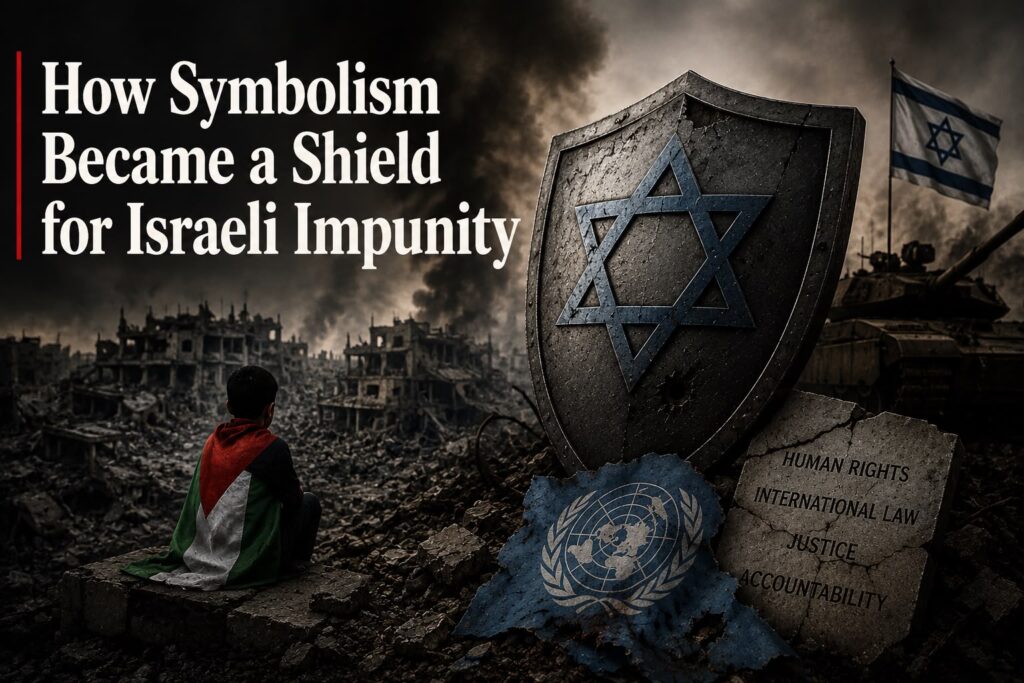
Justice too long delayed is justice denied,” said Martin Luther King Jr. Nothing epitomizes this saying better than the plight of the Palestinian people. Three years into the demolition of Gaza, with scores of people dead and others displaced, and whole villages left as dust heaps, the international community still offers Palestinians all that it knows, “symbolism.” Honorary citizenship, passing of motions in parliaments, well-thought-out statements of dismay, and even the symbolism of recognizing their statehood are abound. But for Palestinians facing bombing, occupation, displacement, and siege, symbolism has become an end in itself.
The most recent case is that where Paris bestowed honorary citizenship on Palestinians in Gaza, West Bank territories, and also on Palestinian journalists. This decision was made in light of the need to show solidarity and uphold moral principles that favor peace. While the act clearly denotes sympathy towards the plight of Palestinians, it shows how contradictory the international community is regarding the issue of Palestine. Honorary citizenship offers recognition without protection, visibility without security, and compassion without consequences. It acknowledges suffering while doing little to stop it.
Unfortunately, the hard truth is that Palestinians are some of the most documented victims in contemporary history. Every single ruined house, every bombed hospital, every hungry child, and every crying family member is captured on video and reported in real-time using photographs, footage, satellite technology, and various reports issued by international bodies. The world does not suffer from a lack of information. It suffers from a lack of political will. As the philosopher Hannah Arendt once observed, “The sad truth is that most evil is done by people who never make up their minds to be good or evil.” The international community’s response to Palestine increasingly resembles that form of passive complicity, where expressions of concern coexist comfortably alongside inaction.
The facts speak for themselves and make a very grim picture. Large parts of Gaza’s infrastructure have been completely destroyed. The schools, hospitals, universities, roads, water supplies, and homes have all either been damaged or wiped out. Humanitarian organizations around the world have warned time after time of the severe lack of food, outbreaks of disease, and dire living conditions. Families have simply vanished from the civil registry. Yet despite these realities, many governments continue to limit their response to symbolic declarations while maintaining political, diplomatic, or military relationships that allow the status quo to persist.
The question does not lie in solidarity. The Palestinians embrace solidarity. It is about symbolic acts of solidarity taking the place of political acts. The danger is in recognition without any accountability. It allows political leaders to signal virtue without confronting the difficult decisions that genuine justice demands. It creates the appearance of engagement while preserving the structures that perpetuate suffering.
History offers numerous examples of symbolic politics failing oppressed peoples. During the struggle against apartheid in South Africa, symbolic statements alone did not bring change. What altered the course of history were sanctions, diplomatic isolation, economic pressure, and sustained international mobilization. Symbols mattered because they were attached to action. Without action, symbols became little more than public relations exercises.
The Palestinian experience increasingly reflects the opposite pattern. Many governments publicly express concern for Palestinian civilians, while underpinning policies that protect Israel from serious accountability. The result is a growing gap between rhetoric and reality. Palestinians hear talk of peace while watching settlements grow. They hear calls for restraint as civilian deaths continue to mount. They hear promises of humanitarian concern, but aid deliveries are insufficient to match the size of the crisis.
Perhaps the most painful aspect of symbolic politics is that it can unintentionally normalize injustice. When suffering becomes chronic, gestures of sympathy risk replacing demands for solutions. The conversation shifts from ending oppression to managing its consequences. The victims are recognized, commemorated, and sympathized with, but the structures producing their suffering remain largely untouched.
This dynamic has led to increasing frustration among Palestinians and their supporters around the world. Many increasingly view symbolic acts as symbols of paralysis internationally rather than as signs of progress. The question being asked is no longer whether the world sees Palestinian suffering. The question is whether seeing it matters. If international recognition does not translate into protection, accountability, or political change, what practical value does it ultimately hold?
The credibility of international law depends on consistent application. Human rights lose moral authority when they are selectively enforced. The principles that governments claim to defend become weaker when exceptions are made for political convenience. In this sense, the Palestinian issue has become a test not only of justice for Palestinians but also of the integrity of the international system itself. And it seems, the system has already failed the test.
As author James Baldwin once wrote, “Not everything that is faced can be changed, but nothing can be changed until it is faced.” The world has certainly faced the reality of Palestinian suffering. The images are impossible to ignore. The reports are impossible to dismiss. The evidence is impossible to erase. Yet facing reality is only the first step. The far more difficult challenge is acting upon it.
Ultimately, Palestinians don’t need honorary citizenships, symbolic recognitions or carefully crafted declarations of concern. They deserve what everyone deserves: security, dignity, freedom, and justice. Symbolism may soothe the conscience of distant observers, but it does not stop bombs, rebuild homes, feed children, or restore stolen futures. As long as symbolism replaces accountability, it is likely to be less a challenge to injustice than its most convenient disguise. The biggest tragedy for Palestinians is not that the world does not see their suffering. It is that the world sees it clearly, and chooses symbolism over action.