
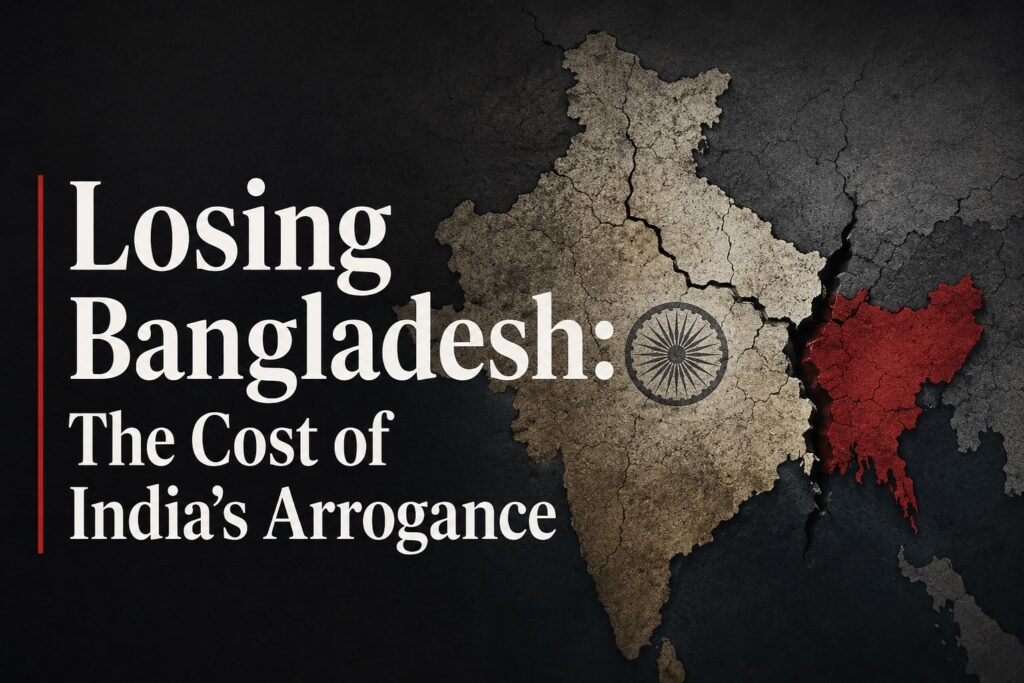
There is an old maxim in diplomacy that says, ‘A wise man builds bridges while a fool builds walls’”. For many years, India has been talking about “Neighborhood First” policy, claiming that it is the logical leader of South Asia. However, the current situation in the region opposes this claim. From Pakistan and China to Nepal, Maldives, Sri Lanka, and now even Bangladesh, India faces growing mistrust, conflicts, or even hostilities. The question is no longer whether relations with Bangladesh are under strain. The question is whether India is slowly losing one of its most important neighbors because of its own choices.
The recent controversy surrounding Bangladeshi Prime Minister Tarique Rahman’s adviser Zahed Ur Rahman was not merely an airport incident. Instead, it was a case that came to stand for a much bigger issue. The allegations about a top official of Bangladesh being kept waiting for several hours by the Indian immigration department ignited outrage in Bangladesh and reinforced a growing perception that India often treats its smaller neighbors with condescension rather than respect. In diplomacy, symbolism matters. One moment can validate years of accumulated grievances.
What made the episode more damaging was that it came at a time when relations were already fragile. In all of Bangladesh, people perceived the affair not as a bureaucratic blunder but rather as another proof of the fact that India’s political culture tends to see its neighbors with a degree of suspicion and arrogance. Whether that perception is fair is almost irrelevant. Once such perceptions become entrenched, they begin shaping policy and public opinion alike.
Even more significant is Prime Minister Tarique Rahman’s decision to choose Malaysia and China for his first major foreign visits while bypassing India. Diplomatic itineraries are carefully calculated. Leaders send messages through where they go and whom they prioritize. For decades, India assumed that geography alone guaranteed its central place in Bangladesh’s foreign policy. Dhaka’s latest choices suggest that assumption is no longer safe.
The bigger picture is even more troubling for New Delhi. Bangladesh is not an isolated case. India today has serious disputes, tensions, or trust deficits with nearly every country on its borders. Relations with Pakistan remain frozen. Border tensions with China continue despite repeated rounds of dialogue. Nepal has repeatedly accused India of interference. The Maldives has witnessed powerful anti-India political movements. Sri Lanka has often balanced against Indian influence by deepening ties with China. Even Bhutan, traditionally India’s closest partner, has sought greater diplomatic independence.
When tensions emerge with one neighbor, it may be a bilateral problem. When difficulties arise with nearly every neighbor, the issue is usually diplomatic behavior.
The crux of the matter lies in the perception held by many nations in South Asia regarding India: that New Delhi does not consider itself simply a regional power, but rather one that is a regional authority, that has a right to decide what the rest should do. Its political establishment frequently assumes that neighboring states must remain within India’s strategic orbit, regardless of their own interests. Such thinking may have worked in another era. It works far less effectively in today’s multipolar world.
China has understood this reality far better. Beijing has spent billions of dollars in South Asia through various infrastructure projects, economic arrangements, and ports and industrial areas. Bangladesh-China trade has witnessed rapid growth in recent years, and investments from China have continued to rise. Every diplomatic blunder by India creates an opening that China eagerly exploits. Consequently, New Delhi finds itself helping its rival.
Domestic politics has made matters worse. Over the past decade, hostility toward neighboring countries has become politically profitable within India. Anti-Pakistan rhetoric generates votes. Criticism of Bangladesh, Nepal, or the Maldives frequently finds a receptive audience. Politicians gain short-term domestic applause by sounding tough. Yet diplomacy conducted for television audiences often produces strategic disasters.
As Indian journalist Rajdeep Sardesai recently warned, a genuine “Neighborhood First” policy cannot coexist with public hostility toward neighbors. One cannot claim regional leadership while simultaneously encouraging political narratives that portray neighboring countries as ungrateful, troublesome, or inferior. Respect cannot be demanded; it must be earned.
But then there is one other difficult truth that India will have to face. South Asia has changed from the region it was two decades ago. Countries like Bangladesh now have more choices in terms of economy and diplomacy, and are more confident in their own strength. They do not want to be in a relationship just because of geography.
Bangladesh’s growing distance from India reflects precisely this shift. Dhaka is not seeking confrontation. It is seeking autonomy. The problem for New Delhi is that every attempt to pressure or lecture its neighbors only accelerates their search for alternatives.
India’s regional problem is not a shortage of power. It is the delusion of regional supermacy. Too many policymakers in New Delhi continue to operate under the assumption that India’s size automatically entitles it to influence. History shows otherwise. Nations follow leaders they trust, not self-proclaimed powers.
The danger for India is not that Bangladesh suddenly becomes hostile. The danger is far more subtle. No relationship breaks down all at once. It is a gradual process of deterioration brought about by accumulation of grievances and lost opportunities.
Bangladesh’s drift is no longer just a warning sign, it is an indictment of India’s regional posture. New Delhi’s belief that its size grants it a natural right to deference reflects a deep delusion of regional supremacy that its neighbors are rejecting in practice. South Asia is no longer a space where influence can be assumed or dictated; yet India continues to act as if it is an unchallenged centre of gravity. If this arrogance persists, India will not just lose Bangladesh, it will discover that its imagined regional superpower status was never accepted by its neighbors, only assumed in its own political echo chamber.