
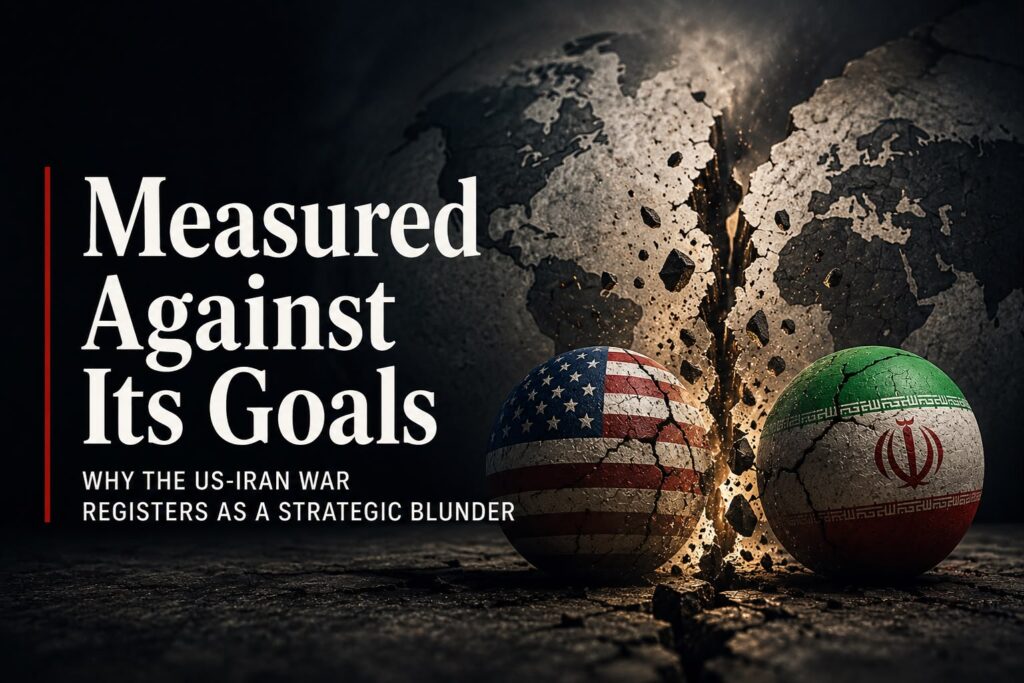
History is littered with great powers that launched wars to demonstrate strength and ended up exposing their weakness. From Britain’s Suez adventure in 1956 to the Soviet Union’s Afghan misadventure in 1979, military force has often produced the opposite of its intended political outcome. Donald Trump’s confrontation with Iran may one day join that list.
What was presented as a decisive demonstration of American power has instead evolved into something far more damaging: a public display of the limits of American coercion in a growing multipolar world.
It is not hard to see the irony. The goal of the war was to undermine Iran, reestablish deterrence, boost American allies’ confidence, and reaffirm the U.S. preeminence in the region. The reality is that the conflict has made Iran more strategically significant, enhanced its bargaining power, and raised doubts regarding whether the U.S. still retains its superpower prerogatives.
The US maintained for months that pressure could bring Iran to its knees, and that military force was the ultimate weapon needed for compliance. The end result was not surrender; rather, it was negotiation. Washington ultimately returned to the same diplomatic table it had attempted to bypass through force.
This is not the image of a victorious superpower. It is the image of a power discovering the limits of its own leverage.
America’s greatest strategic strength was not only its ability to wage war, but the general conviction that any defiance against its will was futile. States could disagree with Washington, but few could successfully challenge it.
Iran has now altered that perception.
Even in the face of sanctions, diplomatic ostracism, military coercion, and outright hostility, Tehran did not succumb. The Islamic Republic displayed a form of resilience that was routinely misunderstood by many Western policymakers.
This marks a fundamental change in political optics.
Across much of the Global South, the conflict is being interpreted not as a story of American strength but as a story of Iranian endurance. In many capitals, Iran is viewed as a country that absorbed pressure from the world’s most powerful military alliance and still emerged at the negotiating table with its core political system intact.
Although America has aircraft carriers, sophisticated missiles, and unmatched defense budgets, prestige is another story. Prestige is all about credibility. And credibility suffers when stated objectives fail to materialize.
The US went into this showdown vowing to diminish the Iranian presence and restore stability. Yet the outcome of the clash revealed how entrenched Iran is in the geopolitics of the Middle East.
One of the most obvious manifestations is the Strait of Hormuz.
Throughout the crisis, Iran demonstrated that it possesses the capability to pose a threat against one of the most crucial waterways in the world. Approximately one-fifth of the World’s oil goes through this particular strait. It is worth noting that any threat of interference was enough to cause a stir in the market. Iran successfully convinced the world that any future discussion about regional security, maritime stability, energy routes, or strategic balance will inevitably involve Tehran.
That alone represents a major political victory for Iran.
For President Trump personally, the episode could well define one of the central contradictions of his tenure.
Trump took power after presenting himself as the president who would bring an end to forever wars and put American interests ahead of any foreign excursions. Trump had campaigned by rejecting the interventionist tendencies of past presidents. Yet the Iran confrontation pulled him into precisely the type of conflict he once criticized.
The implications go far beyond the realm of foreign affairs.
In an era where rising inflation, financial issues, and economic uncertainty are prevalent topics within the nation’s internal discussion, more and more people in the United States have become suspicious about whether or not these military engagements abroad are yielding any substantial results at home. The political appetite for prolonged confrontation has diminished dramatically since the wars in Iraq and Afghanistan. The Iran crisis reinforced those doubts.
Instead of projecting confidence, the conflict highlighted strategic overreach. Instead of demonstrating control, it revealed vulnerability. Instead of strengthening American prestige, it raised questions about Washington’s judgment.
The larger consequences of this shift in global power politics are equally important.
The post-Cold War period was dominated by American hegemony. The US had the ability to mold the global outcome using its military power, economic muscle, and diplomatic leverage. That era is gradually fading. Trump has just accelerated the pace of erosion of America’s status of superpower.
The world is becoming more fragmented, more decentralized, and less responsive to unilateral power. Regional actors possess greater autonomy than before. Middle powers increasingly pursue independent strategies. Alternative diplomatic channels are emerging outside traditional Western frameworks. The Iran episode reflects this transition.
The eventual diplomatic process included several parties, mediators, and actors at the regional level. It was not a process entirely directed from Washington. The United States continued to be an important player, but it was no longer the unchallenged director.
This is significant because superpowers are not defined merely by their ability to project force. They are defined by their ability to shape outcomes. When outcomes require compromise rather than compliance, power begins to look different.
On the other hand, Iran’s emergence from the crisis seems to have granted it something more important than military victory: legitimacy as seen by many international observers. It has gained many well-wishers around the world.
Tehran is gaining recognition for its resilience in many parts of Asia, Africa, Latin America, and the entire Muslim world. While governments may not necessarily agree with Iran’s politics, they respect its capacity to withstand great pressure without succumbing to it.
This contributes greatly to Iran’s diplomatic influence.
It makes Tehran, from being an entity usually viewed as isolated, to a symbol of defiance against overwhelming odds. What should matter here is not whether this particular reading holds true, what matters is that the narrative exists and is gaining traction.
Narratives shape alliances, influence public opinion, and affect diplomatic calculations. The most striking outcome of this conflict, therefore, is not military. It is psychological. The war was intended to reinforce America’s image as the indispensable global power. Instead, it highlighted the constraints on American power. It was meant to weaken Iran. Instead, it showcased Iran’s resilience.
It was supposed to restore deterrence. Instead, it demonstrated that even the strongest military power on earth cannot easily impose political outcomes on determined regional actors.
While the deal in Switzerland may lead to temporary stability, it may also serve to remind the world of an important geopolitical truth. While the war that was supposed to restore American dominance ultimately proved how fragile it is, the nation that was supposed to come out of this war weaker emerged with much more clout, much greater importance, and much more respect on the international stage than it possessed before the first shot was fired.