
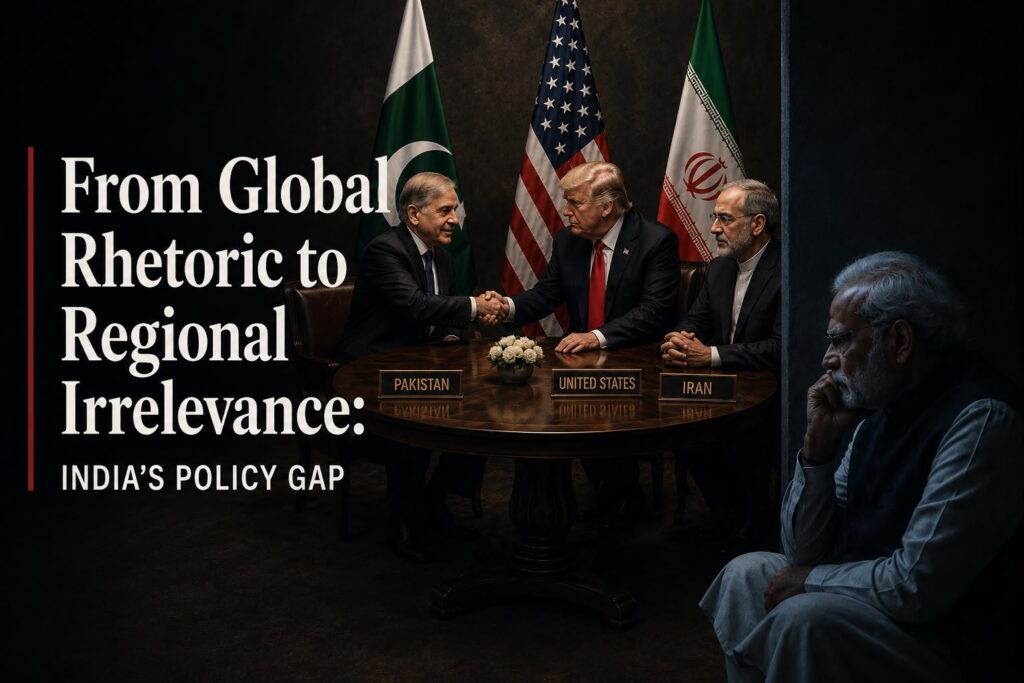
There is a recurring pattern in global politics: some states announce their arrival on the world stage, while others are quietly invited into the room where decisions are actually made. The 2026 US-Iran diplomatic breakthrough has once again exposed this uncomfortable divide in South Asian foreign policy, between projection and participation, between narrative and negotiation, between declared leadership and actual leverage.
India has always seen itself as a nation that would rise to become a civilizational force, the future “Vishwaguru,” and an inevitable component of the future multipolar world. It regularly uses the rhetoric of global governance, crisis management, and leadership. Indian diplomacy dominates in terms of visuality and strategic projection at international gatherings from the G20 to climate conferences.
However, when one of the most consequential diplomatic openings of recent years emerged, the tentative US-Iran détente involving nuclear security, regional de-escalation, and energy stability, India was not part of the architecture at any level. Not as mediator, not as facilitator, not even as a secondary consultative channel. It simply was not in the room.
On the other hand, Pakistan, which has always been painted by India as diplomatically isolated, economically dependent, and strategically constrained, has resurfaced in exactly the type of informal networks in which it becomes important when formal diplomacy becomes impossible. Pakistan’s role as mediator in the initial stage of contact between Washington and Tehran came about through informal back-channel contacts wherein Pakistani interlocutors acted as facilitators before the talks expanded to take place in neutral settings like Switzerland and the Gulf countries. It even intervened and successfully averted the wider escalation right before Washington’s planned attacks on Iran. Pakistan functioned as a transmission node in a system that depends on trust bridges when formal dialogue collapses.
On one side stands India’s foreign policy in the era of Bharatiya Janata Party, whose focus has been on visibility at the cost of ambiguity. The idea behind this policy has been to project India as a global major power through summits, prominent alignments, and association with high-level institutions. The logic behind the whole exercise is very straightforward. Size and technological growth will make India diplomatically significant.
But global diplomacy does not operate on an assumption. It operates on access. Access to adversaries. Access to neutral channels. Access to conversations that cannot be spoken publicly.
Despite being the world’s fifth-largest economy and a key Indo-Pacific partner of the United States, India was absent from all meaningful mediation layers of the US-Iran process. It neither hosted exploratory dialogue nor served as a discreet intermediary. More importantly, it was not even perceived as a viable neutral actor by either Washington or Tehran. This is the critical failure: not exclusion by others, but irrelevance by perception.
The situation of Pakistan, however, is paradoxical yet educational for others. It has a shaky economy, balance of payments crises, and continues to be dependent on foreign financial aid. The country has, however, managed to retain one diplomatic card that India has slowly lost—the card of strategic ambiguity. Pakistan is neither part of a single geopolitical bloc nor entirely excluded from competing ones. This allows it to function as a trust connector in fragmented crisis environments.
Pakistan’s reported role as mediator should be understood in this narrow but crucial sense: not as a peacemaker, but as a permissible conduit in a system where few actors are trusted by both sides simultaneously.
India, meanwhile, has moved in the opposite direction. It has been stuck in a quagmire of a fabricated global image that it has been feeding to its domestic audience. Its growing strategic convergence with Western positions, particularly on West Asian security alignments, has strengthened bilateral partnerships but reduced its acceptability as an independent interlocutor. In regions like the Middle East, neutrality is not a moral category; it is a functional requirement for mediation. Once a state is perceived as aligned, its ability to mediate across adversaries collapses.
The rhetoric of leadership has expanded faster than the infrastructure of mediation. India speaks as a stakeholder in the global order, but rarely acts as an indispensable broker in global disorder. It is present at the summits where outcomes are announced, but absent from the corridors where outcomes are shaped.
Where India represents structured alignment and strategic visibility, Pakistan represents fragmented connectivity and transactional access. One is designed for projection; the other dictates the informal diplomacy. One dominates headlines; the other occasionally appears in negotiation circuits that never reach public acknowledgment until after outcomes are secured.
The uncomfortable implication for Indian foreign policy is not that Pakistan is “overtaking” it in any comprehensive sense. Pakistan is not shaping the global order. But it is intermittently shaping access to parts of it. And in diplomacy, access often precedes influence.
India’s challenge is therefore not capability. It is the acceptability and the inability to break the bubble of a fake global image. Until that image is introspected, India will continue to appear as a power that speaks at the global table, while its rivals are the ones quietly helping set it.
The US-Iran détente may eventually be remembered as another step in cautious de-escalation between two adversaries. But it also exposes a sharper asymmetry closer to home: between a country that proclaims global leadership and another that, at least intermittently, is still trusted to facilitate global communication when silence is no longer an option.
And in that gap between proclamation and participation lies the real story of South Asia’s diplomatic divide.