
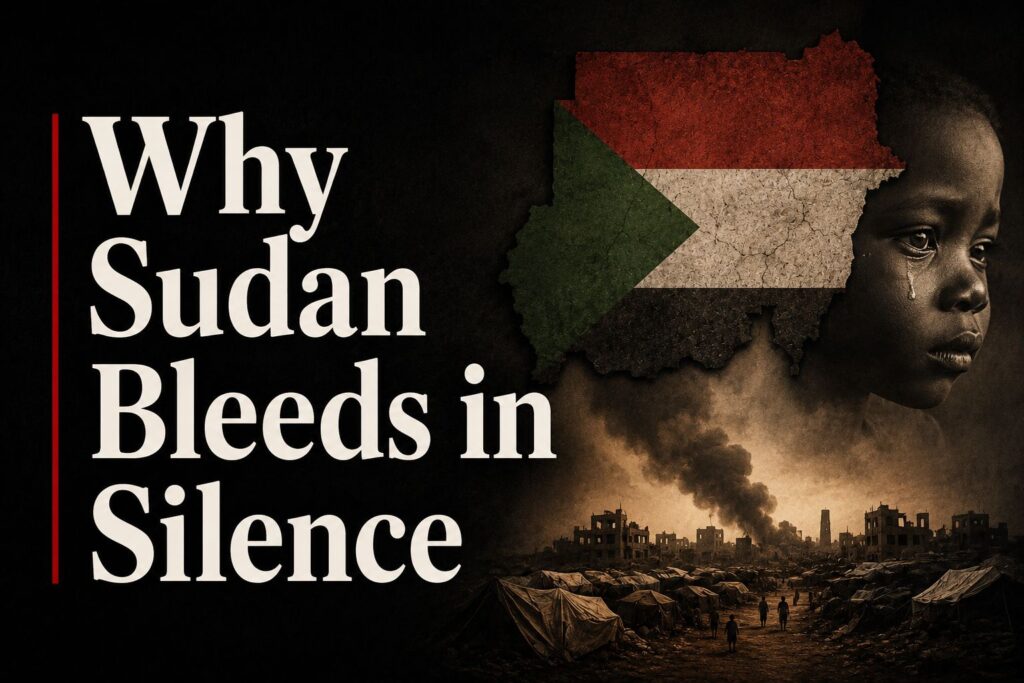
In a world saturated with images of war, some tragedies still manage to disappear in plain sight. Sudan is one of them. While global attention remains fixed on Ukraine and Iran war, Sudan’s civil war has evolved into one of the gravest humanitarian catastrophes of the century. It is a conflict marked by mass killing and starvation of civilians. The calculated indifference of the international system and the geopolitical greed of outside powers have made the matter worse. At the center of this moral failure stands the UAE, whose economic and strategic interests have become deeply entangled with Sudan’s destruction.
The numbers alone should have triggered global outrage long ago because estimates coming from Aid agencies are appalling. Hospitals have been bombed, markets destroyed, and humanitarian workers obstructed. Doctors Without Borders recently warned that aid itself is being “instrumentalized” for military and political purposes, while access to conflict zones is deliberately blocked. The war has killed at least 150,000 people, displaced millions, and pushed population toward famine. Consequently, around 20 million Sudanese are living in hunger, hundreds of thousands of children are suffering from acute malnutrition.
However, Sudan rarely dominates headlines. There are no emergency summits comparable to those held for Ukraine. No sustained sanctions campaign. No global protest movement matching the scale of outrage seen elsewhere. Sudan’s suffering exists in a strange diplomatic vacuum where mass death continues without meaningful political urgency.
This silence is not accidental. Sudan’s war has become deeply internationalized, sustained by foreign sponsors pursuing strategic and economic interests behind the language of diplomacy. The UAE’s involvement remains a major flashpoint. Despite official denials from the UAE, a steady stream of reports from investigative journalists, academics, and human rights watchdogs suggests otherwise. According to these reports Abu Dhabi is directly tied to logistics networks fueling the Rapid Support Forces (RSF), the paramilitary group committing the atrocities in Darfur.
At the core of this relationship lies gold. Sudan has emerged as one of Africa’s largest gold producers, much of it extracted through informal and conflict-linked networks controlled by armed factions. Analysts and researchers have repeatedly described how this gold bypasses Sudan’s state institutions and flows directly into Dubai’s vast trading system. In effect, Sudan’s war economy has become intertwined with the UAE’s commercial ambitions. The longer the conflict continues, the more profitable instability becomes for those positioned to exploit it.
The most disturbing aspect of Sudan’s crisis is the degree to which external involvement operates with near-total impunity. International institutions have largely focused on documenting abuses committed by Sudanese factions themselves. That accountability is essential. But it is no longer sufficient. If foreign states, companies, and financial networks are enabling atrocities, then responsibility cannot stop at Sudan’s borders.
The Sudan tragedy is therefore a mirror for the World. It reflects a world order where humanitarianism is filtered through geopolitical value. Some wars evoke moral urgency, while others fail to get attention and go as the background noise of global politics. The plight of Sudan is met with global indifference because the suffering occurs far from the centers of international power and economic comfort.
But indifference is not neutrality. Silence has consequences. Every delayed investigation, every ignored supply network, and every profitable business relationship connected to the war contributes to prolonging the conflict. Sudan’s civilians are not merely victims of internal fighting. They are victims of an international system willing to tolerate destruction when powerful interests remain untouched.
The people of Sudan deserve more than sympathy. They deserve accountability, not only for local warlords, but for every external actor profiting from their devastation.