
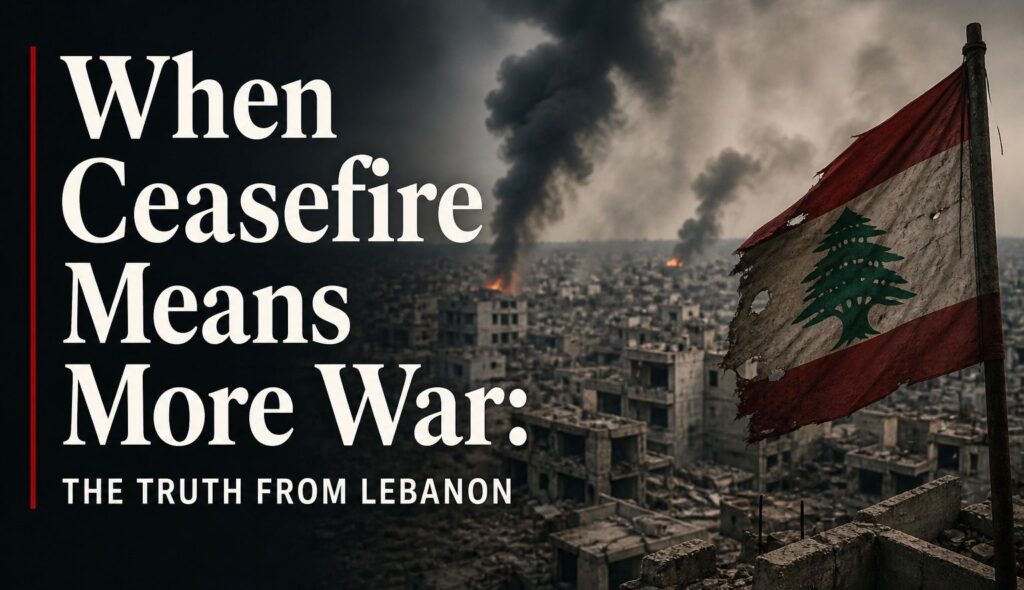
A ceasefire that bleeds daily is nothing but a diplomatic fantasy. The ongoing situation in southern Lebanon exposes the steady erosion of international norms under the ambitions of power politics. The evolving situation in Lebanon is not merely a localized confrontation between Israel and Hezbollah, it is yet another test case for whether international law, multilateral institutions, and human rights organizations retain any tangible effects when confronted with strategic impunity.
The paradox is the modus operandi of Israel. On paper, the US-brokered ceasefire extension through May, signals de-escalation. But the ground reality tells a different story. With over 2600 killed and thousands more injured since early March. The continuation of attacks despite ceasefire agreements introduces us to a pattern where Ceasefires are used as instruments of tactical pauses rather than binding commitments. This new normal of ceasefire violations risks redefining conflict strategy, where agreements exist not to stop violence but to regulate its tempo.
Israel’s long-standing justification for its operations as necessary strikes against Hezbollah, embedded within the civilian environment, does not withstand scrutiny. Reports revealing that a large proportion of those killed are civilians debunk the proportionality. The repeated issuance, or absence of evacuation warnings, further complicates Israel’s claims. An evacuation order within a 1000-metre radius right before strikes is not a humanitarian protection but a legal fig leaf.
The role of the United States adds another layer of complexity, or you may call it diplomatic hypocrisy. While positioning itself as facilitator of Israel-Lebanon talks, Washington simultaneously exerts pressure on Beirut to disarm Hezbollah. This dual-track approach is everything but impartial mediation. It places all the responsibility on the weaker party while overlooking the asymmetry of force and occupation dynamics. The framing of some parts of southern Lebanon as a buffer zone, illustrates this imbalance. Occupation remains occupation, even when rebranded.
Present concerns emanate from the historical trajectory of this conflict. Following the Gaza war in October 2023, particularly after the targeted killing of Hassan Nasarullah in 2024, the region is plunged into persistent warfare. Israel’s reported violation of ceasefires over 10,000 times, whether contested or not, captures the perception of one-sided adherence.
What becomes apparent, therefore, is not a failure of diplomacy but its distortion. International bodies issue statements, but their language is crafted to avoid confronting power. Peacekeeping missions remain deployed, but their mandate is not sufficient to enforce peace. Consequently, the rules-based order becomes selectively enforced, high on promise, low on performance.
If international humanitarian law can be so visibly sidelined, its implications will extend beyond Lebanon. It signals that compliance is optional for those with strategic backing. Restoring credibility, therefore, requires more than lip service. It demands the strengthening of UN mandates and, crucially, the willingness of major powers to stop being selective and start being consistent. Or else, ceasefires will remain illusions masking a continuous war on the weaker side.
Since the ceasefire will not hold, the question is whether the international community is willing to acknowledge the reality or will continue to sustain a narrative that has long collapsed under the weight of its own contradictions. For when empathy is applied selectively, humanity itself is diminished; selective humanity is, in effect, inhumanity.