
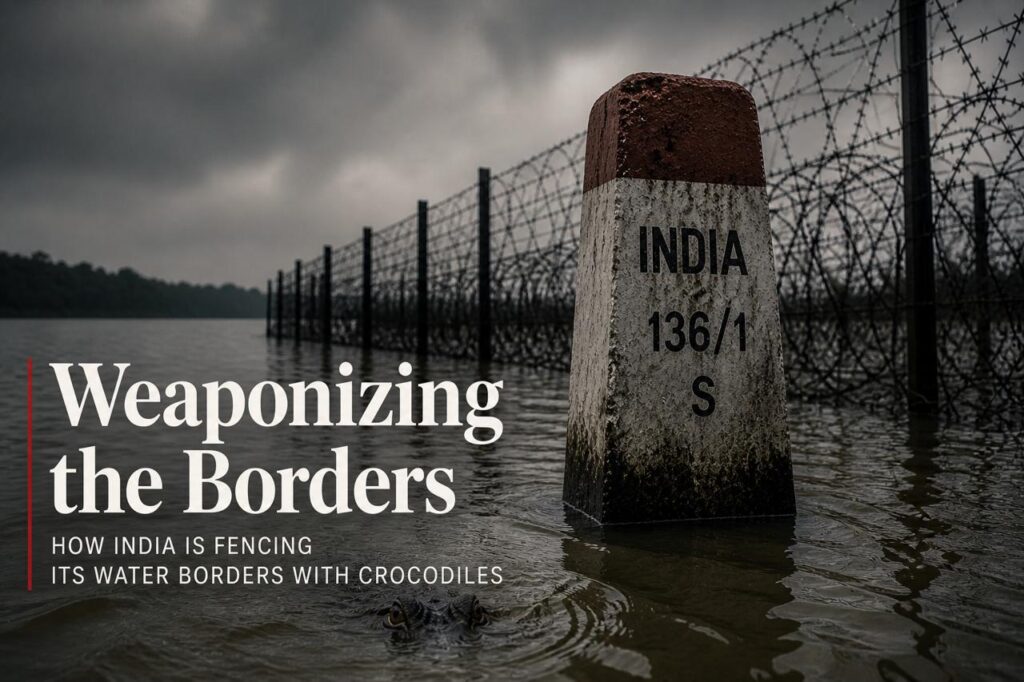
This is one of those moments in statecraft when policy does not merely look controversial and begins to reveal the entrenched anxiety of a state. India’s consideration of deploying crocodiles and venomous snakes to guard unfenced stretches of its border with Bangladesh is not just an impractical idea, but a telling allegory for a border strategy motivated by fear, exclusion, and coercion rather than cooperation and humanity.
This proposal, at a technical level, collapses under scrutiny. Riverine borders are indeed not easy to manage; seasonal floods, shifting water channels, and porous terrain make fencing both difficult and unreliable. However, introducing predators is less a solution and more an admission of policy failure. Wildlife cannot recognize sovereignty. A venomous snake cannot distinguish between a fisherman, a villager, and an illegal migrant. The weaponization of nature is a manifestation of a profound misapprehension of both ecology and governance.
The very idea unmasks the deeper contradiction in India’s border management policy. New Delhi has long maintained that the undocumented migration from Bangladesh is a demographic threat. However, the absence of updated census data undermines the validity and precision of these claims. Empirical evidence, in this case, is overshadowed by the policy of political narratives that blend migration with identity, particularly targeting Bengali Muslims near the border areas.
This conflation sits at the intersection of domestic political trends and border control. The growing majoritarian rhetoric has recast the migration issue as a civilizational clash. In such a political environment, callous measures are not about controlling movement; they are posturing resolve to a domestic audience.
The legal and ethical dimensions of this unsettling idea can also not be ignored. There are boundaries, drawn by international law, human rights, and bilateral agreements, for modern border management. The use of lethal wildlife as a border management strategy blurs these boundaries. It is an inhuman shift from legal state action to indiscriminate natural violence.
Comparison with other countries depicts the abnormality of this thinking. Even the most restrictive policies rely on surveillance and physical barriers. Ecological weaponization is unprecedented, which reflects a global consensus that such measures are inhuman and indefensible.
Cooperation, rather than confrontation, would be the effective approach. Why not work on joint border management mechanisms, data sharing, and legal pathways for migration? Such policies may lack the dramatic appeal to the domestic audience, but they offer something far more valuable: sustainability without violating human values.
Borders, no doubt, mark the limits of sovereignty, and are tension zones. The framework for managing these zones says much about a country’s priorities and confidence. Border management, operated under law, cooperation, and human values, projects strength. Relying on fear, through force or fauna, exposes the vulnerabilities.
The bottom line is that crocodiles and snakes are not created to function as border guards. But the idea of deploying them has entered official discourse that is worth heeding. It points to a deeper need for reevaluation, distant from theatrics and towards policies supported by evidence, ethics, and realism.