
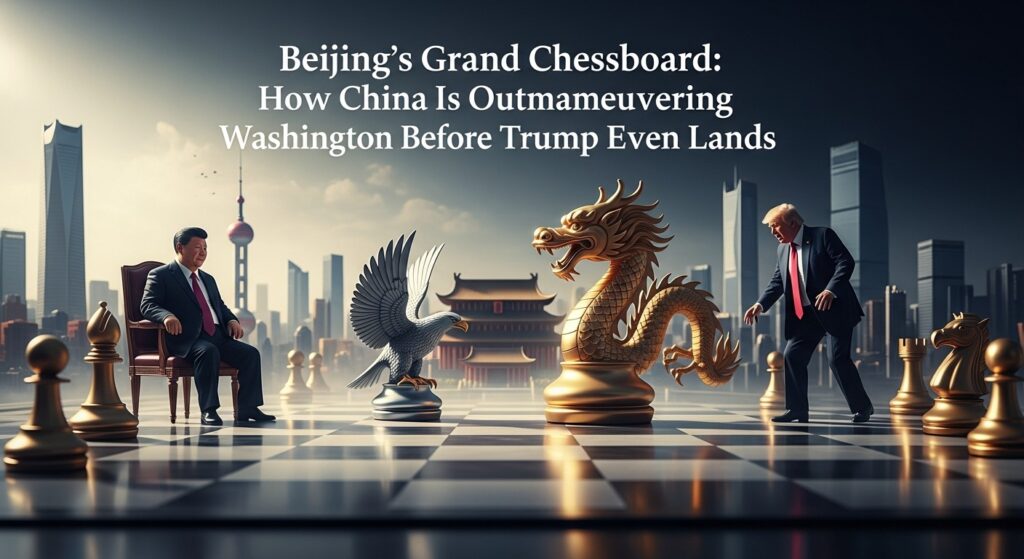
Donald Trump is on his way to Beijing in mid-May, but China has changed the whole situation and Washington seems hardly to get the point. US President Donald Trump will visit Beijing for a major summit with Xi Jinping. China will be ready to greet him, as it has been working to provide the right setting for the meeting for months. From Pyongyang to the Persian Gulf, Beijing has been implementing what analysts are referring to as a “multi-front leverage architecture” a planned, concerted operation to make sure that the negotiation setting is favorable to China well ahead of the two leaders’ meeting. This is not the usual pre-summit talk. On the contrary, it is a large scale continental planning.
The Chinese Foreign Minister Wang Yi’s trip to Pyongyang on April 9,10, which was his first visit to North Korea in over six years, has proved to be one of the most revealing strategically thrusts of Beijing’s pre-summit maneuvers. The visit was performed under the guise of “working-level exchanges” and “joint efforts,” but sending the message loud and clear that China is going to be the main player on the Korean Peninsula which no one can do without, and the US better keep this fact in mind even before the negotiation table.
Beijing is constructing something far more deliberate than standard diplomatic preparation, a coordinated system of diplomatic, economic, and security pressures, synchronized across three continents, designed to ensure that when Trump arrives in China, the terms of negotiation have already been shaped in Beijing’s favor. Normal summitry involves exchanging draft communiqués and managing expectations. What China is doing is qualitatively different: engineering interdependent pressure points so that concessions in one domain can be extracted using leverage generated in another.
The Middle East has handed Beijing an unexpected gift. The rise of US-Iran tensions led to an opportunity, security-wise, which Beijing has skillfully managed to take advantage of without going too far. The war caused the US to divert its concentration, armed forces, and diplomatic efforts away from the Indo-Pacific area. Wang Yi publicly criticized the war and presented China as a voice of moderation in opposition to what it portrayed as American impulsiveness. China is on a diplomatic tightrope – it is intensifying its efforts to end the Iran war, but at the same time, it is concerned about not upsetting Tehran, also keeping the Trump-Xi summit going smoothly. It is a deliberately planned juggling.
On Taiwan, the maneuverings are equally pointed. Beijing is not seeking a breakthrough on Taiwan at the summit, but rather incremental gains designed to gradually weaken Taiwan-US ties. Xi reportedly called for prudence on US arms sales to Taiwan in his last phone call with Trump, pressing for a delay, if not a halt, to Taiwan-US security cooperation. The timing of Xi’s meeting with the chairperson of Taiwan’s main opposition party on April 10, the 47th anniversary of the Taiwan Relations Act, was a calibrated signal. Beijing makes no move by accident.
Russia continues to strengthen Beijing’s network by adding another line of support. Russian Foreign Minister Sergei Lavrov was in Beijing and according to the reports he talked about getting energy cooperation to a higher level. Besides, Moscow has indicated that it is ready to supply resources to the extent the instability of Middle Eastern supply routes would make the resource gap. Also, after Putin is expected to have a meeting with Xi following promptly Trump’s visit, the idea China is going to be strategically triangulating with several major powers is strengthened. However, it seems Washington’s stance is very reactive.
Analysts have expressed concern that the Trump-Xi summit could default to narrow trade discussions while leaving broader security questions entirely unresolved. A deal on soybeans while China consolidates its position in Northeast Asia, the Middle East, and across the Taiwan Strait would not be a win for Washington, it would be a retreat dressed up as diplomacy.
Xi Jinping has framed the relationship in standard diplomatic language, mutual respect, peaceful coexistence, cooperation. The language is boilerplate. The strategy behind it is not.
The question that hangs over May’s summit is not whether China is prepared. It demonstrably is. The question is whether the Trump administration has any coherent counter-strategy, or whether it will arrive in Beijing having handed Xi, piece by piece, every advantage he needed. History will not be kind to those who confused a photo opportunity for statecraft.