
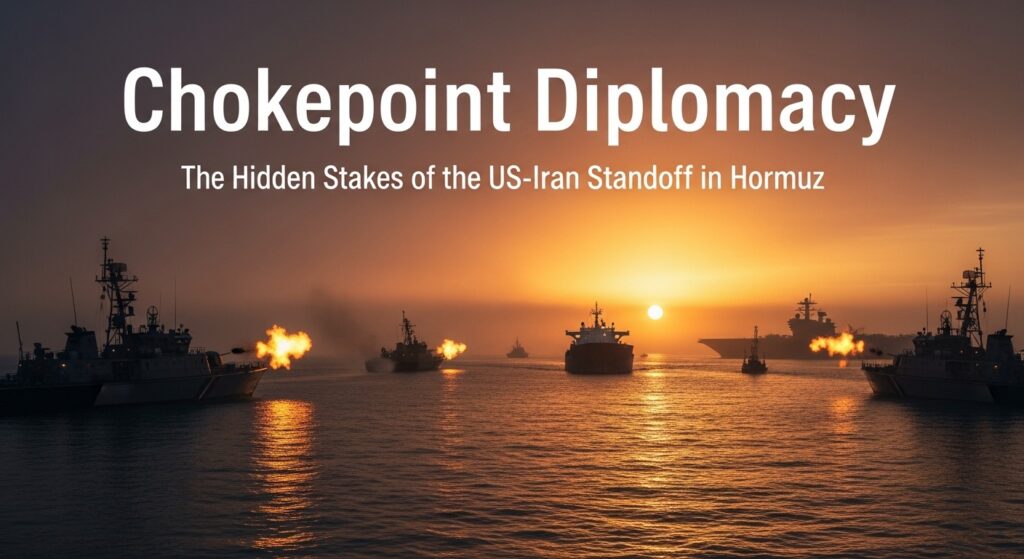
The Strait of Hormuz, which is a narrow sea route through which one-fifth of the world’s daily oil supply flows, has been turned into a weapon again. The US-Israel war on Iran is going through a highly volatile ceasefire in April 2026. The investigation of the latest diplomatic moves has revealed a frightening reality: both Washington and Tehran do not seem to be negotiating in good faith. Rather, they are both playing a dangerous game of global economic blackmail.
Last weekend, the illusion that the tension was easing disappeared. Iran suddenly cancelled its short-term decision to allow the Strait to be open for commercial transit. The Islamic Revolutionary Guard Corps (IRGC) returned the waterway to lockdown status, actively firing upon vessels, including two Indian-flagged ships—that attempted the crossing.
However, in order to grasp the nature of IRGC’s maritime hostility, one has to examine the extent of Washington’s secret naval blockade. On April 14, the U.S. decided to launch a comprehensive and tight naval blockade aimed at totally paralyzing Iranian ports.
Iran’s top negotiator and the Speaker of Parliament Mohammad Bagher Ghalibaf described this naval blockade as “ignorant” and vowed a strong counteraction: if Iranian vessels are denied passage, then no one else shall be allowed either. The consequence of such a maritime hostage situation is the world oil market, which is on the verge of suffering a disastrous supply shortage.
Threats and attacks are mounting rapidly. Recently via his Truth Social account, President Donald Trump charged Tehran of go-behind-the-back ceasefire violation, issued a threatening message:.He stated that in the US-Iran conference in Islamabad if the other side does not “accept a fair deal, ” the US Armed Forces will ” systemically knock out every single power plant, every single bridge in Iran”. The real issue that could set off a massive explosion here goes far beyond the question of shipping lines. It centers on a highly contested, and increasingly contradictory, narrative over nuclear capabilities.
Trump has publicly demanded the immediate confiscation of 440kg of Iranian enriched uranium, bizarrely dubbing it “nuclear dust.” He insists heavy US machinery will excavate the material from sites previously bombed by US forces. Iranian President Masoud Pezeshkian has vehemently rejected this, questioning Washington’s legal and moral authority to strip Iran of its civilian nuclear rights.
It is a very important point that the White House’s alarming talk about nuclear threats does not line up with what its own intelligence agencies say. Looking into the congress records of March 2025, US Director of National Intelligence Tulsi Gabbard clearly stated in her testimony that Iran was not in the process of making a nuclear weapon. She also indicated that the late Supreme Leader Ayatollah Ali Khamenei had strictly kept to the 2003 suspension of the nuclear weapon program. Such a major difference leads to very serious questions that have to be investigated: Is it really the nuclear security that the current conflict is revolving around, or is “nuclear dust” just the cover under which the West’s most crippling sanctions against Iran are being maintained?
The diplomatic map was significantly changed on Valentine’s Day 2026 by US and Israeli actions, which resulted in the killing of Khamenei. Since his son and new leader, Mojtaba Khamenei, has taken charge, the IRGC has thrown itself into a very hard-line, reactionary stance.
Besides that, our research indicates that this confrontation cannot be isolated from the larger context of the Levant. The supposed short-lived Hormuz cessation of hostilities was just a part of an agreement linked to a ceasefire in Lebanon. However, the ten-day ceasefire there is only an illusion. While Israel goes on with its Gaza-styled “yellow line” buffer zone, Hezbollah sees the truce as a one-sided move that insults it, and the group is keeping its fighters ready in the field.
Just when the US delegation is arriving in Pakistan for talks, the diplomatic mask is falling apart. Iran is pushing harder in Hormuz, and the US is threatening to completely destroy the infrastructure of the country; therefore, the situation has gone much further than just a regional dispute. It has become an economic bomb set to explode, and the lead is running out for a global conflict.