
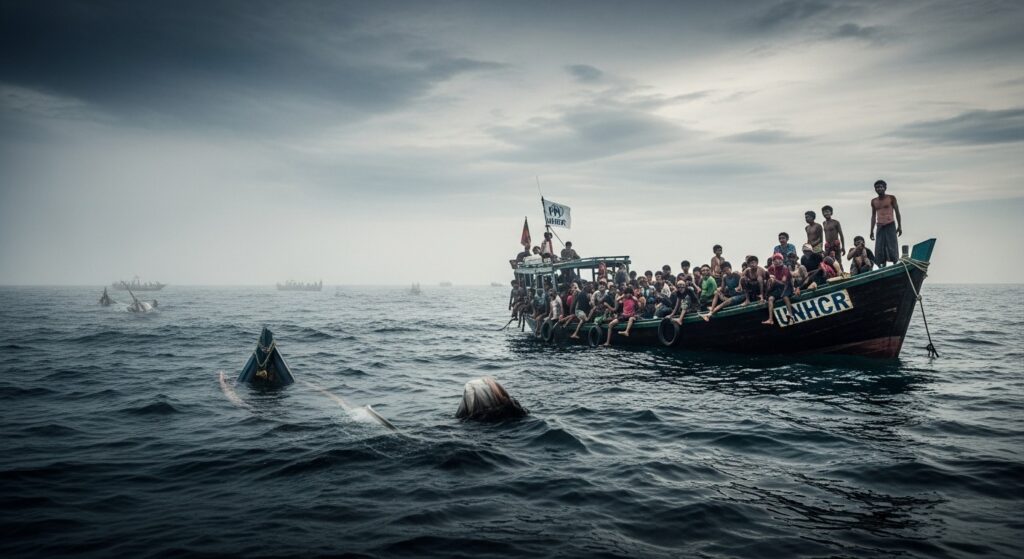
The Bay of Bengal and the Andaman Seahave served as routes to escape for refugees suffering persecution for many years. But the UN refugee agency (UNHCR) is now sounding alarm that these seas are becoming a vast “unmarked graveyard”.
In a shocking press release, they revealed that in 2025, the Rohingya refugees who take to the sea by foot saw the largest number of fatalities. Nearly 900 individuals have either been confirmed dead or have disappeared. And 2026 is not predicted to be any better. The UNHCR warns that the number of persons willing to risk their lives by sea for a better future is on the rise. They are even aware that these boats are prone to accidents and are often overcrowded.
Milestone of Misery
Geneva-based UNHCR communicator Babar Baloch described inhuman conditions of the fast-growing humanitarian crisis. He reported the figure of the last decade’s deaths at sea of about 5,000 Rohingya people. The sharp rise in deaths by 2025 is a sign of change in the crisis. The large number of deaths at sea suddenly sheds light on a sad reality: Many Rohingya may prefer drowning to the continued death of hope in the camps or even death in their homeland.
The Rohingya, a minority ethnic and Muslim group of Myanmar, have been continuously discriminated against and excluded. After the military crackdown in 2017 which resulted in the ethnic cleansing of the community, a large number of Rohingya fled to Bangladesh, the neighboring country. Although Bangladesh had initially given them shelter, the large camps in Cox’s Bazar are in a very poor state.
The Anatomy of Despair
There are lots of reasons why people want to go back to the sea. In the refugee camps, there is just not enough food and medicine to go around. The world’s “donors” have lost their enthusiasm because there are so many crises in the world. So the food has been cut back, and it is hard to find services that people need. The young people in the camps have no schools and no jobs. They are stuck in limbo, not knowing from one day to the next what will happen.
The continuing conflict, persecution, and lack of citizenship prospects mean their very life is without hope,” observed Baloch. A lot of refugees are quite eager to go back to Myanmar’s Rakhine State, according to reports; yet, since safety cannot be guaranteed and in fact, their very basic rights are being denied, the return to their native land is, for the time being, a mere dream. Paradoxically, it is this very despair that largely contributes to the ongoing thriving of the human trafficking market. From the start of 2026 until now, more than 2,800 Rohingya have been left stranded at sea, trying to reach Malaysia or Indonesia. Females and children make up over half of those looking to escape. This is exactly what traffickers want – that is, the victims, the ones traffickers chase the most.
Recent Tragedies and Regional Responsibility
This month, a maritime catastrophe reminded us how fatal these journey can be, as it claimed the lives of many. On April 8, a fishing vessel filled with about 250 individuals Rohingya refugees and some local Bangladesh is capsized in the Andaman Sea due to the bad weather and the large waves. The Bangladeshi coastguard, during the rescue mission, managed to save only nine people. At present, the number of missing persons is hundreds. They are feared to be added to the thousands who have already been lost in the sea.
This particular case is just one example of a larger regional problem of failing to provide a well-coordinated search-and-rescue operation. UNHCR has kept urging the countries of South and Southeast Asia to give priority to life-saving measures and to enable refugee boats to dock safely instead of the procedure of pushing them back into international waters.
A Call for Global Action
UNHCR emphasizing record deaths is the organization’s way of trying to shock the global community into taking action. They are advocating a two-pronged strategy: on the one hand, regional cooperation to stop the deaths of people at sea and, on the other hand, a long-term political solution to the crisis in Myanmar.
The unmarked graveyard in the Andaman Sea will inevitably keep expanding if there is no collective action to reinstating the rights of the Rohingya people in their country and if there is no adequate funding for humanitarian assistance in Bangladesh. The world in 2026 will be faced with a decision: either find the reasons which cause such desperation and tackle them or be ready to log yet another year of huge losses.