
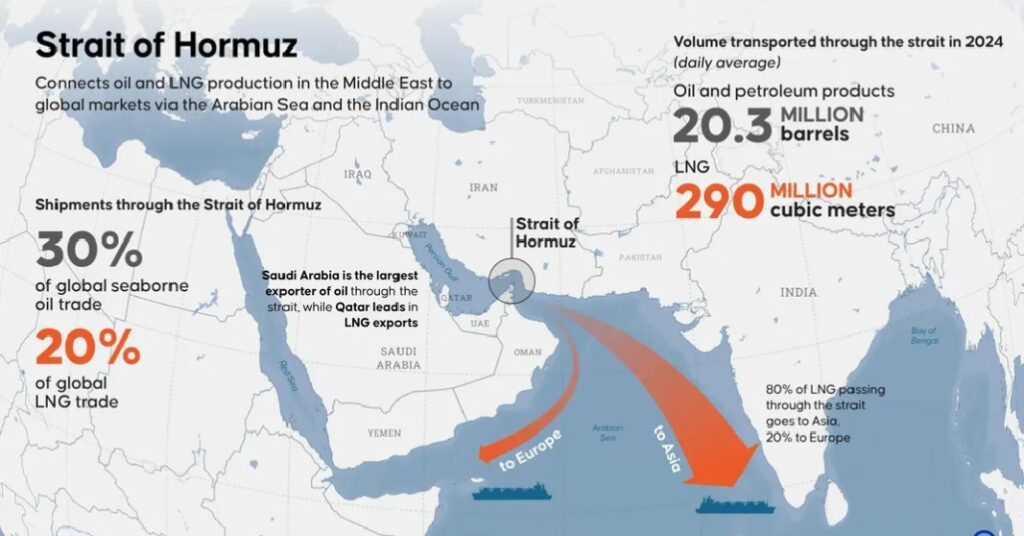
For many years, the Strait of Hormuz ranked as the most dangerous maritime chokepoint globally because it accommodates around 20% of the worldwide daily oil supply. Nevertheless, by early 2026, this waterway, which was considered a strategic asset, ended up as a self-inflicted disaster for the Iranian Revolutionary Guard Corps (IRGC).
What was intended to be a defensive shield has become a “blunder” of historic proportions: a massive, untraceable minefield that Iran built but can no longer take down.
The Great Mine Blunder
What started as a simple act of fear turned into a full-blown crisis? In response to the increasing geopolitical pressure, teams belonging to the IRGC decided to mine the narrow sea route in order to prevent the entry of Western warships. By doing this at such a high speed, they also neglected the military rules. Instead of noting down GPS coordinates or systematically arranging mines, the crews simply dropped the explosives into the water. One of the commentators compared the situation with ”not only locking a door but also welding it shut and throwing away the blueprints”. Besides, the environment worsened the mistake.
The Strait’s brutal currents have since shifted these unanchored explosives, turning the shipping lane into a lethal game of Russian roulette. Because the IRGC failed to map the field, even they cannot safely clear a path. A lane swept today could see a drifting mine float back into it tomorrow, effectively trapping a fifth of the world’s oil behind an invisible, shifting wall.
The Mosquito Fleet and Crypto Tolls
Faced with the loss of over 50 of its prize warships, the IRGC Navy pivoted to asymmetric “old school” tactics: the Mosquito Fleet. Rather than relying on large, easily targeted destroyers, Iran deployed hundreds of fast, fiberglass attack craft, including Ashura, Turk, and modified Boghammer speedboats.
These vessels utilize “swarm tactics,” attempting to overwhelm a US destroyer’s defensive systems by attacking from all directions simultaneously. To fund these operations and exploit the bottleneck, the IRGC even attempted to implement a $2 million “transit toll” payable in cryptocurrency.
The methods for laying mines from these small boats are remarkably low-tech. Using a “stern drop” method, crews literally push massive explosives off the back deck into busy shipping lanes. These boats blend in with civilian fishing dhows, dropping two or three mines, ranging from simple contact mines to advanced acoustic seafloor mines, before vanishing back into the Iranian coastline.
The US Preemptive Response
To counter this “Mosquito” threat, the United States military moved away from reactive clearing and toward a four-part “preemptive denial” strategy.
Preemptive Destruction: Striking mine-laying vessels before they can deploy their ordinance.
Intelligence Coups: Utilizing P-8 Poseidons and RC-135s to pinpoint exactly where vessels are most vulnerable.
Moored Strikes: Attacking Iranian boats while they are docked. Hitting a stationary target in port is infinitely safer and more precise than hunting a moving target in a crowded international strait.
Dual Target Doctrine: Simultaneously destroying the vessels and the land-based mine storage facilities to ensure no replacements can be armed.
The Precision of the MQ-9 Reaper
The tide of this conflict was largely turned by drone technology. The mainline weapon to deal with the Mosquito Fleet was the MQ-9 Reaper armed with AGM-114 Hellfire missiles. Since the Hellfire missiles can reach speeds exceeding one Mach, they use a combination of semi-active laser and millimeter-wave radar to chase the very fast speedboats. Hence, even if the Iranian pilots are attempting to escape the attack by flying at a speed of 70 mph, the unmanned aerial vehicle with its sensors observes continuously the movement and direction so the missile is able to make a very precise hit.
A 10-Day Decimation
The effectiveness of these strategies resulted in the destruction of over 60 Iranian warships and submarines in just 10 days. Notable engagements included the sinking of the Joshin during the world’s first-ever ship-to-ship missile duel, and the destruction of the frigate Sahand. In one surgical strike, a US pilot reportedly dropped a laser-guided bomb directly down the exhaust stack of the frigate Savin, crippling the vessel instantly.
While the IRGC sought to control the world’s most critical chokepoint through chaos, the lack of strategic foresight, symbolized by the lost mine maps, has instead created a global economic standoff that neither side can easily resolve.