
By Ahan S. Prakash
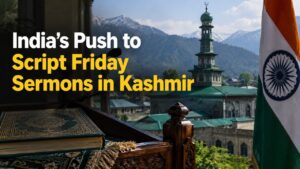
The Jammu and Kashmir Waqf Board’s move to standardize Friday mosque sermons across Indian administered Kashmir is not some minor bit of bureaucratic tinkering. It is a pretty deliberate play to tighten the state’s grip on religious life. With a top official at the helm, a handpicked figure from the ruling Hindu nationalist BJP, the Board wraps its initiative in the language of cooperation and public good. But when you strip away that tidy messaging about rooting out social evils, the real agenda comes into focus: the state wants to turn religious expression into something predictable, manageable, and ultimately, harmless to its interests. Mosques in Kashmir have always been more than places of worship; they have been wide open forums for truth telling, for airing the community’s anxieties and aspirations. For those in power, reining in the Friday sermon is all about gutting faith of its rebellious edge.
Thinking this push for uniform sermons is just bureaucratic meddling misses the bigger picture completely. It is only the latest step in a long, calculated strategy to shape a version of Islam that is quiet and pliant. The goal here is not to get rid of religion, just to keep it boxed in, nice and tidy in its own lane, focusing on ritual and personal morality, steering clear of any mention of political oppression, the ongoing military presence, or the denial of basic rights. What the state wants is simple: a mosque that faithfully repeats the official line and never dares to challenge it.
Over the years, the methods for enforcing this submission have kept shifting. Sometimes, the state brings down the hammer. Security forces have locked the doors of Srinagar’s historic Jamia Masjid hundreds of times in recent years. If the authorities even think that the cleric, Mirwaiz Umar Farooq, could spark unrest, he is put under house arrest, no questions asked, just to keep the congregation from gathering. When shutting down the mosque outright feels too risky, the state switches tactics. That is where plans like this standardized sermon come in. Sure, the mosque stays open. But what gets said inside is heavily monitored, spontaneity is swapped for officially approved messages.
The state wants to turn religious expression into something predictable and manageable, gutting faith of its rebellious edge by replacing spontaneity with approved messages.
The fixation with what is spoken during prayers goes even further. Imams have been told not to mention the Palestinian struggle in Kashmiri anymore. If someone wants to pray for Palestine during Friday prayers, they have to use Arabic, a language most people in the congregation recite but do not really understand. That is not some random policy. It is a nervous, calculated move from a government desperate to block any sparks of solidarity between Kashmir’s own struggle for self determination and global anti colonial movements. When people hear prayers in a language they understand, there is a risk they will feel moved, energized, maybe even inspired to act. If the words are unfamiliar, though, all that emotion is safely neutralized.
This logic plays out in public processions too. Take the Shia Muharram procession in Srinagar. After three decades of banning it, the authorities finally let it happen, but only with strings attached. No photos of young Kashmiris killed by security forces, no banners from outlawed groups, no slogans or statements against Indian rule. The government claims this is religious freedom, but the commemoration is stripped of all its local meaning as a day of protest against injustice. The ritual is allowed, but the biting critique that once gave it life is muzzled.
State intervention is not just about what is forbidden, it is also about what is promoted. The authorities actively bring in and prop up religious leaders who will toe the official line. Preachers under state sponsorship stand at the minbar, urging acceptance, obedience, and peace, a thinly veiled code for going along with the state’s agenda and ignoring the reality outside. These co opted voices build a distorted narrative, where Sufism becomes nothing more than acceptance of whatever hardship the government inflicts. They do not mention the troops, the land grabs, the mass arrests, or the violence. That is not by accident; it is by design.
When a government goes out of its way to control even the prayers of a people, it makes its own weakness plain, revealing a community the state cannot quite trust.
Getting to this point has taken years. The takeover of the Jammu and Kashmir Waqf Board shows how methodical the process has been. It started as a community trust, run by locals for locals. Over time, it was pulled closer to the state government, and after the 2019 Reorganization Act, control was yanked straight to New Delhi. The central government replaced everyone in charge with its own picks. Suddenly, control over shrines, mosques, and huge endowments was not in the community’s hands anymore. These assets became tools for policy.
This anxiety about Islam’s revolutionary stories is not anything new for the Indian government. Even decades back, state run Radio Kashmir censored stories of Islamic history that featured tiny communities standing up to overwhelming odds. Why? Those stories hit too close to home in a place under occupation, calling people to see their struggles mirrored in their faith’s past. It is a lesson the state never forgot: religious history, when left uncensored, can turn into a rallying cry.
The proposal to script Friday sermons is the latest, and maybe the most bureaucratic, way to try and keep that rallying cry locked away. It replaces brute repression with a quieter but no less effective administrative stranglehold. If the government can script what is said from the minbar, it hopes to make the mosque just another extension of its own voice. But here is the flip side: when a government goes out of its way to control even the prayers of a people, it makes its own weakness plain. It is a nervous admission that, beneath all the slogans about normalcy and unity, there is still a faith, and a community, the state cannot quite bring itself to trust, let alone conquer.
About the Author
Ahan S. Prakash is a Geopolitical analyst and columnist covering South Asian affairs, strategic security, and international relations.