
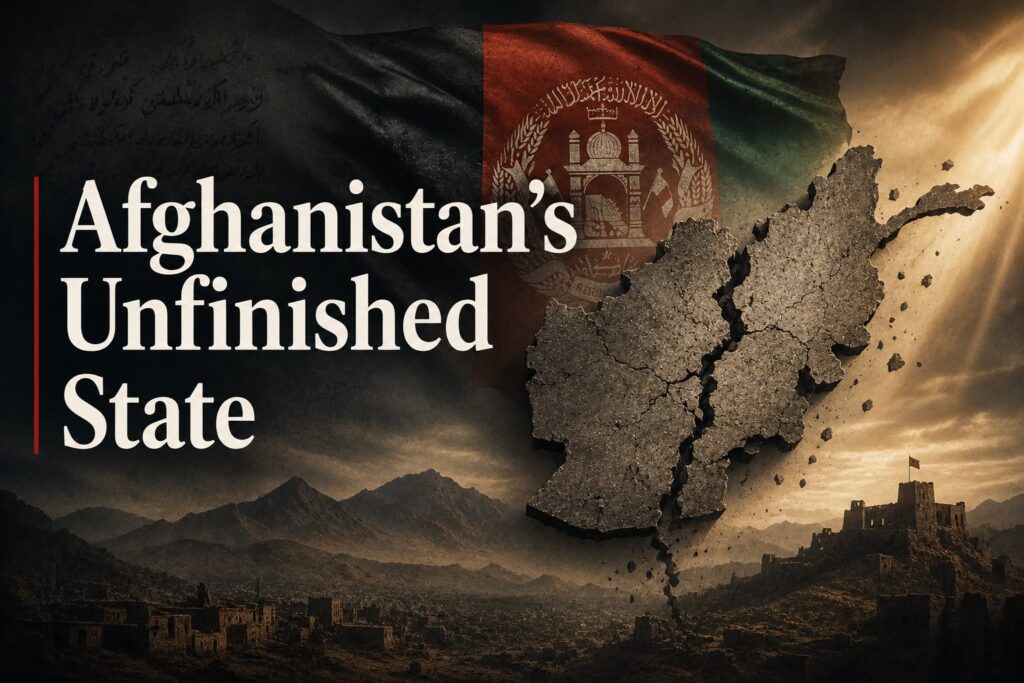
Afghanistan remains resistant to every effort aimed at political reductionism. Every time when it seems as if Afghanistan settles down into a certain political order, its underlying contradictions rise up again with new vigor. When it comes to the Islamic Emirate of Afghanistan (IEA) after 2021, there were many expectations that it could finally create coherence from decades of conflict. However, rather than creating any form of conventional statehood, the IEA has created a state that becomes impossible to categorize through conventional means.
Perhaps the most overt example of such a state of affairs has been the deterioration in the relationship between Afghanistan and Pakistan. Pakistan has traditionally been considered to be the primary external actor in dealing with the Afghan government irrespective of political dispensation, at times functioning as sanctuary, conduit, economic player, and security actor all rolled into one. However, today that relationship is one dominated by distrust and strategic differences. The core concern here has been cross-border militancy, specifically the Tehreek-e-Taliban Pakistan (TTP).
Failure to convert the territorial gains into actual gains over non-state actors constitutes the primary issue of the Afghan order established after 2021. Even while assuring Pakistan that Afghanistan will not be used as a launch pad against other countries, facts on the ground confirm the continued existence of operating space for TTP operatives. The security analysis carried out by the Pakistani side over the past two years has clearly pointed out that there is more militancy occurring in border areas like Khyber Pakhtunkhwa compared to pre-2021 levels. This gap between stated policy and operational reality is the core driver of strategic mistrust.
This is because of an underlying structural issue present in Afghanistan’s internal governance system. The Islamic Emirate, rather than being a completely centralized Weberian state that exercises monopolistic use of force, is an organization that relies on multi-layered systems of authority wherein local command structures and factional ties continue to exercise substantial leverage. This leads to a situation where declarations from the higher echelons do not necessarily guarantee implementation at all levels. Thus, while outsiders view Afghani actions in light of strategic state behavior, internally it may reflect fragmentation and limited administrative reach.
This problem of internal fragmentation is even more compounded by the presence of the militant TTP-type entities operating in a sort of grey zone of association and autonomy. On some occasions, the Afghan authorities have tried to deal with such groups or even move them around, but their ability to fully eliminate them has been doubtful at best. As a result, one ends up with an ambiguous situation where there is neither approval nor elimination. But for Pakistan, such ambiguities can mean serious security issues.
The economic aspect only adds to these weaknesses. The economy of Afghanistan continues to face the constraints of fiscal weakness, inadequate access to foreign banking services, and reliance on humanitarian funds. Based on figures provided by many international financial organizations, the economy of Afghanistan suffered considerable losses after 2021, making it a difficult time to restore any economic growth. In this context, it becomes even more difficult for the state to enforce effective governance within the country.
The economic vulnerability of the country also influences its foreign policy orientation. Trade and transit through border areas are seen as means of survival, often making the borderline unclear between legal economic relations and illegal operations. This has the effect of making Afghanistan even more reliant on connectivity in the region while at the same time undermining its ability to curb the security issues.
The geographical location of Afghanistan, in turn, speaks to a larger realignment in strategic considerations. While it was thought that ideology and history would shape post-2021 conduct, this assumption turns out to be wrong. On the contrary, Afghan international relations have become more transactional due to the need for immediate survival rather than strategic considerations. This has produced an environment where relationships are simultaneously maintained and contested, cooperative in trade but adversarial in security discourse.
This is the context within which the contradictions in Afghanistan become evident. The policies have been formulated based on ideologies, which have then been implemented through compromises. While externally, the messages conveyed are about being sovereign and not succumbing to pressures, internally, it reflects their dependence on the international community, including aid and trade relations.
The wider implication at a regional level is that Afghanistan is becoming an area where different security perceptions intersect without any conclusion. For example, while Pakistan is concerned with counterterrorism and border control, Afghanistan focuses on issues related to sovereignty and consolidation. Similarly, other regional players engage with Afghanistan from a containment perspective. The lack of a common security understanding means that misunderstandings will keep repeating themselves.
Nevertheless, Afghanistan is not doomed to perpetual strategic immobility. The nation’s past shows a pattern of consolidation and disintegration, typically brought about by alterations in the level of cohesion within the country itself and the external situation it faces. Yet at present, Afghanistan finds itself lacking both an effective external integrative environment and substantive internal institutional development.
In essence, Afghanistan today is neither a fully functional state nor a collapsing entity. It is a system operating under structural constraint, where authority exists but is unevenly applied, where sovereignty is asserted but partially compromised by dependency, and where regional relations are simultaneously necessary and unstable.
For the larger region, the real test is not to solve the puzzle that Afghanistan has presented as a political riddle but to handle its paradoxes in such a way that they do not become the cause of any regional instability. This means accepting the reality that the process of change within Afghanistan will be gradual, erratic, and as much a function of structural constraint as political choice. Till then, Afghanistan will continue to be what it has become again, an uncertain place that promises more than it delivers.