
By Adam Reed
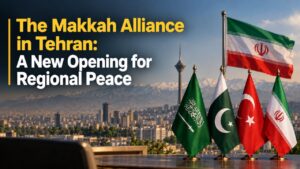
The high profile meeting in Tehran between Iranian leaders and representatives from the Makkah Defence Alliance, Saudi Arabia, Pakistan, and Türkiye, signals a decisive moment in the evolving West Asian security landscape. Set against a backdrop of renewed U.S. Israeli military operations and intensifying shadow conflicts across the Arabian Peninsula, this gathering is significant. It’s the first time ministers from Tehran and the alliance have met since Houthi strikes on Saudi Arabia escalated sharply, threatening to draw the region further into chaos.
The roots of this meeting reach back to the recent visit of Pakistan’s military leadership to Tehran. That trip paved the road, but what unfolded in Tehran stemmed from something deeper, an acknowledgment in Gulf capitals that trusting foreign powers to guarantee security has left the region dangerously exposed. Decades of dependence on outside actors, above all the United States, haven’t created lasting stability. Instead, the underlying structure of the region’s security order feels ready to snap under the relentless pressure of great power competition and local proxy wars.
Right now, the most stubborn obstacle to even temporary stability remains the frozen conflict between Washington and Tehran. The breakdown of the June ceasefire left the U.S. with a familiar playbook: ramp up pressure until Iran blinks. This time, the administration imposed a stiff naval blockade, openly demanding that Iran either surrender or ship out its entire stockpile of enriched uranium, stockpiles that have already crossed key thresholds. Iran, for its part, hasn’t flinched. Instead, Iranian leaders have taken a hardline stance, refusing to negotiate under duress and insisting that sanctions and blockades must end before any talks can resume.
Decades of dependence on outside actors haven’t created lasting stability; durable order must be built by regional partners closer to home.
Iran’s hand isn’t weak. Its control over the Strait of Hormuz, a narrow waterway where a staggering share of global oil and LNG passes each day, serves as an unmistakable reminder that any military showdown will cause ripple effects far beyond the Middle East. The global economy feels that leverage acutely; disruptions here hit everything from energy prices to supply chains.
On the other side of the negotiating table, Saudi Arabia faces a harsh reality: near daily missile and drone attacks launched by the Houthis from Yemen, putting infrastructure and national security on edge. For Riyadh, represented by Defense Minister Prince Khalid bin Salman in Tehran, the calculation is blunt. Any escalation between the U.S. and Iran risks pulling the Kingdom directly into the fray. If U.S. Israeli strikes hit Iranian soil, reprisal attacks will almost certainly target U.S. assets, and, by extension, Gulf energy facilities and the strategic digital backbone that powers financial centers.
Saudi Arabia is hardly alone in this anxiety. By participating in the summit with its Pakistani and Turkish counterparts, Riyadh made it clear that it wants to build direct lines of communication and crisis management closer to home, out of Washington’s shadow. They’re not just hedging bets; they’re trying to ensure that, when the next crisis erupts, national interests aren’t sacrificed on the altar of someone else’s regional order.
For Iran, the meeting served another purpose. Tehran has pushed the idea of an endogenous security architecture for years. The goal? Forge security partnerships and protocols among neighbors, gradually edging the U.S. out of its role as the region’s security broker. Remarks from Mohsen Rezaei, Secretary of Iran’s Supreme National Security Council, reflected a cautious optimism, the hope that this marks the beginning of a new chapter, one where regional countries finally set the rules.
Durable stability can only emerge if West Asian states find the will to craft a new security order that puts local priorities above outside interests.
Still, optimism must be tempered with realism. The Tehran meeting ended without a joint declaration, an omission that underscores just how much mistrust and structural division remains. No single round of talks can erase the threat of a fresh U.S. Israeli intervention. American naval forces aren’t going anywhere, and the strategic logic in Washington and Western capitals still tilts toward the use of hard power, even if it means more instability.
There’s another hard truth: unless Iran uses its influence to broker a credible ceasefire between Riyadh and the Houthis, Gulf states will remain trapped in the crossfire of shifting alliances and regional rivalries. Proxy dynamics won’t vanish simply because leaders pose for photographs or trade guarded statements.
Layered on top of these regional factors is a jittery international climate. Reports that Washington and Tel Aviv might time military moves to domestic election cycles add a combustible ingredient to an already unstable mix. Defense officials in Tehran haven’t minced words. If aggression continues, their counterstrikes will be broader, targeting not just military hardware, but critical infrastructure, data centers, undersea cables, the fundamental backbone of global communications.
If that happens, the region’s wars won’t be confined to crumbling cities or oil terminals. Disruption could leap from the battlefield into the world’s financial nervous system, exposing just how interconnected, and vulnerable, everyone has become to violence in West Asia.
Even with all these dangers looming, the Tehran gathering points to a different path, or at least the possibility of one. Lasting regional stability demands more than staged displays of unity. It’s about concrete steps: hammering out maritime security protocols in the Persian Gulf and Red Sea, so miscalculations don’t spiral into shooting wars; putting real fences around how, and by whom, national territory and airspace are used for foreign military purposes; and, above all, insisting that local priorities, not distant superpower rivalries, decide how security gets built, brick by brick.
All said, the Tehran summit doesn’t erase decades of rivalry or end sanctions with the stroke of a pen. But it marks a turn. Regional leaders seem more willing than ever to acknowledge an uncomfortable reality: external military interventions are at best a stopgap, not a solution. Durable stability can only emerge if West Asian states, Saudi Arabia, Iran, Türkiye, Pakistan, find the will to craft a new security order that puts the region’s future above outside interests.
The next steps won’t be easy. Mistrust runs deep, and the stakes of miscalculation could not be higher. Yet, for the first time in years, the outlines of a new, homegrown security framework are beginning to take shape. Whether they succeed depends on if these states move beyond slogans and risk real cooperation, knowing that the alternative is simply more of the same, cycle upon cycle of instability, with no end in sight.
About the Author
Adam Reed is an International affairs analyst focusing on geopolitics, defense strategy, and global security trends.