
By Adam Reed
Military strategists often fall into a pretty common trap. They obsess over tactical scorecards, how many targets they hit, which missile sites they shut down, or how much enemy infrastructure they have wrecked. But then you hear statements like the one from IRGC spokesman Hossein Mohebi, declaring Iran’s new offensive and asymmetric doctrine, and it really shines a light on how empty those numbers can be. The message of Mohebi unmasks the big disconnect between having the strongest military and actually winning anything political. Iran’s shift comes out of a cold eyed reality. They know full well you do not have to outgun a larger opponent to deny them a real win. Instead, they are aiming to make all that Western firepower, no matter how overwhelming, basically useless, both politically and economically.
Look, at the heart of this Iranian doctrine is a pretty clear admission: on a straight up battlefield, they are outmatched. They have seen what happens if they go toe to toe with the US or Israel. The odds are not just bad, they are impossible. That is why, under planners like Major General Amir Hatami, Iran is betting everything on asymmetric tactics. Forget big tanks and endless jets. They are building drone swarms you can barely track, setting up command networks with no clear center, and moving missile launchers around so they do not get wiped out in one strike. The IRGC keeps insisting their missile stockpiles keep going up. They claim they have boosted the numbers by half since the last major round, and they are not just piling up, they are getting better at hitting their targets and reaching farther, all while planning to outlast even the most advanced aerial bombardments.
You do not have to outgun a larger opponent to deny them a real win; the goal is to make overwhelming firepower politically and economically useless.
This approach creates huge problems for anyone trying to go after them. Suddenly, a Western military has to use million dollar interceptors to knock out a wave of cheap drones or mobile missile trucks. That is a losing game economically. Iran is not trying to win by knocking out armies, what they want is to keep enough firepower moving or hidden so they can always hit back, even after taking a pounding. The point is not to rack up kills; it is to make every act of aggression so expensive and messy that rivals start questioning if it is even worth it.
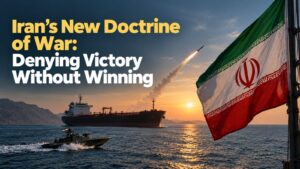
But Iran’s playbook goes beyond just the battlefield. Their greatest leverage comes from making the war bigger than just Iran. The plan is to tie every local clash directly to the global economy, because once you do that, the stakes shoot up for everyone. Iran treats places like the Strait of Hormuz as live battlegrounds. That is not just regional theater; that is the beating heart of global oil and gas supply. We are talking about a waterway carrying 20 million barrels of oil a day, nearly a fifth of what the world uses, plus a huge chunk of LNG shipments. The math is simple: if things go sideways in these waters, oil prices spike, shipping insurance goes through the roof, inflation gets worse, and everyone from boardrooms to kitchens feels the sting, not just generals. Iranian mines and attacks on tankers are not just about local retaliation, they are reminders that conflict here ricochets around the world, forcing everyone to care.
Still, betting everything on strategic denial is not foolproof. Sure, threatening to wreck oil flows or blow up pipelines gives Iran some diplomatic muscle, at least right away. But it comes at a price. For one, it pushes Iran’s neighbors and even bigger players to lock arms against them, isolating them further. It risks creating new alliances, tightening sanctions, and bolstering the US’s role in Gulf security. Plus, just causing pain does not buy Iran the real bargaining power it needs to win big concessions or get sanctions lifted for good.
And let us be real, economic pain only goes so far. Governments sometimes grit their teeth and absorb losses if they think backing down risks their reputation or national security. If Iranian planners are banking on pain alone forcing the West to fold, they are fooling themselves. It is about as naive as thinking a few bombing runs will make Iran surrender. What actually happens is both sides escalate, each convinced the other will blink first, and nobody has room to step back.
Blocking your adversary from winning can work for a while, but it is not a strategy for building peace; it is a way to stretch out the battle until everyone is exhausted.
There is a deeper problem, too. When you make deterrence, not diplomacy, your end goal, things start to rot. You use military power as a blunt instrument, but where does it actually get you? Commanders in Washington or Tel Aviv might celebrate taking out every bunker. Iranian officers might brag about hitting oil transit routes or getting in a few missile shots across borders. But at the end of the day, neither side actually moves closer to what they want. One is left sitting in ruin, the other surrounded by chaos. Nobody is winning.
This is the real paradox of modern asymmetric warfare. Both sides claim victory according to their own playbook. In reality, both end up more battered and less stable than before. You can be a tactical genius and still find yourself stuck, facing a future where success just means endless, grinding conflict, with none of the political goals ever achieved.
Iran’s new doctrine lays this out in blunt terms. Blocking your adversary from winning, making their efforts pointless, can work for a while. But it is not a strategy for building peace. It is just a way to stretch out the battle until everyone is exhausted or the costs are too high to bear. The real answer needs to come from somewhere else. If you want to avoid sleepwalking into a endless war of attrition, you need more than a clever military doctrine. You need real, trusted ways to talk down a crisis: technical inspections, honest reporting, real de escalation hotlines. Those are the things that build a ladder out of the pit. If all you do is aim to make your enemy’s victory impossible, that is what you get: a stalemate that just keeps bleeding both sides, with no end in sight.
About the Author
Adam Reed is an International affairs analyst focusing on geopolitics, defense strategy, and global security trends.