
Asymmetric Interdiction, Strategic Void, and the Collapse of Conventional Maritime Deterrence
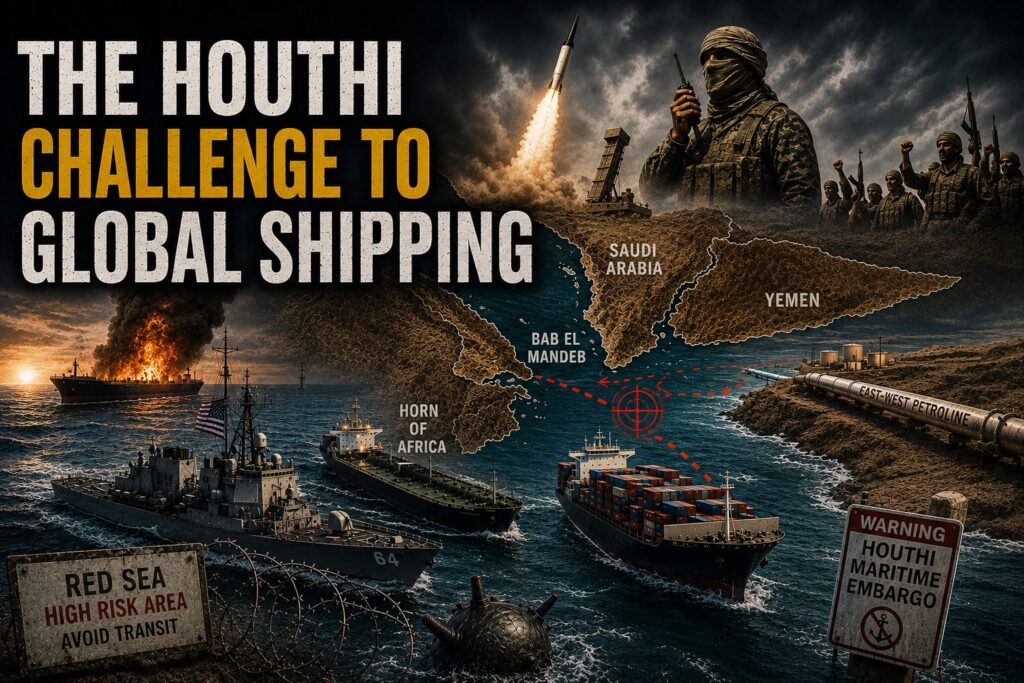
Something fundamental has shifted in how conflict actually works in the Middle East, and it isn’t going back. The old assumption, that Western naval power and conventional deterrence simply sat at the top of the hierarchy unchallenged, has quietly dissolved into something messier and far harder to manage: asymmetric interdiction. When the Iranian backed Houthi movement, Ansar Allah, announced a formal maritime embargo against Saudi Arabia on July 20, it effectively opened a second front in what’s becoming a genuine global maritime war. And in doing so, it proved something uncomfortable, that a hyper localized non state actor can paralyze global trade with almost no physical investment at all. Combined with Iran’s long running, selective grip on the Strait of Hormuz, the effective closure of the Bab el Mandeb exposes a hard truth. The current international order simply has no coherent strategy for countering adversaries who weaponize narrow geographic chokepoints while operating entirely outside the traditional rules of state responsibility.
“Through an email sent via their Humanitarian Operations Coordination Center, the Houthis warned global shipping operators directly, declaring that any vessel loading or unloading cargo at Saudi ports would become a target anywhere within reach of Yemeni forces.”
The mechanics behind the Houthi declaration are almost elegant in how devastating they’ve turned out to be. That single administrative message effectively put a target on the entire Bab el Mandeb Strait, the narrow passage between Yemen and the Horn of Africa that carries somewhere between ten and twelve percent of global commerce, and up to seven percent of the world’s oil shipments. It also landed a direct hit on Saudi Arabia’s main strategic hedge, the East West Petroline, the pipeline Riyadh had been counting on to bypass the Persian Gulf entirely by pumping crude across the peninsula to its Red Sea terminal at Yanbu.
The speed of the commercial response says everything about how much power friction alone can wield without a single shot fired. The EU’s ASPIDES naval mission quickly warned commercial vessels tied to Israel, the United States, or Saudi Arabia to steer clear of the Red Sea and the Gulf of Aden entirely. Almost overnight, major shipping lines, including state backed Chinese vehicle carriers like the Liu Jiang Kou and a string of Hong Kong and Indian oil tankers, made sudden U turns mid voyage. By some economic estimates, the forced rerouting around the Cape of Good Hope adds twenty to forty percent to maritime transit costs. Through nothing more than a credible threat, a militia operating out of the Yemeni highlands has effectively imposed a tax on global trade, proving that the mere perception of danger can be just as powerful as an actual strike.
“For eleven straight nights, US Central Command has carried out heavy bombing raids against Iranian military infrastructure, hitting command centers, drone depots, and naval installations. But rather than deterring Tehran, these strikes have pulled the United States deeper into an escalatory spiral it doesn’t seem to have an exit plan for.”
All of this economic turmoil is compounding a worsening military crisis in Washington, where the entire foreign policy apparatus increasingly looks trapped in a loop of tactical strikes with no larger strategy behind them. Iranian retaliation across the region has already killed American service members stationed at Jordan’s Muwaffaq al Salti air base, provoking an angry, impulsive response from President Trump.
The president’s public statements reveal a genuinely erratic approach to a conflict this dangerous. Threatening to bomb key Iranian infrastructure, including sites in or near Tehran, for every commercial ship struck in the Strait of Hormuz is the kind of rhetoric that edges uncomfortably close to violating international law outright. And Trump’s fixation on the heavily fortified Kolang Kouh site, better known as Pickaxe Mountain, highlights just how limited conventional airpower actually is here. Buried under eighty to a hundred meters of solid granite, that facility is essentially immune even to massive bunker busters like the 30,000 pound GBU 57. Nonproliferation experts at institutions like the Institute for Science and International Security have pointed out that threatening a site buried that deep does little to change Tehran’s calculations. If anything, it hands Iran a convenient excuse to accelerate its covert nuclear work even further out of reach of international inspectors.
This mismatch between Western military doctrine and the reality of modern asymmetric conflict points to a much deeper institutional crisis. The United States and its allies are still fighting the way militaries have always fought, relying on attrition based campaigns, measuring success through daily target lists and damage assessments. Tehran and its network of regional proxies, meanwhile, see this entirely differently. For the Houthis and Iran, winning doesn’t mean beating the US Navy in open water. It just means keeping enough low cost strike capability active to make securing international shipping routes financially unbearable for the West.
The international community is now staring into something close to a strategic void. The maritime agreements that have governed global shipping for decades were written for an era when state navies fought each other under clearly recognized legal frameworks. Nobody drafting those agreements imagined a world where a non state actor could use anti ship missiles, uncrewed surface vessels, and a simple commercial email to enforce a unilateral blockade over some of the world’s most vital trade routes. As Washington promises even heavier strikes and regional actors brace for a long stretch of instability, the lesson from this whole crisis is hard to miss. Until the international community actually builds new legal and military frameworks capable of addressing proxy warfare and maritime coercion, the global economy is going to stay permanently exposed to whichever actor is willing enough to exploit the cracks already sitting wide open in the current world order.