
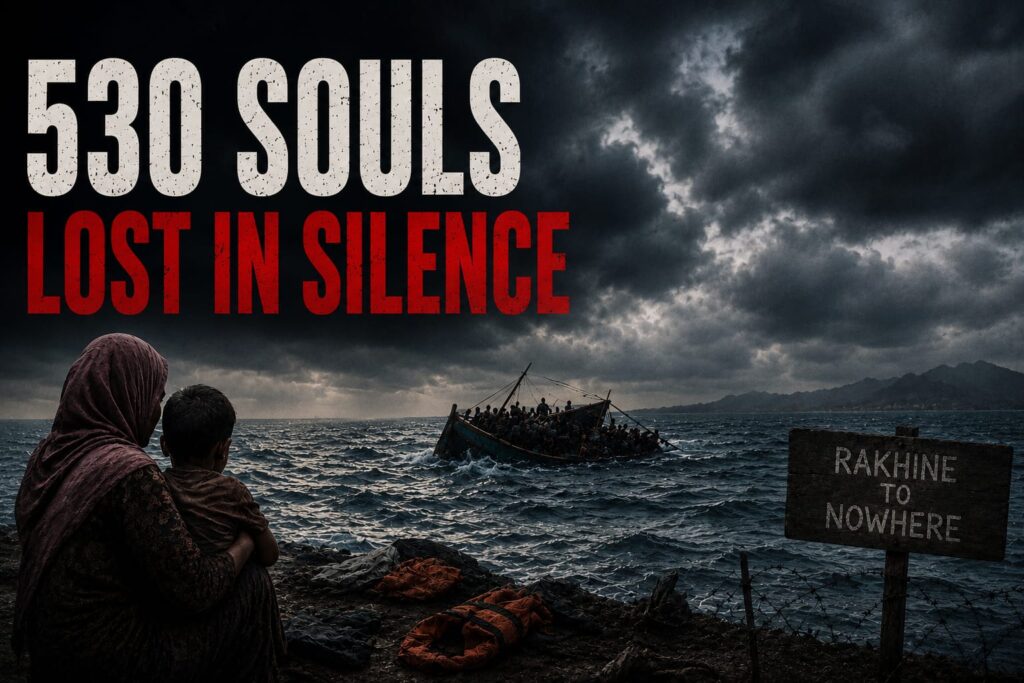
The Tragic Disappearance of Rohingya Asylum Seekers in the Andaman Sea
Two boats carrying an estimated 530 Rohingya asylum seekers have vanished off the coast of Myanmar, and it’s a genuinely horrific tragedy that says a lot about just how little the region seems to care. Think about that number for a second. That’s basically an entire jumbo jet full of people, gone into the rough waters of the Andaman Sea. And yet the global response has been an almost eerie kind of silence.
That silence tells you something ugly about the reality these people live in. For the Rohingya, being stateless means their lives, and their deaths, barely register as real to the rest of the world. They’re a people stuck between a brutal civil war back home and a wall of hostile borders everywhere else.
The Fatal Crossing
The details of what actually happened are staggering on their own. Two overloaded fishing trawlers left the village of Sin Tet Maw in Myanmar’s Rakhine State on June 29, and nobody’s heard from them since. Monsoon season had already kicked in by then, bringing violent seas and unpredictable storms. These boats are famously unseaworthy to begin with, often crudely modified just to cram in as many desperate people as physically possible.
“Chris Lewa, who directs the Arakan Project, thinks it’s almost certain both boats capsized with few or no survivors, and that roughly half the passengers were women and children. This wasn’t some freak accident.”
It was a predictable, almost inevitable outcome of a system that gives these people no safe way out. And the conditions pushing people onto boats like these keep getting worse.
Escalating Persecution in Rakhine State
Inside Rakhine State, there’s a fierce ongoing conflict between the military junta and the insurgent Arakan Army. The military has cut off nearly all telecommunications, leaving the whole region in an information blackout. Caught right in the middle of it are roughly 600,000 Rohingya still living there, a quarter of whom are stuck in miserable displacement camps.
On top of that, the junta has started forcing young Rohingya men into military service, which is a genuinely cruel twist given that the same army carried out a genocidal campaign against them back in 2017. And it’s not like the other side offers any real refuge either. The Arakan Army deeply distrusts the Rohingya and has its own serious accusations of abuse against them hanging over it. Facing forced conscription on one side and open hostility on the other, fleeing starts to feel like the only option left.
Deteriorating Conditions in Bangladesh
Things aren’t much better for the ones who already made it out to Bangladesh. Over a million Rohingya refugees are packed into camps in the southern district of Cox’s Bazar. International aid money keeps drying up, which means food rations keep getting cut. Working is legally banned, and organized crime has taken hold across the camps, running extortion schemes and kidnappings pretty much unchecked.
What started as a temporary refuge has basically turned into a massive open-air prison. Once international support fades and just surviving day to day becomes nearly impossible, the sea starts to look like the only way out left, no matter how dangerous the crossing actually is.
The Exploitative Human Trafficking Network
All this desperation has turned into an incredibly profitable business for human trafficking networks that stretch across Bangladesh, Myanmar, Thailand, Malaysia, and Indonesia. Traffickers charge up to 3,000 dollars a person to move people out, squeezing profit directly out of human misery. And if a family can’t come up with the money, the consequences get brutal fast.
People get held in hidden transit camps, beaten, sometimes tortured on camera, all just to pressure relatives back home into wiring cash. This trade has been running for decades now, just quietly shifting its routes whenever enforcement in one area gets too tight.
Regional Containment and State Exclusion
Southeast Asian governments carry a lot of the blame for keeping this cycle going. Back in 2015, the discovery of mass graves in southern Thailand forced a brief crackdown on land smuggling routes, and for a moment regional governments actually talked about fixing the root causes of the crisis. Instead, what they actually did was pivot to a policy of containment and exclusion.
Malaysia, the country most Rohingya are trying to reach because of its established diaspora, routinely uses its navy to intercept boats and push them straight back out into international waters. Even local fishing communities that used to help have grown noticeably colder toward arrivals.
Indonesia has seen a similar shift. Coastal communities in Aceh used to greet arriving refugees with food and basic medical help. These days, fueled partly by coordinated disinformation campaigns online, a lot of that hospitality has quietly disappeared. Across the region, the pattern is pretty much the same everywhere—a kind of collective game of passing the buck, where migrants get pushed from one maritime border to the next until their boats simply give out under the weight of the sea.
The Failure of International Law
The UN has repeatedly called for safe, legal pathways for the Rohingya to seek asylum, and those calls have basically gone nowhere. No government in South or Southeast Asia is willing to grant them legal status, the right to work, or any real path to permanent resettlement. And by refusing to offer any legal way out, these states are directly feeding the black market that smuggles people instead. Traffickers aren’t creating the demand out of nowhere. They’re just exploiting a vulnerability that state policy created in the first place.
This isn’t just a localized migration story either. It’s a real failure of international humanitarian law. The principle of non-refoulement, the basic rule that says you can’t send asylum seekers back to a place where they’ll face persecution, gets routinely ignored here. When regional navies push unseaworthy boats back out to sea, they’re directly complicit in whatever happens next. And the wider international community, distracted by a dozen other ongoing crises, has largely reduced the Rohingya to a footnote in global affairs.
An Unmarked Graveyard
Losing 530 lives on June 29 is a grim reminder of what happens when the world simply looks away. If a passenger plane carrying 500 people from a wealthy Western country had vanished, it would trigger a massive, coordinated international search and rescue effort. It would dominate headlines for weeks. Governments would demand answers immediately. But when 530 stateless Rohingya disappear into the ocean, it barely makes a dent in the news cycle.
“To be stateless is to be completely unprotected by the modern international system. With no state to claim them, their deaths don’t require an official investigation, and their loss doesn’t require any national mourning.”
The world needs to understand that containment policies don’t actually stop people from fleeing for their lives, they just make the journey deadlier. Until regional governments actually start cooperating on real asylum protocols, and until Myanmar is pressured into restoring basic citizenship rights for the Rohingya, the Andaman Sea is going to keep serving as an unmarked graveyard for one of the most persecuted groups of people on the planet.