
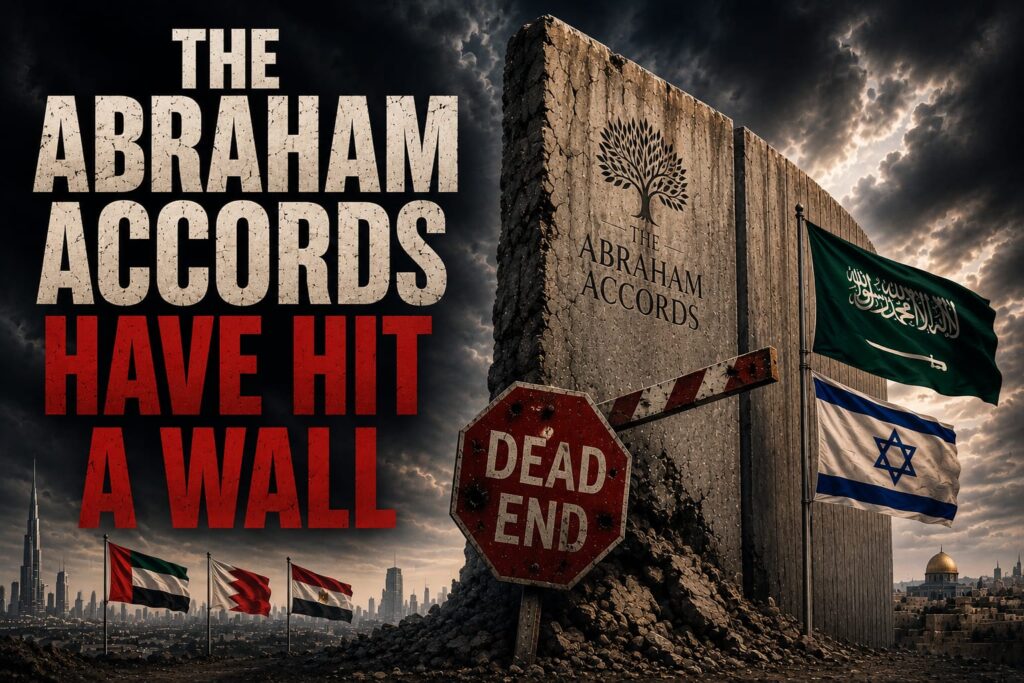
Normalization in the Middle East has gone from being talked about as some grand geopolitical inevitability to something that now feels more like a long, transactional waiting game. Back when the Abraham Accords were signed in the fall of 2020, they were sold as a whole new paradigm for the region, a way to basically sidestep the Palestinian issue entirely and build a shiny alliance around trade, tech, and everyone’s shared anxiety about Iran. But based on Riyadh’s latest backchannel messages to Washington, that original version of the accords is dead and buried. Saudi Arabia is now putting conditions on the table that are so disruptive to Israel’s current political setup that they barely function as a negotiating opener anymore. They read more like an ultimatum.
The Saudi demands are strikingly specific, and they go straight for the core of Israel’s domestic politics. Riyadh is reportedly asking for Prime Minister Benjamin Netanyahu to be replaced after Israel’s next election, a full reversal of Finance Minister Bezalel Smotrich’s expansion of settlements in the West Bank, and a clear, binding commitment from Israel toward an eventual Palestinian state. That’s a massive shift from where things stood before October 7, back when Crown Prince Mohammed bin Salman was hinting that a deal felt closer every day. Now the kingdom is stuck in a genuinely difficult balancing act. On one side, Riyadh really wants the crown jewel of this whole arrangement, a formal bilateral defense pact with the United States plus American help building out a civilian nuclear program. On the other side, Saudi leadership knows perfectly well that Netanyahu simply can’t, and won’t, deliver the kind of Palestinian concessions that would make normalization something Riyadh can actually survive politically at home.
This tension inside the Saudi camp was on full display throughout the broader regional conflict with Iran. As missiles flew and proxy fighting threatened to pull the whole Gulf into the mess, Riyadh was carefully weighing whether formal recognition of Israel in exchange for airtight American security guarantees was worth it. In the end, the talks stalled because ignoring the anger on the Palestinian street became politically too expensive to justify. The late Senator Lindsey Graham spent his final weeks throwing himself into exactly this problem, meeting with top Saudi and Israeli officials, trying to convince Netanyahu that lasting regional integration was worth compromising on Palestinian statehood. But Graham’s sudden death in 2026 took away the effort’s most energetic American champion, and it laid bare just how limited Washington’s ability really is to talk either side into a compromise both view as existential.
The real question is whether any Israeli government, even a future one, would ever actually accept Saudi terms like these. Honestly, no. Under the current right wing coalition, these demands are a complete non-starter. For Netanyahu, agreeing to a Palestinian state or rolling back West Bank settlement expansion would collapse his government almost instantly, triggering an election he might not politically survive. And even if a more centrist coalition led by someone like Naftali Bennett or Yair Lapid takes power after a late 2026 election, the underlying political math doesn’t get much friendlier toward Saudi expectations. The Israeli public has shifted noticeably rightward on security since October 7. Sure, most Israelis are fine with normalizing ties with Saudi Arabia in the abstract, but there’s basically zero appetite in the Knesset for actually guaranteeing a Palestinian state, something a lot of Israelis now see as a genuine security risk rather than a diplomatic nicety.
So the Abraham Accords are facing a real structural crisis. The whole original premise, that Arab nations would normalize with Israel first and sort out the Palestinian question later, has been completely shattered by the reality of a long, brutal war. The countries already in the accords, especially the UAE and Bahrain, have taken serious public backlash and have had to quietly freeze or downplay their cooperation with Israel. The idea that Saudi Arabia, custodian of Islam’s two holiest sites, would just sign onto the existing framework without demanding massive, historic concessions for the Palestinians is basically a fantasy at this point.
If Riyadh ever does normalize relations, it won’t be by quietly joining the existing Abraham Accords framework. Instead, expect the Saudis to build their own distinct, Saudi centered security arrangement, one that positions Riyadh, not Abu Dhabi, as the undisputed leader of the Arab world. That’s already stirring up a quiet rivalry between Saudi Arabia and the UAE, with Riyadh increasingly seeing the UAE’s tight alignment with Israel as more of a liability than an asset. Instead of expanding, the Abraham Accords are basically stuck, drifting from what was supposed to be a vibrant regional integration project into a fragile, defensive arrangement that can’t really show any real momentum anymore.
This kind of standstill has huge implications for Washington’s broader regional strategy too. The US has long imagined building one big, integrated air and missile defense network linking all its Middle Eastern allies together, and that whole vision leans entirely on Saudi Israeli normalization as its political anchor. Without Riyadh actually joining in, that network stays fragmented and incomplete. The Saudis know exactly how much leverage that gives them, which is why they haven’t budged on their price. Keeping their demands high sends a pretty clear signal to both Washington and Tel Aviv that Saudi cooperation isn’t something you can buy with vague promises or small economic sweeteners.
So the future of regional normalization is basically stuck in limbo for now. The Saudis will keep their tough conditions parked on the table, fully aware they’re too steep for Jerusalem to swallow, while still keeping backchannels open with Washington to keep the possibility of a US defense treaty alive. Meanwhile Israel keeps chasing tactical military wins, hoping raw force alone can eventually push its neighbors into accepting normalization on Israeli terms.
At the end of the day, this whole gridlock says a lot about the limits of transactional diplomacy in a region shaped by deep, old grievances. The idea that economic incentives and flashy defense deals could permanently bury the Palestinian issue has turned out to be a pretty expensive illusion. Saudi Arabia has clearly recognized that shift and adjusted its terms accordingly, making it clear it won’t trade away its regional leadership for a rushed, symbolic win. Unless some future Israeli leadership goes through a genuinely unlikely transformation and commits to a real path toward Palestinian statehood, the long promised Saudi Israeli peace deal is going to stay a mirage, and the Abraham Accords will keep looking like a bridge that never quite gets finished.