
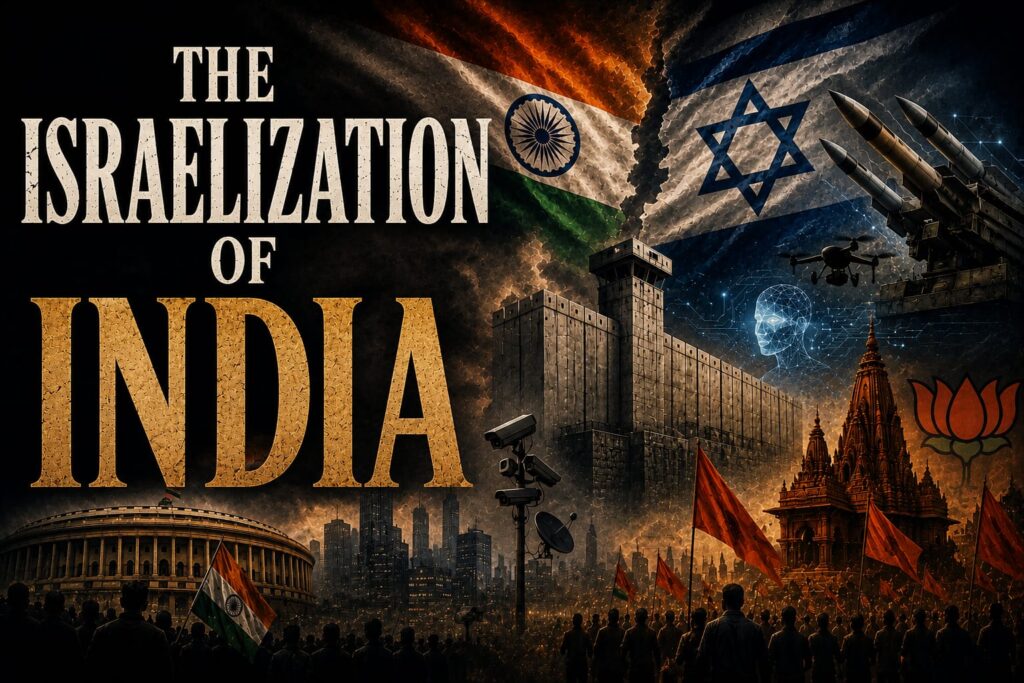
Nations rarely flip their entire worldview overnight with one dramatic speech. It happens slowly, in small doses, until one day the compromise just gets rebranded as realism and the selling out gets rebranded as strategic depth. That’s exactly the con New Delhi is running on itself right now. For decades, India liked to talk a big game about non-alignment, about anti-colonial solidarity, about standing with the Palestinian cause on principle. That was the story India told the world, and mostly itself. These days, though, that whole inheritance is quietly being pawned off in exchange for a much smaller, much pettier prize. By cozying up harder and harder with Israel on defense, tech, and domestic politics, India isn’t leading the Global South anymore. It’s playing understudy to a hyper-militarized, majoritarian security state, and doing it happily.
You could see the whole thing on full display during Modi’s state visit to Tel Aviv. This wasn’t a routine handshake tour. It ended with the two countries formally upgrading ties into a Special Strategic Partnership for Peace, Innovation, and Prosperity, dressed up in language that sounds nice until you look at what’s actually inside it. Seventeen bilateral agreements covering artificial intelligence, cybersecurity, and joint missile production. Critics have every right to call this what it is: New Delhi buying into Israel’s whole playbook, a doctrine built on overwhelming firepower, preemptive strikes, and permanent paranoia dressed up as vigilance, instead of actual regional diplomacy. This is a country that used to speak the language of Bandung, of solidarity among formerly colonized nations, and now it measures its worth by how big its arsenal looks next to everyone else’s.
The embarrassing part is that India is copying the wrong homework. Israel’s so-called strategy isn’t a strategy at all, it’s a hostage situation it’s built for itself. Constant military operations, economic blockades, isolating its neighbors on purpose, that’s not stability, that’s a garrison mentality dressed up in a suit. It hasn’t bought Israel lasting peace. It’s locked the entire region into permanent conflict and torched Israel’s standing on the world stage in the process. And for a country like India, with genuine civilizational depth and long-standing ties across the Arab world, Africa, and Iran, mimicking that same paranoid, trigger-happy posture isn’t clever. It’s a downgrade. India is trading real, durable global influence for the cheap thrill of getting a seat at the Western security table, like it’s begging to be let into a club that mostly just uses it.
And when actual crises hit, the emptiness of this new posture shows immediately. When the US and Iran started trading blows recently, New Delhi went strangely quiet. Other big emerging powers in BRICS and the Shanghai Cooperation Organization at least tried to throw their diplomatic weight around. India offered up the bureaucratic equivalent of a shrug, some soft statement about restraint and de-escalation that meant absolutely nothing to anyone. That silence says everything. In its rush to buy Western weapons and Western tech, India has gutted its own ability to act like an independent power with real influence. The world needed someone willing to actually lead without picking a side, and India chose to be just visible enough to get counted among Western allies, while being too spineless to matter to the regional players who actually needed a mediator.
That gap between swagger and substance got exposed even harder during the brief but intense standoff with Pakistan. All that aggressive rhetoric, all that television-ready nationalism, ran straight into the wall of reality once actual hardware and air defense systems were on the line. Talking tough on prime-time news doesn’t automatically translate into battlefield dominance, and that lesson landed hard. A foreign policy built mostly on domestic PR is going to keep running into that same wall, over and over.
But the defense deals and intelligence sharing are honestly the smaller problem. The real damage is what this alignment is doing to India internally. The republic was supposedly built on pluralism, secularism, a genuinely diverse national identity, at least that was the pitch. What’s actually happening on the ground looks more and more like a copy of Israeli-style majoritarianism, just with different names on the buildings. Tolerating communal polarization, sidelining minority communities, treating a massive Muslim population as permanent suspects instead of citizens, that’s the exact same domestic playbook Israel runs, just imported wholesale. Certain political factions in India have apparently decided that national unity is best achieved by crushing everyone who doesn’t fit the majority mold, and they’re not even being subtle about where they got the idea.
Even India’s cultural power, which used to be genuinely unmatched, is getting cannibalized by this same shift. Bollywood used to be one of the country’s biggest diplomatic assets, films full of romance, music, and universal emotion doing more for India’s image abroad than any official delegation ever could. Now a huge chunk of that output has been repurposed into state propaganda, historical fantasies dripping with majoritarian grievance, patriotic spectacles that feel choreographed rather than felt. Even yoga, something that used to belong to the whole world, has been flattened into a branding exercise for the state, a civilizational souvenir instead of a shared human tradition.
At the end of the day, India chasing prestige by copying the domestic and foreign policy choices of an isolated, embattled garrison state is nothing short of self-sabotage. There’s no lasting security or genuine respect to be found by building a bunker, whether that bunker is physical or psychological. Leaning on preemptive violence and majoritarian exclusion doesn’t buy stability, it just guarantees more of it slipping away over time. And this isn’t some abstract, far-off risk for India, the way it might be for a smaller, more homogenous state. This is a country already dealing with multiple separatist movements and simmering regional discontent across its own map, from the northeast to Kashmir to pockets of the south. A nation carrying that many internal fault lines has no business importing a security doctrine built entirely around domination and exclusion. If anything, India should be spending its energy holding its own fragile, diverse union together, not borrowing tactics from a state whose entire model is premised on managing permanent conflict rather than resolving it. If New Delhi’s foreign policy establishment actually studied where Israel’s trajectory has led, moral isolation, endless conflict, a shrinking circle of genuine allies, they’d see it for exactly what it is: not a model worth chasing, but a cautionary tale about what happens when a country sells off its principles for the illusion of being untouchable, especially one that can least afford the fracture such a path invites.