
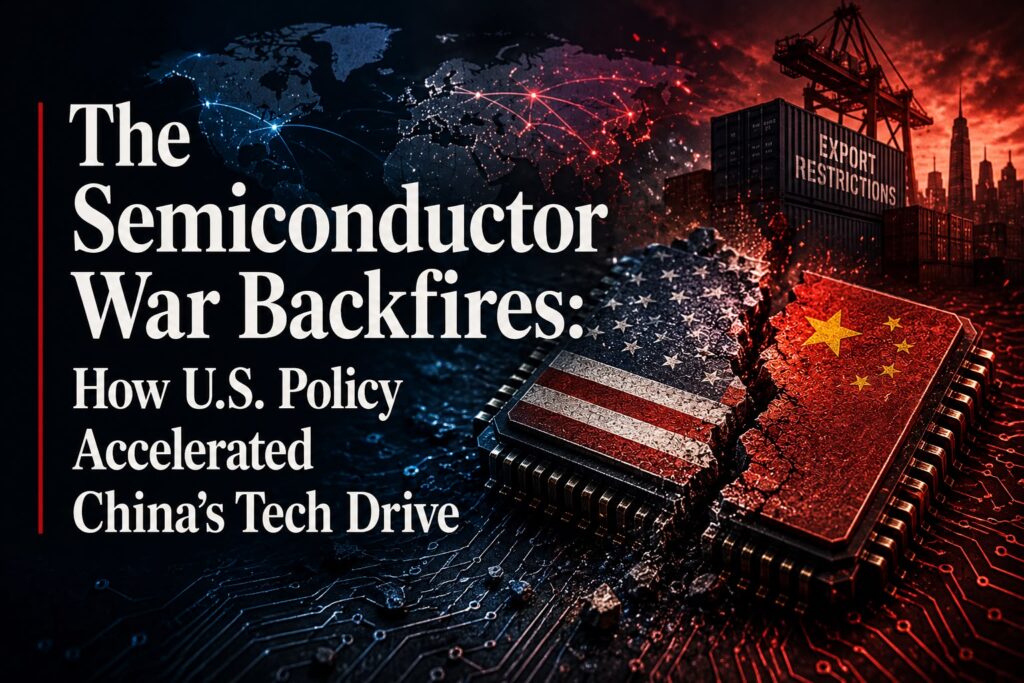
The semiconductor confrontation between the United States and China was never just another episode of trade friction. It was framed in Washington as a strategic intervention designed to slow, if not structurally constrain, China’s ascent in artificial intelligence and advanced computing. The underlying assumption was straightforward: control the chokepoints of the semiconductor ecosystem, and you control the trajectory of the world’s most critical emerging technology. However, as the policy unfolded through successive export restrictions, equipment bans, and allied pressure campaigns, a very different reality began to emerge, one that now resembles strategic reversal rather than strategic containment.
This competition entered its modern stage in October 2022 when the US government imposed broad export controls on China’s acquisition of advanced semiconductor chips as well as the means of their production. The policy was later reinforced by regulations introduced in 2023 and 2024, which included control over the export of high-end GPUs, control over extreme ultraviolet lithography equipment through cooperation with Japan and the Netherlands, and tighter control over the transfer of semiconductor fabrication equipment and technology. Firms like Nvidia, AMD, and Intel had to adapt their product lines in the Chinese market or abandon it altogether. It is estimated that up to 20 to 25 percent of revenue was earned from China by some of the most prominent semiconductor companies before the new export controls came into force.
Washington’s expected that China’s AI ecosystem would slow under the pressure of restricted compute access. Artificial intelligence development, particularly large-scale model training, is heavily dependent on advanced GPUs and high-bandwidth memory systems, many of which are concentrated in US-aligned supply chains. The assumption in policy circles was that without sustained access to these inputs, China’s capacity to scale frontier AI systems would be meaningfully constrained, creating a widening technological gap. For a brief period, this appeared plausible, especially as Chinese firms initially faced shortages and scrambled for alternative supply routes.
However, the structural reality of global technology diffusion quickly complicated that assumption. China responded not with retreat but with acceleration of domestic substitution. State-funded efforts to achieve semiconductor independence continued through initiatives such as “Made in China 2025” as well as other industrial policies, which involved massive financial resources in tens of billions of dollars invested into design, fabrication, and tools for semiconductors. Companies such as Huawei, SMIC, along with many others state-sponsored foundries and design houses, managed to close gaps on certain technologies, primarily on mature nodes and increasingly in advanced packaging and AI-optimized designs. By 2025, multiple research assessments indicated that China had achieved measurable progress in producing domestically designed AI chips, even if still trailing in leading-edge lithography-dependent nodes.
This dynamic reflects a recurring pattern in sanctions-driven technology policy. Historical precedent, from Iran’s industrial adaptation under sanctions to Russia’s reorientation of energy exports after 2022, suggests that comprehensive restrictions often accelerate internal substitution rather than enforce dependency. In China’s case, the scale of its domestic market, combined with centralized industrial coordination and long-term capital deployment, created conditions for what economists describe as forced technological convergence. Instead of decoupling China from advanced computing, the restrictions incentivized parallel ecosystems designed to reduce external reliance over time.
At the same time, the policy has produced unintended pressures within the US technology sector itself. Semiconductor firms operate on globally integrated revenue models, where China has historically functioned as both a manufacturing hub and a critical demand center. Restrictions on exports have not eliminated demand; they have redirected it. Chinese firms have increasingly turned to domestically produced or third-country adapted alternatives, while US companies have had to absorb revenue constraints and increased compliance costs. In parallel, global AI competition has intensified rather than slowed, with Chinese firms continuing to release competitive large language models and AI systems trained on optimized, albeit constrained, compute infrastructure.
A second-order consequence has emerged in the architecture of technological sovereignty. The United States retains clear leadership in frontier semiconductor design and AI model development, but the gap it sought to widen has not expanded in linear fashion. Instead, it has entered a phase of diffusion under constraint. As one observer of sanctions regimes once noted, “pressure does not eliminate systems; it reorganizes them.” In this case, the reorganization is visible in China’s accelerated push toward self-sufficient semiconductor supply chains and diversified AI compute strategies that rely less on a single chokepoint and more on distributed resilience.
There is also a geopolitical feedback loop operating here. The more restrictive the policy of the United States is, the more it contributes to the creation of China’s strategic logic of technological sovereignty in terms of national security. This has resulted in record-level collaboration between state and business in China’s semiconductor industry, including the financing mechanisms of research and development, programs of talent repatriation, and large-scale infrastructure investment in fabrication facilities. The result is not technological isolation, but technological mobilization under constraint conditions.
What emerges from this trajectory is not the technological containment of China, but a more ambiguous outcome: a bifurcated innovation ecosystem in which restrictions function less as barriers and more as accelerants of parallel development. The assumption that AI advancement can be geographically throttled through supply-side constraints has encountered the structural reality that knowledge diffusion, capital accumulation, and state-directed industrial policy can partially offset hardware limitations over time.
Ultimately, the semiconductor war highlights a wider point concerning technological competition in the twenty-first century. The intentions behind strategy do not necessarily lead to strategic control, particularly when the system in question has both size and adaptability. As the ancient strategist Sun Tzu is often paraphrased, “in war, the way is to avoid what is strong and strike what is weak.” In this case, the strike on semiconductor access has not weakened China’s resolve; it has redirected its industrial trajectory toward self-sufficiency at unprecedented speed.
The result is a competition that has not produced technological stasis, but technological acceleration on both sides. And in that acceleration lies the paradox Washington now faces: a policy designed to slow China’s AI rise may ultimately have ensured that the race is no longer unipolar, but permanently contested.