
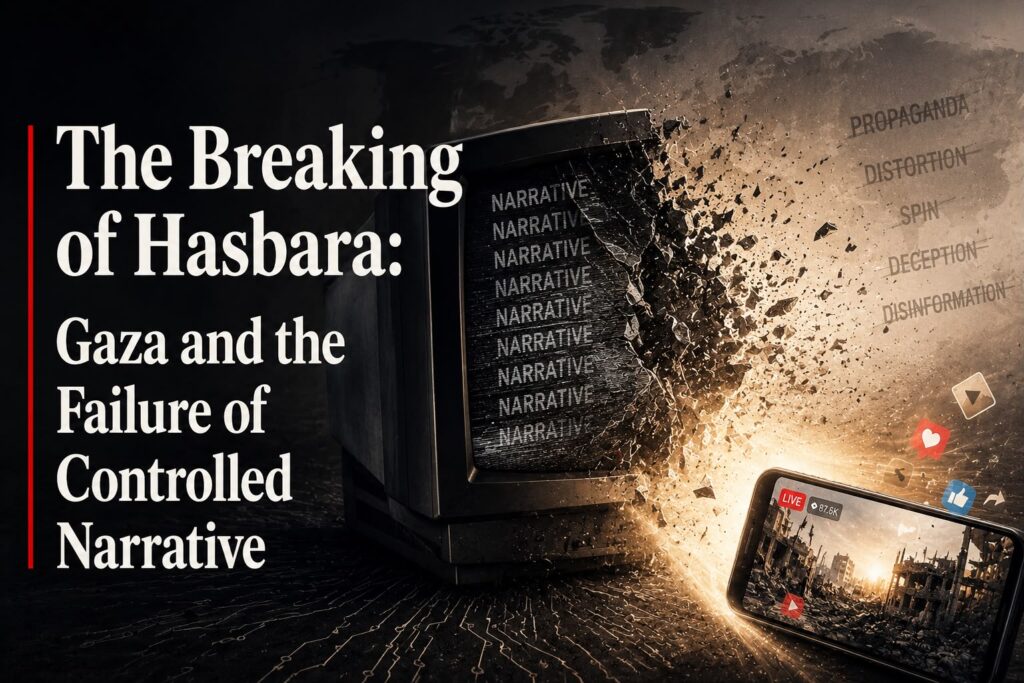
Israel’s conduct in Gaza has not only unfolded on the battlefield; it has unfolded simultaneously in the information space, where perception has become as strategically contested as territory. In the modern era of instantaneous digital communication, the conflict has demonstrated how states no longer rely solely on military outcomes to shape global understanding, but on parallel systems of narrative construction. Israel’s long-standing doctrine of hasbara, traditionally framed as public diplomacy, has in recent years evolved into a far more industrialized and data-driven apparatus of messaging, targeting, and audience segmentation. What was once reactive communication has increasingly become a structured, high-budget system of influence designed to shape how wars are interpreted before they are even understood.
The transformation of this system did not occur in isolation but followed a series of regional conflicts that exposed the limits of conventional messaging. During the 2006 war in Lebanon and the 2008-09 Gaza Offensive, for the first time, real-time combat footage and social media became powerful tools against the state-controlled information discourse. By the moment when Israel waged war on Gaza in 2014, it was already prepared to create a special team in the foreign ministry responsible for information operations. The emergence of platforms such as Act.IL further extended this infrastructure, allowing for distributed participation in shaping online narratives through coordinated amplification and reporting mechanisms. These developments laid the foundation for what has since become a fully integrated digital ecosystem linking state agencies, military communication units, and external advocacy networks.
The escalation after October 2023 marked a decisive acceleration in both scale and institutional commitment. According to publicly reported figures cited in policy and media analyses, Israel significantly expanded its public diplomacy and digital outreach budgets, with estimates suggesting allocations rising into hundreds of millions of dollars annually by 2025–26. Government advertising agencies such as Lapam reportedly multiplied their output several times over within a single year, with a substantial portion of content explicitly targeting international audiences. This expansion was accompanied by the establishment of specialized coordination units across government ministries, reflecting a recognition that the Gaza conflict would be fought not only in physical space but in global perception arenas where legitimacy itself was at stake.
The defining characteristic of this messaging system has been its diversity of languages and platforms utilized. Messaging campaigns have been launched in different languages and regions, including targeted messaging in Arabic, English, Turkish, and European languages using official military or state-sponsored channels. The objective has clearly been to circumvent any filtering by traditional media and reach out to the audience across the world. This form of communication blurs the boundary between state messaging and social media engagement, creating an environment where official narratives circulate alongside influencer-driven amplification and algorithmically boosted content. The result is not simply messaging, but ecosystemic narrative engineering.
However, the Gaza war has exposed structural weaknesses in this narrative strategy. The first weakness is the enduring existence of ground-level documentation, which cannot be controlled by any storyline. The presence of smartphones among the people in Gaza has led to the generation of an unending stream of photographic evidence that goes around the world without any intermediary explanation. This has resulted in a second set of archives of the war, which is at odds with the official storyline and has thus forced continuous adjustment in the coverage of the war in the international press. In several instances, major outlets have issued corrections or contextual revisions after initial reliance on official or secondary sources, contributing to a gradual erosion of narrative certainty in global discourse.
A second limitation lies in credibility fatigue. As competing claims circulate across platforms at high speed, audiences have become increasingly sensitive to inconsistencies between official statements and independently verifiable material. In information theory terms, repeated dissonance between message and evidence leads to degradation of trust in the source itself. In the Gaza context, this has manifested in heightened scrutiny of state-linked narratives, particularly when juxtaposed against extensive visual documentation from the ground and reporting by international organizations operating within the conflict zone.
A third constraint has emerged through institutional legal processes. Proceedings and filings at international judicial bodies, including the International Court of Justice, have increasingly incorporated digital material as evidentiary submissions. This development has transformed digital content from a purely persuasive tool into a potential legal record, introducing an unintended consequence for large-scale narrative operations: the possibility that informational output becomes legally admissible evidence. This convergence of digital communication and legal scrutiny has fundamentally altered the risk profile of information campaigns in active conflict environments.
At the same time, the Gaza conflict has demonstrated that even highly resourced information systems operate within constraints imposed by immediacy, visibility, and decentralization. Unlike previous eras, where state messaging could dominate via controlled broadcasting, modern warfare takes place within an arena where recording is widespread and distribution cannot be controlled. This asymmetry between structured messaging and unstructured evidence has created a persistent tension at the heart of modern information warfare.
Ultimately, the Gaza war has become a case study in the limits of narrative engineering under conditions of total digital visibility. Israel’s expanded hasbara infrastructure represents one of the most sophisticated state-led information systems in operation today, yet it operates in a landscape where authenticity is continuously verified, contested, and redistributed in real time. The result is not the disappearance of propaganda, but its exposure to a level of scrutiny that fundamentally alters its effectiveness.
The outcome of the battle between years of constructed Israeli narratives and raw truth is the fall of narrative superiority in the face of documented facts. Digital warfare can always buy time and manipulate perception, but there is no way to keep on sustaining a constructed narrative when it is constantly debunked by the reality coming out of Gaza. In that collision, the accumulated architecture of Israeli propaganda has begun to fracture, losing sympathizers, and eroding credibility that propaganda alone can no longer repair.