
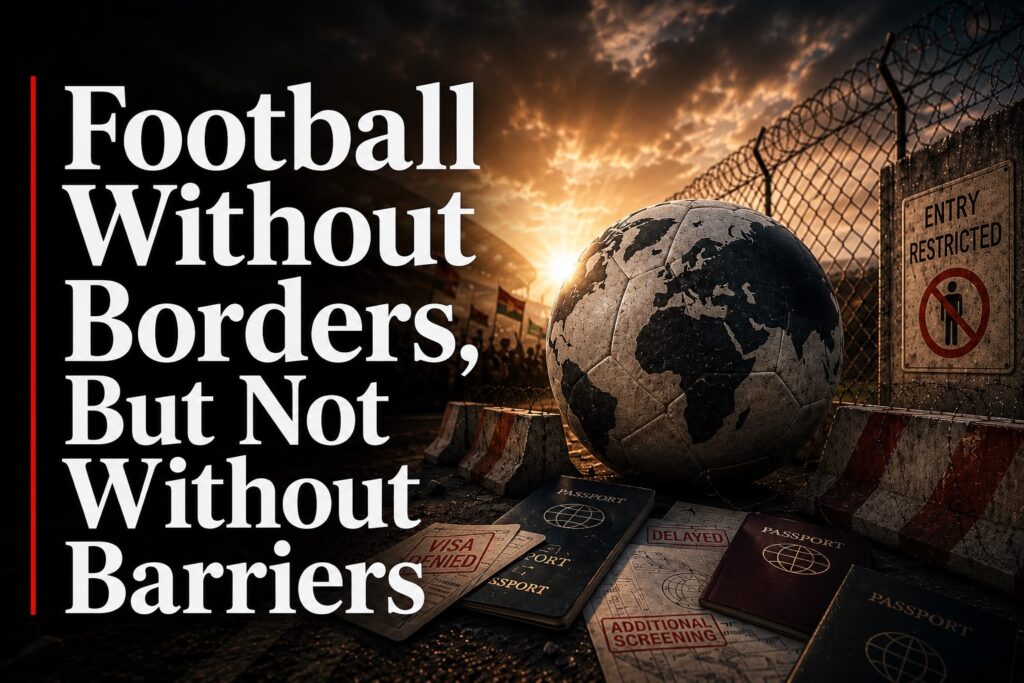
The FIFA World Cup 2026 is described as the most inclusive event in the history of football. It features an expanded number of participating countries, and more regions in the world will be able to experience the magic of the World Cup than ever before. Is it possible for a country that discriminates against the nationals of several Islamic countries to host such an inclusive event?
It is not a question of whether the United States has the right to protect its borders. Every sovereign nation has that right. What matters is whether FIFA is ready to live up to the same non-discriminatory principles that it expects others to follow. The result will determine both the legitimacy of the 2026 World Cup and of FIFA itself.
In the past, FIFA has adopted a strict stance any time political considerations begin to impact sporting participation. The clearest case would be from 2023, where Indonesia lost the hosting rights of the Under-20 World Cup due to political objections to the participation of Israel. FIFA maintained that any team that has qualified cannot become a pawn in political games. Regardless of what opinion one had, the message was clear: Football is not to be dictated by politics or nationality.
Three years later, however, a different challenge confronts the organization.
Unlike Indonesia, the concern surrounding the United States is not a hypothetical scenario based on political statements. It revolves around existing visa systems, enhanced screening measures, travel restrictions, and documented cases involving visitors from countries across the Middle East, North Africa, and parts of Asia.
Exemptions have eventually been accorded to athletes, but the World Cup is much more than just the participants on the playing field. It is a huge network comprising coaches, medical personnel, federation officers, media workers, and millions of fans. If large segments of that ecosystem face unequal barriers to participation, the tournament’s claim to universality begins to weaken.
The numbers illustrate the scale of the challenge.
The 2026 World Cup is expected to attract more than five million visitors across the United States, Canada, and Mexico. FIFA anticipates billions of viewers worldwide and participation from nations spanning every continent.
However, issues related to accessibility persist. Citizens of several nations still have difficulty owing to delays in visa applications, increased vetting processes, document needs, and lack of entry permits. The human rights groups and migration experts have expressed grave concern that this may disproportionately impact individuals hailing from particular regions.
A supporter from Western Europe may be able to secure travel authorization relatively quickly. A supporter from parts of the Middle East or North Africa may face weeks or months of uncertainty. Journalists covering qualifying campaigns have reported difficulties obtaining visas. Some football officials from affected countries have described additional security screening procedures not routinely experienced by counterparts from other regions.
These things may seem to be merely administrative when seen individually, but collectively, there is a perception that not all the participants are coming into the competition equally.
It matters since sports get much of their power through symbolism.
The World Cup is among the rare instances when nationality, religion, and politics are meant to take a backseat in favor of something everyone shares. Fans travel for thousands of miles because they think that football provides a unique sense of equal opportunity. However, when such access is denied to anyone, the symbolism begins to fracture.
This challenge becomes even more significant when viewed against FIFA’s recent history.
The ruling body of football has for years been projecting itself as an organization that is committed to inclusiveness and diversity. Its constitution forbids any form of discrimination on the basis of nationality, race, or religious beliefs. Campaigns against discrimination and racism have been an integral part of international tournaments held by FIFA. FIFA officials regularly emphasize football’s role in bringing people together across political divides.
Such principles are easy to invoke when applied to smaller states. They become far more difficult when the host is the United States.
The larger geopolitics involved make this issue particularly important. The West has had problems with many Islamic states because of years of fighting, restricted travel, and political difficulties. This is an opportunity for them to help heal some of these wounds. They can prove that even now, despite everything else, sport is still a realm where equality counts.
But that opportunity can easily be squandered.
Imagine a scenario in which qualified supporters from certain countries face extraordinary obstacles while others move freely. Imagine journalists unable to obtain timely visas. Imagine football officials subjected to repeated scrutiny not experienced by their counterparts elsewhere. The tournament would still proceed, but the narrative surrounding it would change dramatically.
The challenge is not insurmountable. Proper visa assurances, clear entry requirements, special processing channels for accredited individuals, and guarantees about equal treatment would certainly do much to alleviate the concerns of the states that are participating. What matters most is that these assurances are visible and credible.
However, the true dilemma for FIFA is ethical rather than organizational. As FIFA said in Indonesia, there should be no discrimination against any competent participant for political reasons. This point holds good. However, the issue is whether this policy works in all circumstances or only when it is convenient.
Indonesia lost hosting rights over fears of discrimination. The United States was awarded one on the promise of inclusion. Now that the tournament is underway, the question is no longer theoretical. FIFA must demonstrate that a fan from Tehran, Baghdad, Algiers, Rabat, or Riyadh can access football’s biggest stage as easily as a fan from London or Paris. If exclusion is wrong in principle, it cannot become acceptable because the host is a superpower. FIFA, therefore, faces an uncomfortable question: are its rules truly universal, or do they apply differently depending on who is being excluded?