
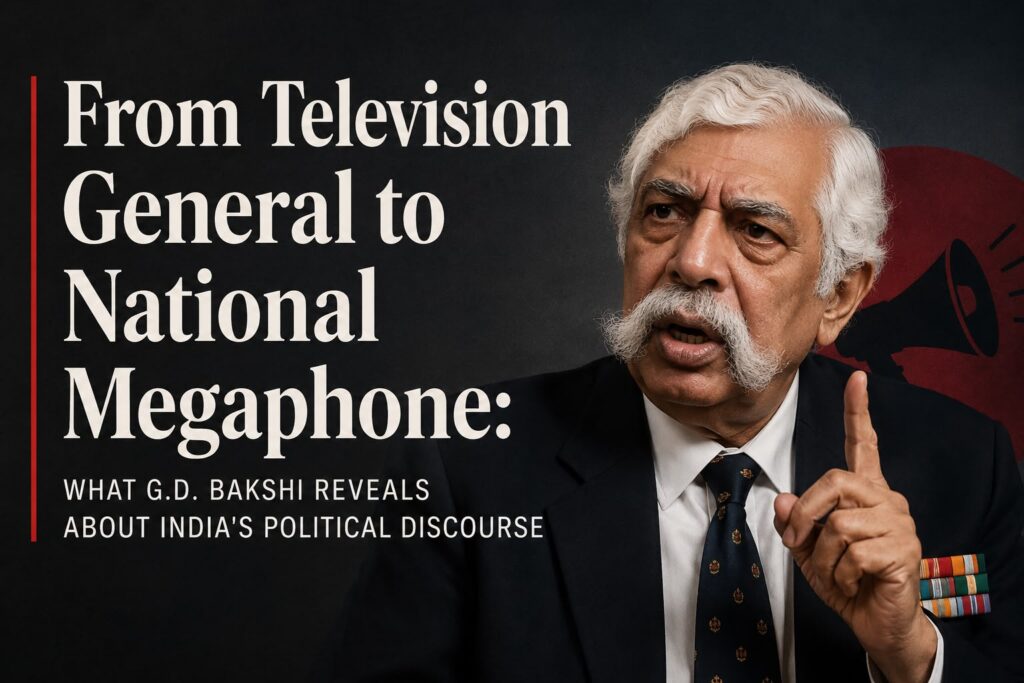
For years now, Major General (Retired) G.D. Bakshi has been one of the most recognizable faces on Indian TV screens. He has made his name for being vociferous, aggressive, and always raring for a fight, with no one ever able to come up with a tougher response and a more threatening remark. His latest outburst, directed not at Pakistan or China but at India’s own government and the United States, is significant not because it is unusual, but because it is entirely consistent with the style of politics and media culture that elevated him in the first place. When a retired military officer casually invokes nuclear retaliation against major cities, whether New York, Islamabad, or anyone else, he is not demonstrating strategic seriousness. He is performing for an audience.
Nuclear bombs are not debating props that we use on TV shows. Rather, these are powerful weapons whose usage will claim many lives and redefine the world order. In the Indian TV culture, however, there have been instances where the usage of such language has been seen not so much as a red flag but rather as something valuable to watch.
Following reports that three Indian nationals were killed in a U.S. military strike involving a commercial vessel, Bakshi launched into a furious denunciation of Washington and New Delhi alike. He accused the Modi government of behaving like America’s “doormat,” questioned why Indian deaths appeared to receive so little official attention, and suggested that powerful countries only respect those willing to retaliate.
The actual issue here is not only one of substance, but it is also a matter of how such criticism is framed. When citizens are killed abroad, governments should always be challenged. Democracies thrive under examination and accountability. What really matters is how the criticism is articulated.
For a long time, Bakshi has been an embodiment of Indian television’s nationalism, which equates volume with strength and aggression with strategy. Indian viewers have seen panel discussions for many years where former army generals, political activists, and biased TV anchors fight over who can make the most threatening statement. Military action has become entertainment and diplomacy is seen as weakness.
In that environment, Bakshi did not emerge despite the system, he emerged because of it.
His latest statements reflect a wider issue. With the terms of the public discourse defined by humiliation, vengeance, and national pride, every disaster is turned into a trial of masculinity. No longer does the matter become one of how well a country’s policies work, but rather of how enraged it looks on television.
This is not strategic thinking. It is political theater.
What is particularly enlightening in this case is that Bakshi’s ire is now being expressed against the very system of politics that has served as a broad story in which he made himself known. The era of Modi has seen Indian television become an avenue that favored extreme nationalists. Television debate programs have ceased being informative, becoming more emotional in their aim to mobilize the audience. The loudest voices often received the most airtime.
Consequently, a whole cadre of television pundits has made their names by turning each international conflict into an existential struggle, and each compromise into a sign of weakness. This approach has a flaw because it is self-consuming in nature, once one’s approach depends on creating constant outrage, Once public discourse is built around perpetual outrage, there is always pressure to escalate further. Today’s patriot becomes tomorrow’s critic for not being patriotic enough.
Criticism from Bakshi about the government demonstrates this reality. When a country is repeatedly told that being powerful involves confrontation, then being moderate amounts to conceding defeat. Where every difference of opinion is made out to be a clash of civilizations, diplomacy seems suspect.
There is no dearth of serious military strategists, diplomats, and policy analysts in India. However, these individuals are not always featured prominently on television. Their caution does not make for virality. Their knowledge does not lend itself to controversy. And their sophistication does not allow itself to be framed through the black-and-white paradigm of victory and treachery.
The result is a public sphere where theatrics frequently overshadow analysis.
The implications go well beyond just India. As India moves forward in its quest for playing an important part on the international stage, the world outside is starting to look at India not just as a developing economy or an aspiring military power but also through the lens of the discourse in which Indians engage. When prominent Indian voices use provocative statements, threats, and rhetoric, the implications cannot be missed.
It may be that the US analysts recognizes that the opinions of TV commentators do not constitute India’s foreign policy, yet they recognize also that what a society selects as its most prominent voices speaks volumes about that society’s political culture. To a nation with global aspirations, such a discourse creates doubts that economic and diplomatic success cannot address.
It can thus be said that the issue that surrounds the figure of G.D. Bakshi extends beyond one retired general. This is an issue of the politics of discourse being transformed into a performance and of the dangers inherent in elevating spectacle above expert opinion, and the long-term consequences of turning nationalism into a television genre.
For a country aspiring to global leadership, that should be a far greater concern than the latest shouting match on prime-time television.